What happened
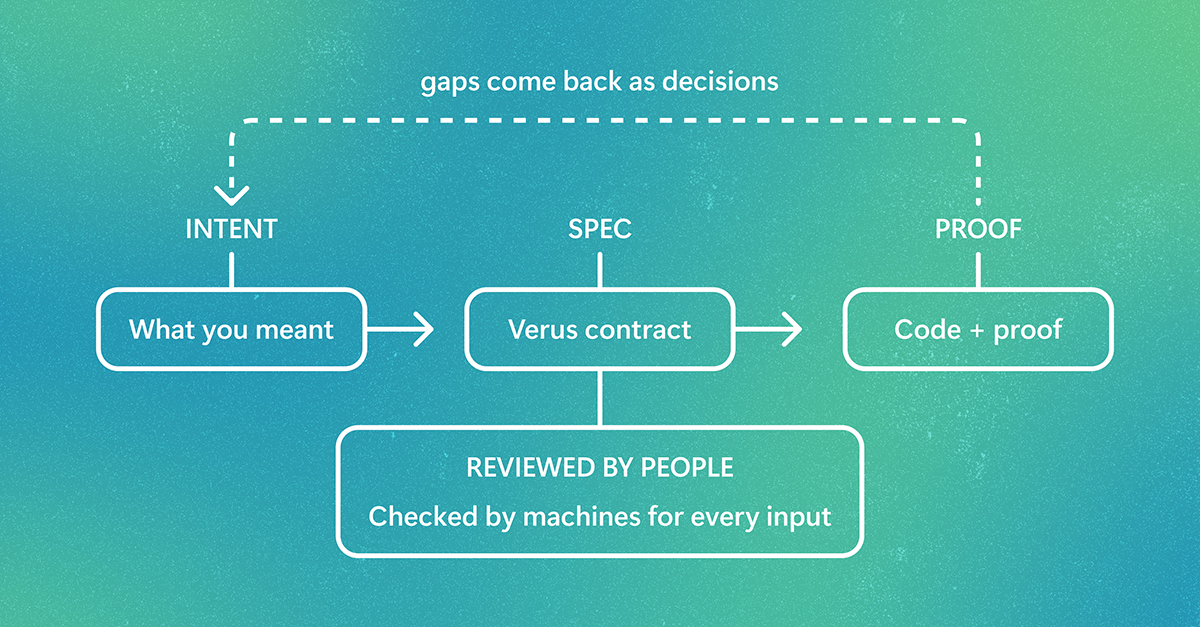
Microsoft Research unveiled PDD Kit, which converts intent into a Verus formal specification, proves the agent's code meets it for every input, and uses tests where a proof can't reach. Applied to Pet Store's login inside GitHub Next's Chopin, Verus hardened the code and uncovered existing bugs, proving the absence of login bugs against the spec while the developer never read the generated code line-by-line.
Why it matters
AI agents now ship features spanning hundreds of thousands of lines, so line-by-line review no longer scales, and agents can drift from the plan and write tests that pass for their own implementation. PDD Kit closes that gap by labeling each result as proof or as test evidence, with a trusted boundary the developer must sign off on.
WHO IT HITSEngineering teams adopting coding agents for large codebases, and developers without a formal methods background, get a way to hold agent-written code to their intent without reading every line within practical review limits.
Summaries like this, every morning.
The premise behind PDD Kit is that the plan has become the contract between a developer and a coding agent, yet nothing forces the agent to follow it. An agent can implement something slightly different and then write tests that pass for its own implementation, so continuous integration fills with tests while the gap between what was asked for and what shipped stays hidden until a bug report surfaces. Microsoft Research argues tests alone can't close that gap because they exercise only a tiny slice of what a program can do, which is where proofs come in.
The demonstration shows how the toolkit handles the ambiguity an agent would otherwise settle silently. In Pet Store's login, the sentence "you only get a token with the right password" rules out a wrong password getting a token, but a login that refuses everyone keeps that promise perfectly. PDD Kit surfaced that the converse, "the right password always works," was the half that rules it out, and the developer chose both directions, making the requirement an if-and-only-if. The two readings differ in a single cell, a right password that gets no token.
Where proof stops, PDD Kit makes the line explicit. For login, the developer signed off on six trusted pieces, including the two database lookups, check_password around bcrypt, generate_token, expiry_from_now and the handler shell, with each assumed clause getting a planned test written before the test exists. The toolkit also records what nobody is promising, such as whether the login ever completes or how other endpoints read the role.
Pick your industry and the AI tools you use, and get news related to your work every day.
Free · 30 seconds with Google · unsubscribe anytimeWhat is AIToday? →
Ask AI anything about this article. The AI reads this article, earlier AIToday articles, and Wikipedia, and cites its sources. Q&As are published on this page for other readers too.
For April–September 2026, Nomura Research Institute posted revenue of 4299億円, up 8% year on year, and operatin…
Claude Code inserted users' email addresses into the User-Agent header sent to external sites, reported on Git…
University of Bologna and CINECA researchers published The SIMPLE Law for Energy Cost of LLM Inference, a four…

Franklin Templeton is using OpenAI's Codex and other tools to build a connected intelligence layer combining r…
Four Seeds said on November 6 that it apologized over a Pizza-La collaboration ad for the TV anime Dr.STONE, w…

In the "Robber Bots" study, researchers from Harvard Business School and Andon Labs had 20 AI models from 8 co…