What happened
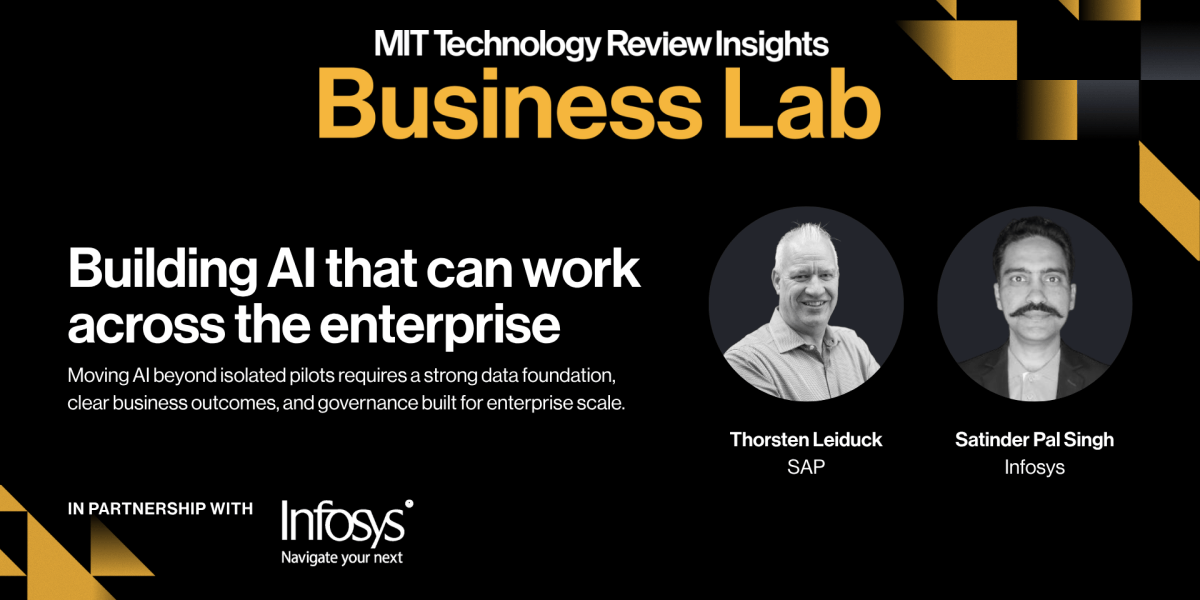
In a Business Lab discussion produced with Infosys, SAP's Thorsten Leiduck and Infosys's Satinder Pal Singh said an Infosys–HFS survey of over 500 global 2,000 enterprises found only 14% have successfully scaled AI, leaving 86% in pilot phases.
Why it matters
Singh called the gap an “AI as a department trap,” where a walled-off AI team builds technically strong pilots the business does not recognize, so solutions end up searching for problems; he said the shift is to treat AI as an operating model transformation, not a technology initiative.
Summaries like this, every morning.
The discussion, produced in partnership with Infosys, pairs SAP's platform view with Infosys's implementation experience. Thorsten Leiduck argues that too many programs start as isolated proofs of concept on different AI technologies and inconsistent data foundations, creating duplication and no clear path to scale. He cites a BCG report showing 74% of organizations stuck in pilot mode with no plan to scale, and an Anthropic survey in which 42% struggle to access data of sufficient quality.
Satinder Pal Singh adds a second data point: only 8% of companies qualify as AI native on the Infosys Knowledge Institute AI Maturity Index, yet those companies achieve four times the revenue contribution from AI versus laggards. He warns that the advantage from 18 months of agent behavior data, a calibrated knowledge graph, and a workforce that has internalized AI cannot be bought later by purchasing the same platform.
Both executives tie the scaling problem to governance and data rather than model choice. Leiduck says AI is absolutely dependent on a connected, semantically rich data layer, and that while 80% accuracy may be good enough for everyday applications, it is a very terrible result for supply chains or financial close. Singh says the absence of governance does not speed adoption but creates a risk backlog that can force a disruptive stop and audit.
Pick your industry and the AI tools you use, and get news related to your work every day.
Free · 30 seconds with Google · unsubscribe anytimeWhat is AIToday? →
Ask AI anything about this article. The AI reads this article, earlier AIToday articles, and Wikipedia, and cites its sources. Q&As are published on this page for other readers too.
Goldman Sachs' 2027 U.S

Jensen Huang resigned as Nvidia CEO last Wednesday after 33 years at the helm, and CFO Colette Kress has taken…
Z Creative Partners said it will validate pairing OpenAI's "Businesses in ChatGPT" official metrics, such as B…

Intel traded at $56.96 premarket, down 42.0% over one month, as it pivots to edge AI with 130+ customers testi…
Bob Morse of Strattam Capital and Michael Quoia of KSE Leadership propose that new graduates become managers o…

GHGSat CEO Stéphane Germain wrote in Fortune that AI is built into GHGSat's data processing to flag likely met…