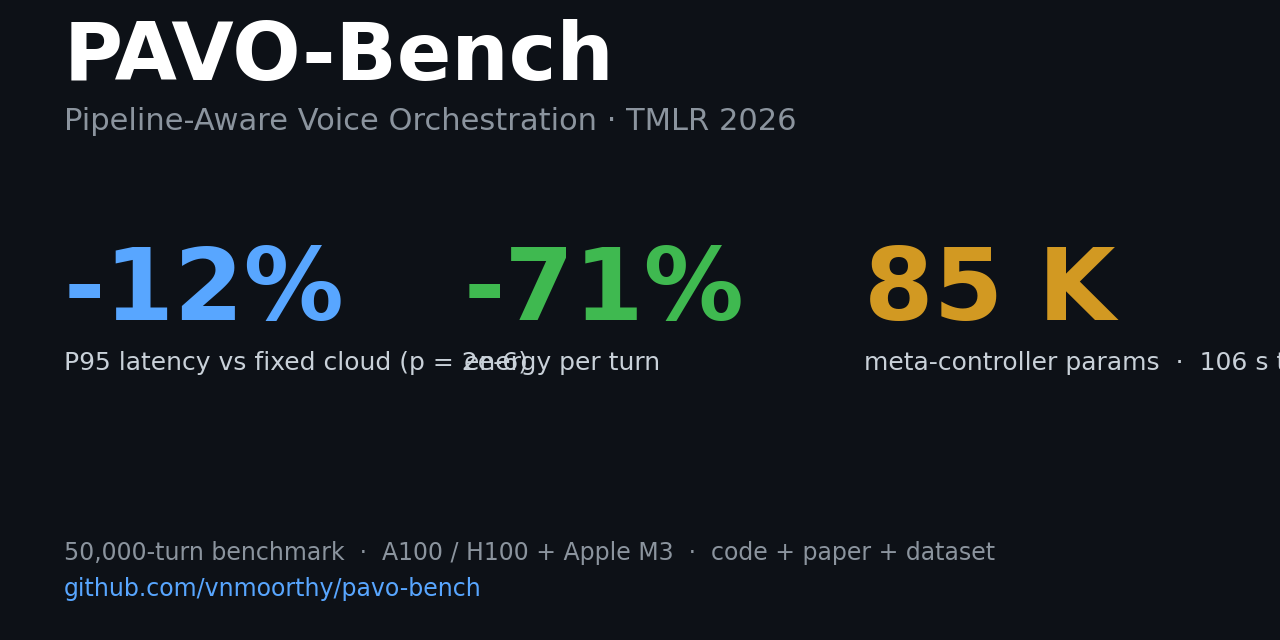
Researchers at University of Pennsylvania and Google released PAVO-Bench, a 50,000-turn voice interaction dataset (40K train / 10K test) with complexity labels on HuggingFace, plus a trained tiny meta-controller (85,041 parameters) that decides per turn whether to route ASR → LLM → TTS calls to cloud or edge.
The router characterizes inter-stage coupling: Gemma2 2B quality drops from 0.825 → 0.585 as ASR word-error rate crosses 2% (n=200 per WER level), meaning downstream LLM performance depends on upstream ASR configuration. Hard-constraint masking reduces coherence-failure rate from 7.1% → 0.9% (7.9× reduction) at +110 ms median latency cost.
Against a fixed-cloud baseline on LibriSpeech, PAVO achieved P95 end-to-end latency −10.3% (−167 ms, p = 2×10⁻⁶), median latency −34%, and energy per turn −71%, measured on NVIDIA H100 and Apple M3 8 GB across Llama 3.1 8B, Mistral 7B, and Gemma2 2B.
Code, trained weights, and all 5,430 coupling calibration measurements are open-sourced; full reproduction takes roughly half a day on an H100; training-only reproduction runs in ~2 minutes on a single A100.
Summaries like this, in your inbox every morning.
Pick your industry and the AI tools you use, and get news related to your work every day.
Free · 30 seconds with Google · unsubscribe anytimeWhat is AIToday? →
Ask AI anything about this article. The AI reads this article, earlier AIToday articles, and Wikipedia, and cites its sources. Q&As are published on this page for other readers too.
Chunghwa Telecom president Rong-shy Lin said the shift from conversational AI to autonomous AI agents is resha…

Apple and Meta said they would jointly release a new open-weight AI model designed to run on high-end Macs, ai…
A writer and entrepreneur opened his daily to-do list and found 156 items, and concluded that an AI assistant…

A Zenn contributor sorted AI use into three modes — AI as an assistant, AI running alongside people, and AI th…

A non-engineer operator says one person ships four smartphone apps on Google Play, three on the App Store, wit…
The walkthrough points the CLI at a local mock via the ANTHROPIC_BASE_URL environment variable

