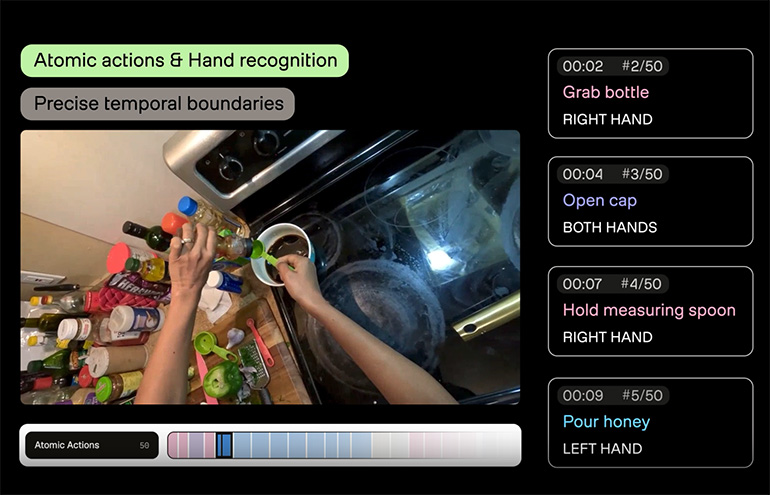
What happened
IEEE Spectrum and Wiley released a white paper on HiPHI, a 617.5-hour whole-body motion dataset with 245.7 hours of human-object interaction, captured at sub-millimeter accuracy and organized with FrameNet.
Why it matters
Internet video shows diverse behavior but cannot capture precise physical states, and lab motion capture usually covers only a narrow set of actions, so this dataset may help close the data gap limiting humanoid robot learning.
What to watch
The paper reports policies trained on the dataset and deployed on a physical Unitree G1 humanoid, but it remains to be seen how well they generalize beyond the actions and objects captured.
WHO IT HITSRobotics researchers and engineers working on humanoid robot learning now have a documented, large-scale motion and interaction dataset, plus a reported sim-to-real deployment, to evaluate against their own training pipelines.
Summaries like this, in your inbox every morning.
Humanoid robots need to learn balance, movement, and object interaction across many situations, but existing data sources have clear limits. Internet video offers diverse behavior yet cannot capture precise physical states, while laboratory motion capture records accurate movement but usually covers only a narrow set of actions. HiPHI aims to address both sides of that gap by combining optical motion capture at sub-millimeter accuracy with a wide range of actions.
The dataset's design leans on FrameNet, a linguistic framework for human action, to systematically organize whole-body motion coverage. It also pairs motion with synchronized object trajectories and meshes for 245.7 hours of human-object interaction, which the paper argues makes the data useful for teaching tasks such as carrying, pushing, and pulling. A benchmark suite for motion diversity and interaction grounding gives researchers a way to measure progress.
The white paper goes beyond data collection by reporting policies trained on the dataset and deployed on a physical Unitree G1 humanoid robot. Whether that sim-to-real transfer holds up across the full range of captured actions and objects, rather than the specific tasks tested, is likely to determine how broadly robotics teams adopt the dataset.
Pick your industry and the AI tools you use, and get news related to your work every day.
Free · 30 seconds with Google · unsubscribe anytimeWhat is AIToday? →
Ask AI anything about this article. The AI reads this article, earlier AIToday articles, and Wikipedia, and cites its sources. Q&As are published on this page for other readers too.
Faraday Future plans a US robotics factory online by the end of 2026, with the first "Built in USA" robot due…
Plus One Robotics CEO Erik Nieves said faster humanoid robots reinforce the need for human oversight, citing a…
Caterpillar and CoreWeave shortened the data-labeling and feedback loop for training autonomous construction m…

Chinese logistics robots are spreading in Japan, and Toyota, Komatsu and others have adopted them, with the la…
Daiwa House's corporate venture capital arm invested in Persona AI, a US company developing industrial humanoi…

TwelveLabs released Pegasus 1.6, which it says is its first model built for egocentric video