AIToday

Open-source AI models capture frontier traffic; mixture-of-experts shifts cost boundary

Tomasz Tunguz (Theory Ventures)6h agoSend on LINE
Open-source AI models capture frontier traffic; mixture-of-experts shifts cost boundary

Key takeaway

The AI inference market is no longer dominated by a single frontier model; instead, it has segmented across cost, speed, accuracy, and architecture. OpenRouter data shows that a year-old open-source model still carries 36% of the token load of Anthropic's newest frontier model, while mixture-of-experts designs now allow very large models to run at the computational cost of much smaller ones. This segmentation signals a healthy, competitive market where users can match models precisely to their needs rather than all defaulting to the most powerful option.

Summaries like this, in your inbox every morning.

Sign up free →

3 Key Points

  • What happened

    OpenRouter data shows a year-old open-source model (GPT-OSS-120b) still commands 36% of the daily token volume of Anthropic's Opus 4.8, a frontier model that shipped weeks ago. Separately, GLM 5.2 now serves 495B tokens a day, and Anthropic recently shipped Opus 5 to compete in the mid-model segment where Moonshot's Kimi 3 operates.

  • Why it matters

    The inference market is segmenting by cost, speed, accuracy, and other attributes (size, origin, architecture, modality) rather than all users choosing the same frontier model. A mixture-of-experts architecture now lets a 118-billion-parameter model (Laguna S 2.1) run at the decoding speed of a 26-billion-parameter model while delivering frontier-class quality—pulling high-end capability down to local-deployment tiers. For developers, this means precise model matching: a coding agent using Laguna reduced tool-call failure rates by 7 percentage points compared to a 26B model.

  • What to watch

    Competition is pushing the boundary upward. Poolside launched Laguna S 2.1 as a US mid-market model, and Anthropic's Opus 5 is explicitly positioned to contest Kimi 3's ground. The mixture-of-experts cost advantage will likely spread as competitors adopt the architecture.

In Depth

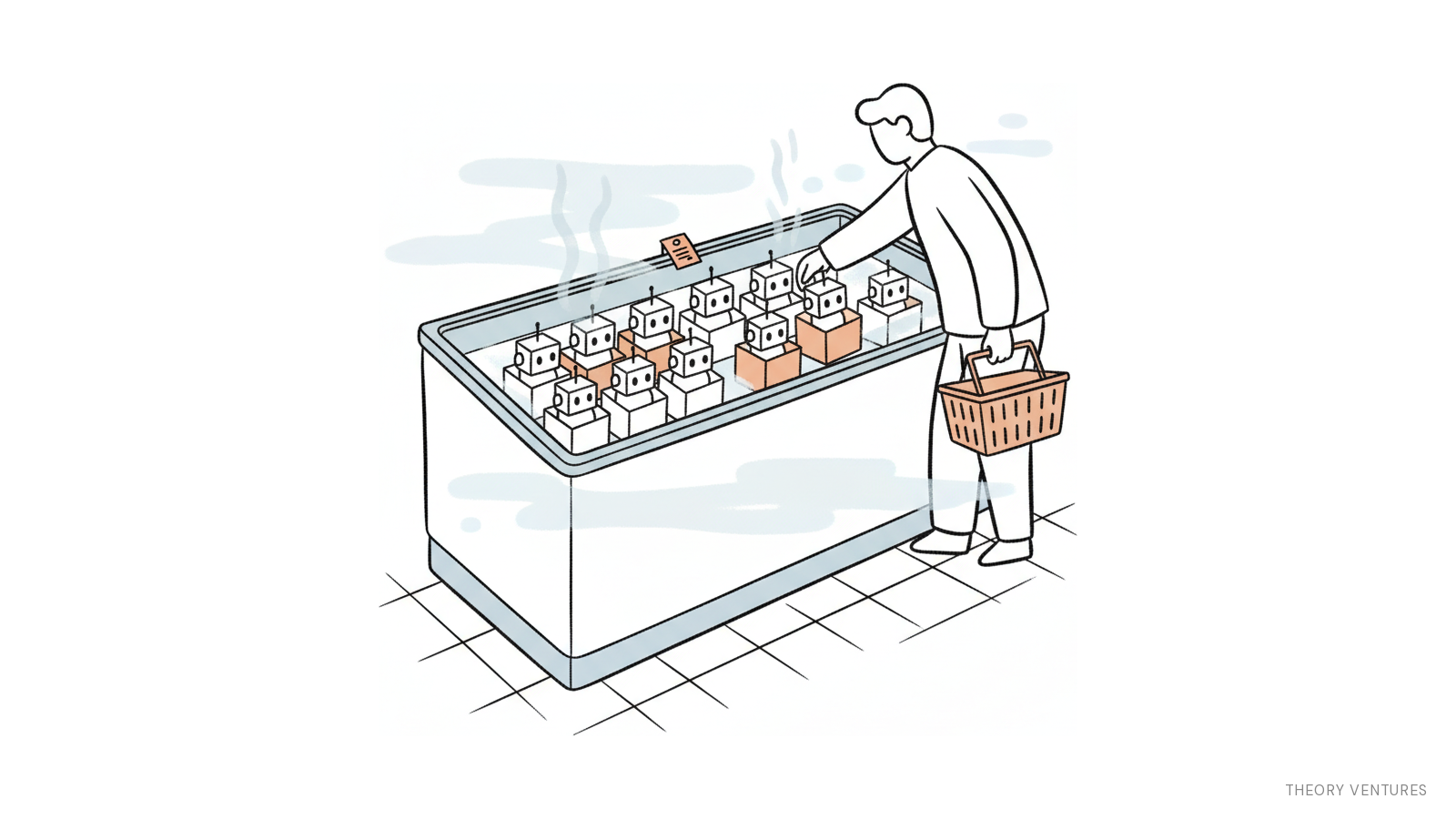
In 1989, Boris Yeltsin visited a supermarket in Houston and was amazed by the variety of ice cream available. OpenRouter, the author suggests, is now the AI equivalent: a marketplace where different models coexist and users choose based on their specific needs.

Data from OpenRouter reveals a surprising market structure: OpenAI's GPT-OSS-120b, a year-old open-source model, still commands 36% of the daily token volume of Anthropic's Opus 4.8, a frontier model that shipped weeks ago. Separately, GLM 5.2 now serves 495B tokens a day. This persistence of older or less-capable models is not a sign of market failure; rather, it reflects segmentation. Buyers vary in their needs—cost, speed, accuracy, size, origin (US versus China), architecture (dense versus sparse), accuracy specialization (coding or general), token speed, and modality (text-only or vision)—and they are choosing models that fit their constraints rather than all converging on a single best option.

Competition is actively shaping this segmentation. Last week, Anthropic shipped Opus 5, described as smaller and cheaper than Fable, explicitly to contest the ground that Moonshot's Kimi 3 targets. Poolside launched Laguna S 2.1, positioned as a US mid-market model. This is a market behaving competitively: vendors are building for specific niches.

A crucial breakthrough is the mixture-of-experts architecture. The author tested Laguna S 2.1, a 118-billion-parameter model with a sparse architecture, against Gemma 4 26b on an M5 Max machine. Although Laguna is much larger, it generates at the same speed because only 8 billion parameters activate per token—even though all 118 billion are stored in memory. This means a 118-billion-parameter model now runs at the decode cost of a 26-billion-parameter model. The practical payoff: the author's coding and email agent, which uses tool calls, saw tool-call failure rates drop from 29.4% (with Gemma 4 26b) to 20.1% (with Laguna), a 7-percentage-point improvement. Frontier-class quality is now accessible at local-deployment cost.

Segmentation, the author concludes, is a sign of a healthy market. The frontier still serves the world's hardest tasks, but it no longer has to serve all of them. The local tier has just received a much higher ceiling, and competition will push this trend forward.

Context & Analysis

The article illustrates a fundamental shift in how the AI market is organizing itself. A year ago, the narrative was that all traffic would eventually consolidate toward the single best frontier model; instead, the market is splintering into distinct segments, each optimized for different trade-offs. OpenRouter's data—showing that a year-old open-source model retains 36% of the traffic of Anthropic's newest frontier offering—is evidence that buyers are choosing based on cost, latency, and accuracy rather than pure capability. This segmentation is not accidental; it is being driven by intentional competition. Anthropic's decision to ship Opus 5 as a smaller, cheaper model to contest Moonshot's Kimi 3, and Poolside's launch of Laguna S 2.1 as a US mid-market option, show that vendors are explicitly building for niches rather than chasing the frontier-only race.

The mixture-of-experts architecture breakthrough amplifies this trend by collapsing a key cost boundary. When a 118-billion-parameter model can decode at the speed of a 26-billion-parameter model, it shifts what is possible in local deployment. The author's real-world test—where Laguna reduced tool-call failure rates by 7 percentage points over its predecessor—suggests that this capability gap is practical, not just theoretical. The implication is that the local tier (where models run on a user's own device or a small instance) is no longer confined to small models; it can now access much larger, more capable architectures, provided the developer can afford the memory footprint at inference time.

FAQ

How can a year-old open-source model still serve 36% as many tokens as a new frontier model?
The inference market has segmented across cost, speed, accuracy, and other attributes. Different users have different needs: some prioritize cost or speed over maximum accuracy, so they choose older or smaller models even when newer frontier options exist. This segmentation is accelerating as competition drives new releases targeting specific niches.
What is a mixture-of-experts architecture and why does it matter?
Mixture-of-experts is an architecture where a large model (e.g., 118 billion parameters) keeps all parameters in memory but activates only a fraction per token (e.g., 8 billion). This lets a 118-billion-parameter model decode at the cost of a 26-billion-parameter model, pulling frontier-class quality down to local-deployment tiers where it was not possible before.
What concrete improvement did Laguna S 2.1 show in the author's testing?
On a local deployment (M5 Max), Laguna S 2.1 (118 billion parameters) matched the speed of Gemma 4 26B despite being much larger. In a coding and email agent using tool calls, Laguna reduced the tool-call failure rate by 7 percentage points compared to the 26B model it replaced, falling from 29.4% to 20.1%.

Get the latest Large Language Models news every morning

AI-summarized, only the topics you pick — one digest a day via Email, Slack, or Discord.

Free · takes 30 seconds · unsubscribe anytime

Discussion

No comments yet. Be the first to share your thoughts!

Log in to join the discussion

Related Articles

Stay ahead with AI news

Get curated AI news from 200+ sources delivered daily to your inbox. Free to use.

Get Started Free

Free · takes 30 seconds · unsubscribe anytime