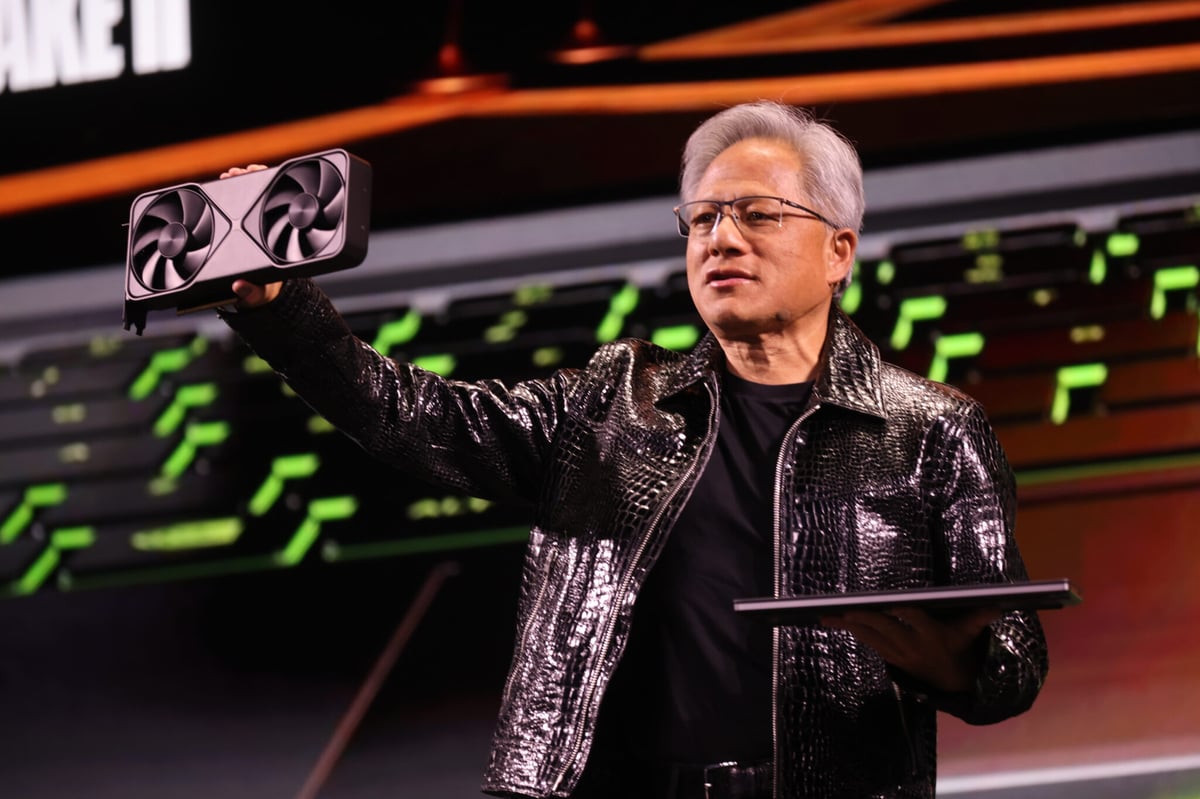
Nvidia CEO Jensen Huang is launching a $500 billion financing initiative with major Wall Street firms to create securities backed by GPUs, allowing AI companies and data center operators to borrow at attractive rates.
The plan mirrors mortgage-backed securities from the 1970s but carries risks similar to 2008's financial crisis — the collateral (GPUs) could depreciate faster than expected, and Nvidia's potential guarantee of a quarter of each loan concentrates system risk on a single company.
What happened
Nvidia CEO Jensen Huang is partnering with major Wall Street firms — Goldman Sachs, BlackRock, Blackstone, KKR, Apollo, and Brookfield — to create $500 billion in chip-backed securities, where GPUs in data centers serve as collateral backing loans for AI infrastructure buildout.
Why it matters
Hyperscalers (Microsoft, Alphabet, Amazon, Meta) have depleted free cash flow funding what is set to surpass $700 billion in capital expenditures this year, so securitizing GPU assets offers a new funding channel. However, the structure echoes pre-2008 mortgage-backed securities, where collateral can lose value — and if Nvidia guarantees a quarter of each loan (as it may offer case-by-case), system risk concentrates on Nvidia itself.
What to watch
Nvidia may guarantee portions of loans to improve borrower interest rates, but borrowers must use Nvidia's preferred system architecture; the full terms and lock-up provisions for private credit investors remain unfinalized, and critics question whether hyperscalers are underestimating GPU depreciation due to rapid new chip releases.
For decades, asset-backed securitization has been a pillar of financial markets. Ginnie Mae pioneered the concept in 1970 with mortgage-backed securities, and the mechanism spread to auto loans, personal loans, student loans, and commercial loans. Now Nvidia CEO Jensen Huang is proposing to apply the same model to computing hardware: GPU-backed securities, where graphics processing units deployed in data centers serve as collateral.
The catalyst is a funding bottleneck in AI infrastructure. Microsoft, Alphabet, Amazon, and Meta Platforms — the main hyperscalers driving the AI buildout — have historically generated massive cash flows to self-fund expansion. But capital expenditures are set to exceed $700 billion this year and rise further next year, exhausting free cash flow and forcing reliance on equity raises and debt. Huang's plan offers a third avenue: securitization. Nvidia would partner with major Wall Street firms including Goldman Sachs, BlackRock, Blackstone, KKR, Apollo, and Brookfield to raise $500 billion in capital. AI labs, enterprises, and cloud players could then borrow from this pool at attractive rates to fund data center buildout and equipment purchases. Investors buying the securities would receive returns derived from the revenue streams of the GPUs themselves — the compute delivered and its utilization by end users.
Waldemar Szlezak, KKR's head of digital infrastructure, explained the concept on a CNBC panel: "You can think about it as a revenue stream, and you can securitize it or effectively divide that risk and sell it to investors who want to participate anywhere in that stack." Nvidia may also offer, on a case-by-case basis, to guarantee a quarter of each loan, potentially lowering borrower interest rates. Borrowers would be required to use Nvidia's preferred system architecture, preserving the infrastructure's value if a borrower defaults.
Yet the plan carries material risks. Asset-backed securitization itself is sound in principle — Goldman Sachs CEO David Solomon acknowledged that GPUs are "real assets" with real value — but the collateral can lose value. In 2008, mortgage-backed securities imploded when housing prices fell contrary to universal expectations. GPU collateral faces a similar threat: chip lifespans depend on the pace of new releases, and critics argue that hyperscalers are not properly accounting for depreciation as newer models become standard faster than assumed. Additionally, Nvidia's potential guarantees concentrate system risk; if Nvidia falters, the backstop disappears. Private credit investors in such structures may also face redemption pressures and lock-up provisions, tying up capital for extended periods. The details of future financing agreements remain unfinalized, but the concept signals how the AI infrastructure boom is beginning to look to Wall Street innovation to sustain its growth.
Nvidia's proposal emerges from a genuine funding crunch in AI infrastructure. Hyperscalers have historically self-funded expansion through cash generation, but capital expenditures are poised to exceed $700 billion this year and climb further, forcing them to seek external financing beyond equity raises and traditional debt. Securitization — pooling GPU-backed revenue streams and selling them as tradeable securities to investors — offers a way to unlock capital from the broader investment community, not just the balance sheets of a few tech giants.
The structure is not inherently flawed; as Goldman Sachs CEO David Solomon noted, GPUs are real assets with real value, and asset-based financing against infrastructure is a natural development. However, the parallel to mortgage-backed securities is unavoidable and instructive. The problem in 2008 was not the financial mechanism but the assumption that collateral (housing) would not materially depreciate. In the GPU case, the collateral risk is acute: chip lifespans depend on how quickly new generations arrive, and hyperscalers may underestimate depreciation as competition forces Nvidia and rivals to release faster iterations. Nvidia's willingness to guarantee a quarter of loans case-by-case introduces counterparty risk — if Nvidia's business deteriorates or the guarantee becomes material, the backstop evaporates, threatening the entire pool.
The plan is still in its earliest stages, with many terms unresolved, including lock-up provisions for private credit investors and exact guarnatee mechanics. This uncertainty suggests the market has room to reflect on the risks before the structures are finalized.
AI-summarized, only the topics you pick — one digest a day via Email, Slack, or Discord.
Free · takes 30 seconds · unsubscribe anytime
Ask AI anything about this article. Q&As are published on this page for other readers too.
DeepSeek, a Chinese AI startup, has officially launched V4 Pro with enhanced agent capabilities while signific…
SMIC is considering breaking out revenue from AI-related peripheral chips as a standalone line item in its fin…
Alibaba Cloud has begun commercial service for its Zhenwu M890 supernode in Ulanqab, Inner Mongolia, offering…
Airbnb shares rose on Thursday following a strong second-quarter report showing revenue up 17% year over year…
Michael Burry criticized Nvidia's memorandum of understanding with six major asset managers—Apollo Global Mana…
Cisco posted record fiscal 2026 revenue of $63.3 billion (up 12% year-over-year) and guided fiscal 2027 revenu…
The AI news that matters, in one minute each morning.
Sign up free