What happened
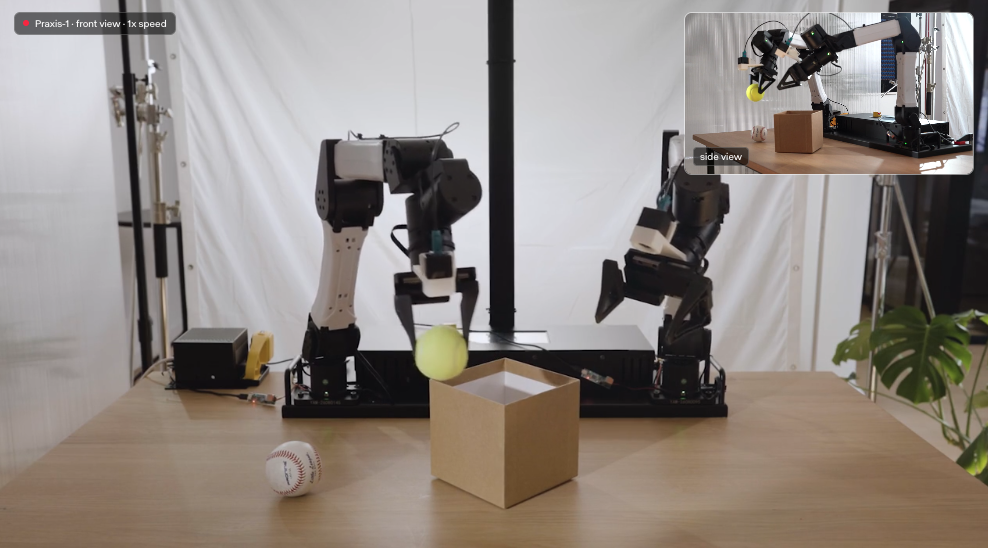
Runway announced Praxis-1, its first open-weight world action model for controlling robots, built on the same large-scale video pretraining as its world models.
Why it matters
Runway says video pretraining gives a robot policy a head start over one trained only on robot action data, which could ease robotics' data bottleneck.
What to watch
Runway reported 16.1 cm placement error for web-video pretraining versus 16.0 cm for teleoperated robot video, a difference it calls not statistically significant.
WHO IT HITSRobotics hardware developers and AI researchers evaluating open-weight models stand to gain flexibility, since Runway says open world models give hardware developers control they don't currently have.
Summaries like this, in your inbox every morning.
Runway built its reputation on generative video, and Praxis-1 extends that lineage rather than starting from scratch. The model draws on the same large-scale video pretraining behind Runway's general world models, including Solaris and GWM Worlds 2, which are built to represent how environments and objects change over time. In Runway's telling, teaching models to generate accurate physics — how objects behave, how hands move, what a task looks like partway through — creates environments where agents can be trained for both the digital and physical world.
The problem Praxis-1 targets is a practical one. Collecting real-world robotics data is expensive and time-consuming, especially when robots must be teleoperated through tasks repeatedly. Runway's alternative is to lean on the far larger quantities of ordinary video already available, on the argument that a policy already understanding physical plausibility and object behavior has an enormous head start. The company compares this to how large language models acquire a broad grasp of language from text before being adapted to specific tasks, and says its experiments point to a similar scaling effect, with policy performance improving as more third-person video is used in training.
What the results so far show is more modest than the framing suggests. In one experiment, policies pretrained on ordinary web video and on teleoperated robot video ended up nearly level after fine-tuning — 16.1 cm versus 16.0 cm in placement error, a gap Runway itself calls not statistically significant. Runway is also testing harder manipulation problems and a single policy running in both a studio and a domestic kitchen without retraining, and it reports a 0.95 correlation between simulated robot policies inside its world model and later real-world performance. Whether the approach scales may hinge on tests with Noble Machines, Standard Bots and Ultra, whose hardware spans bimanual manipulation, a six-degree-of-freedom arm and a mobile platform, and on whether the open-weights strategy draws enough robotics developers to expand the early-access program before the public release.
Pick your industry and the AI tools you use, and get news related to your work every day.
Free · 30 seconds with Google · unsubscribe anytimeWhat is AIToday? →
Ask AI anything about this article. The AI reads this article, earlier AIToday articles, and Wikipedia, and cites its sources. Q&As are published on this page for other readers too.
On Micron's fiscal Q4 2026 earnings call, CEO Sanjay Mehrotra said humanoid robots are expected to need memory…
NVIDIA published DIN Deploy, open-source C++ samples that combine ONNX Runtime with the TensorRT RTX execution…
RobotPlusPlus closed a Series C worth "hundreds of millions of RMB (tens of millions of USD)" led by Qianggang…
A NeurIPS 2026 spotlight paper reports that combining DEER with generalized teacher forcing (GTF) speeds up tr…
AWS released Strands Decider 2B, an open-source decision model that makes choices instead of generating text

Flytrex launched rooftop docking and predictive AI positioning at active merchant locations across the Dallas-…