What happened
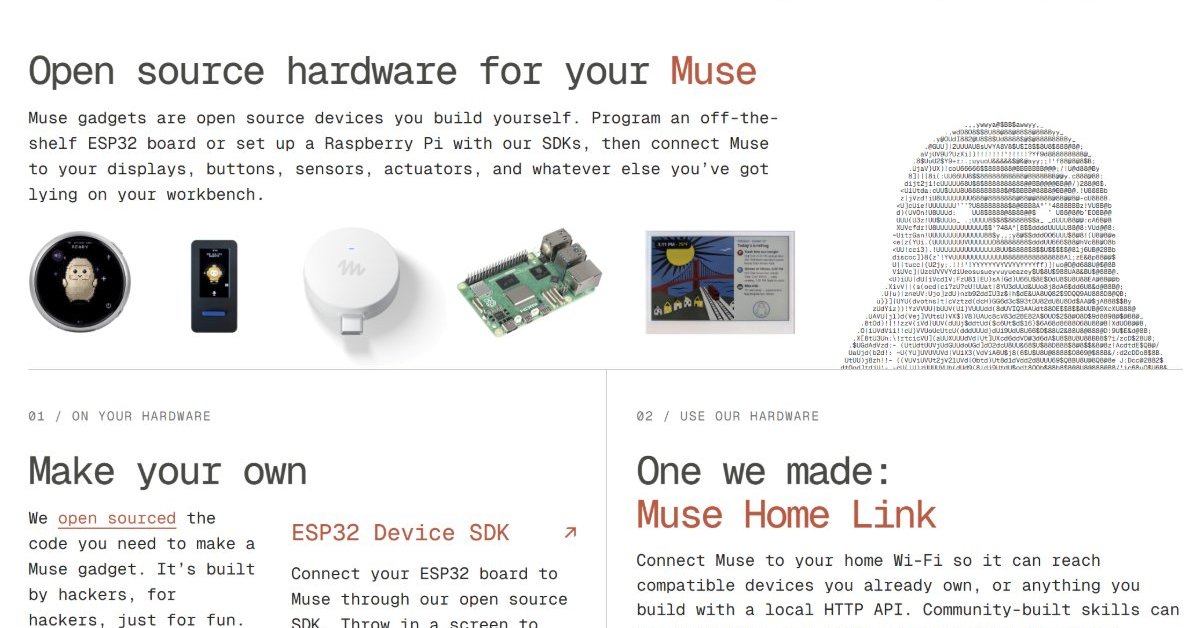
Meta announced "Muse Gadgets" on October 2, letting users embed its SDK into off-the-shelf ESP32 boards and Raspberry Pi so displays, buttons, sensors, and actuators can connect to Muse. The device SDK and firmware are published on GitHub under Apache License 2.0.
Why it matters
The SDK discloses in public, under Apache License 2.0, how third-party boards and Linux machines connect to Meta's personal AI agent.
What to watch
Meta calls this a side project built by hackers for hackers, and warns boards may stop working or warranties may be voided. Meta says it does not endorse or guarantee the third-party devices listed.
WHO IT HITSThis lands on hardware tinkerers, makers, and developers who want to build their own gadgets around a personal AI agent, and on Linux users with Raspberry Pi machines.
Summaries like this, in your inbox every morning.
Meta's Muse Gadgets project rests on two device SDKs: "ESP32 Device SDK" for ESP32 boards and "Linux Device SDK" for Raspberry Pi and Linux machines. Meta describes the SDK as letting a board show images, handle audio input and output, or read sensors, while Linux users can add custom commands so Muse takes on system administration or operates the home-automation software Home Assistant.
The project also includes Muse Home Link, a device Meta itself made. It connects to a home Wi-Fi and lets Muse reach a user's existing compatible gadgets or self-built devices with a local HTTP API, and Meta is offering it free to US Muse subscribers, one unit per person, shipping from October on a first-come basis through a waiting list. A Discord community exists for developers, and gadgets shared in its "#projects" channel may be featured on the website.
Meta frames the effort as a hacker side project built for fun, and its own warnings suggest the appeal is aimed at people comfortable improvising with hardware rather than at mainstream buyers. Whether the project draws a broad developer community may depend on how many of the listed third-party devices actually work smoothly with Muse, since Meta says it does not endorse or guarantee them.
Pick your industry and the AI tools you use, and get news related to your work every day.
Free · 30 seconds with Google · unsubscribe anytimeWhat is AIToday? →
Ask AI anything about this article. The AI reads this article, earlier AIToday articles, and Wikipedia, and cites its sources. Q&As are published on this page for other readers too.
Manulife Financial Corporation launched a first-of-its-kind CoverMe travel insurance plugin in ChatGPT in late…

Google said free Gemini app users will be restricted to the "Flash-Lite" model starting October 9; "Flash" nee…
Indie developer Robert Varadan argues that AI models like Opus 5.5 and GPT-6 Astra can clone game demos from a…
Engineer Takashiba, who works on business systems, built a shogi AI on a single RTX 3060 using the dlshogi app…

A developer published Rai, a small Rust engine that runs language models on an ordinary PC's CPU, using only t…

The developer published fk2000/minecraft-ai-bot, which uses Jev to assemble instructions, Gemini to pick from…


