
What happened
The developer published fk2000/minecraft-ai-bot, which uses Jev to assemble instructions, Gemini to pick from allowed actions, and Mineflayer to hold the Minecraft Java Edition connection.
Why it matters
The build limits Gemini to choosing from three allowed actions — say, follow, and stop — so the AI cannot run arbitrary commands inside the game, which the author presents as reducing the risk of executing raw model output.
What to watch
The few-yen-a-month goal assumes an existing machine runs the bot and every service stays within its free tier, so the test is whether actual API usage and runtime stay under those limits. The author says the repository ships no bot implementation or Jev API definitions, so buildPrompt and similar parts must be replaced for the real Jev interface.
WHO IT HITSIndependent developers and hobbyists who want to run an AI-controlled Minecraft bot on a home machine are the main audience, since the design targets reusing existing hardware and free tiers rather than paying for new hosting.
Summaries like this, in your inbox every morning.
The design reflects a common split among hobbyist AI projects: one layer handles the instruction and conversation flow, another picks among allowed moves, and a third keeps a long-lived game connection. Here that means Jev formats the user's natural-language request together with the bot's role, current situation, and available actions; Gemini then selects one action and returns it as structured JSON rather than prose; Mineflayer executes the approved action.
The author is explicit that this is a design example rather than a working product. The repository includes no bot implementation or Jev API definitions, so buildPrompt and similar code must be adapted to Jev's actual interface. Safety choices are central: inputs are length- and character-limited, untrusted chat is not treated as commands, and the bot side re-validates whatever reaches it before calling the Mineflayer API. Failures such as network errors, empty responses, or broken JSON result in no action at all.
On cost, the few-yen-a-month figure is described as a target that only holds when an existing machine runs the bot and each service stays within its free tier. Renting new hardware can push the bill past that on its own, and the author notes that Gemini and Cloudflare free tiers, pricing, and available models change, so conditions should be checked before launch. Whether the cheap-operation claim holds for a given reader therefore hinges on usage volume, uptime, and which machine is already on hand.
Pick your industry and the AI tools you use, and get news related to your work every day.
Free · 30 seconds with Google · unsubscribe anytimeWhat is AIToday? →
Ask AI anything about this article. The AI reads this article, earlier AIToday articles, and Wikipedia, and cites its sources. Q&As are published on this page for other readers too.
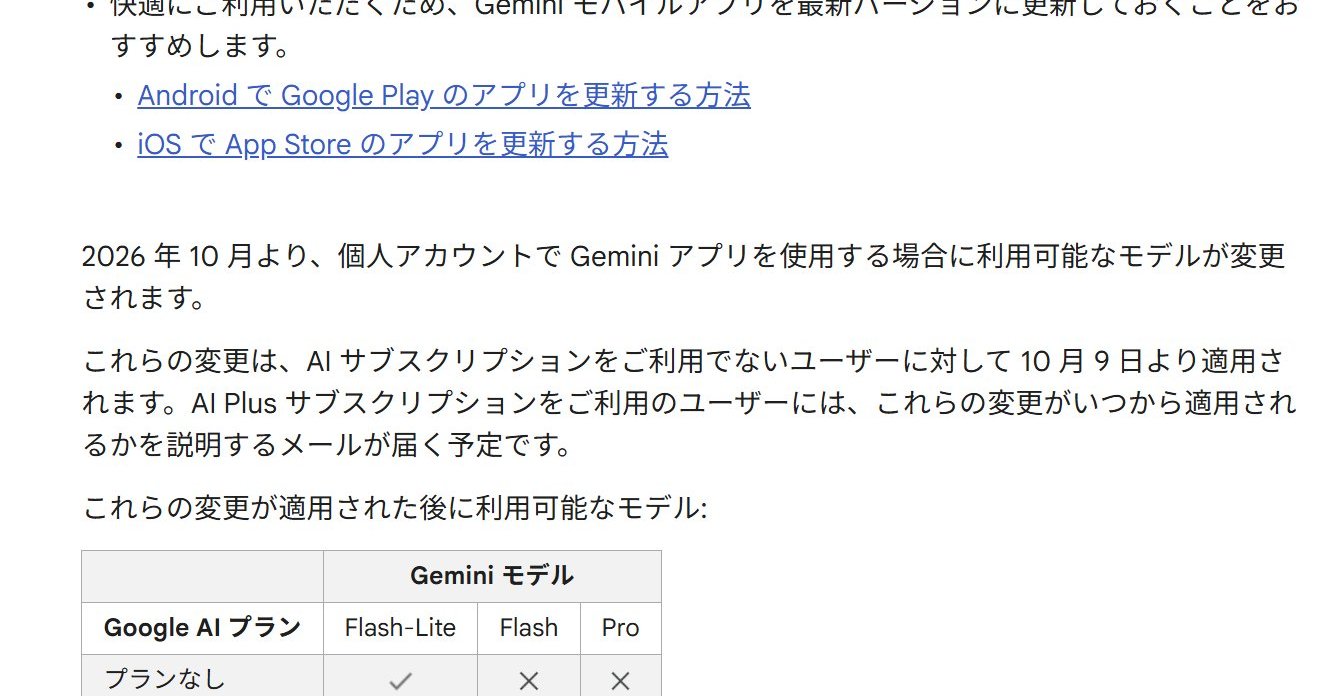
Google said free Gemini app users will be restricted to the "Flash-Lite" model starting October 9; "Flash" nee…
Indie developer Robert Varadan argues that AI models like Opus 5.5 and GPT-6 Astra can clone game demos from a…

Engineer Takashiba, who works on business systems, built a shogi AI on a single RTX 3060 using the dlshogi app…

A developer published Rai, a small Rust engine that runs language models on an ordinary PC's CPU, using only t…

On September 22, 2026, Anthropic announced Claude Opus 5.5 at $4 input / $20 output per million tokens, then O…
A developer writing on Zenn compressed the full list of instructions he gives AI — intent, completion criteria…

