AIToday

AI speeds drug design for biologics, cuts timelines by up to 50%

Hacker News1h ago
AI speeds drug design for biologics, cuts timelines by up to 50%

Key takeaway

Pharmaceutical companies like AstraZeneca are using AI to accelerate biologic drug design by predicting which molecular candidates will succeed before expensive lab testing, potentially cutting discovery timelines by as much as 50%. The approach combines AI prediction with robotic automation in closed-loop systems, and companies are building proprietary datasets to fine-tune frontier AI models. The field is moving toward "de novo" design, where AI generates entirely new proteins from scratch, though safety prediction and standardized benchmarks remain critical hurdles.

Summaries like this, in your inbox every morning.

Sign up free →

3 Key Points

  • What happened

    AstraZeneca and other pharmaceutical companies are embedding AI into every stage of biologic drug development—from design and testing to analysis—using AI to predict which candidate molecules will work before lab testing, narrowing the field of possibilities and accelerating iteration cycles.

  • Why it matters

    Drug discovery has long been expensive and failure-prone; McKinsey estimates generative AI combined with computational tools could cut discovery timelines by as much as 50%. AI also enables work on previously untreatable targets by handling optimization across multiple variables (potency, stability, manufacturability, safety) simultaneously, a task beyond human capacity at scale.

  • What to watch

    AstraZeneca is building a "lab of the future" facility in Kendall Square, Cambridge, Massachusetts, designed as a closed-loop system where AI makes predictions, robots execute experiments, and instruments generate data that feeds directly back into models. The longer-term goal is "de novo" design—AI generating entirely new protein sequences from scratch—though key obstacles remain: standardized training data, evaluation benchmarks, and robust safety prediction for computationally generated molecules.

In Depth

Designing and developing a new medicine is an expensive, failure-prone undertaking that can take years and represents a significant investment; even then, most candidates never reach patients. For biologic medicines—therapies made from engineered proteins rather than synthetic chemistry, often used across major acute and chronic diseases—the complexity is especially acute: scientists must explore vast quantities of possible molecules, identifying the rare few that will bind to the right target, remain stable in the human body, and be manufacturable at scale.

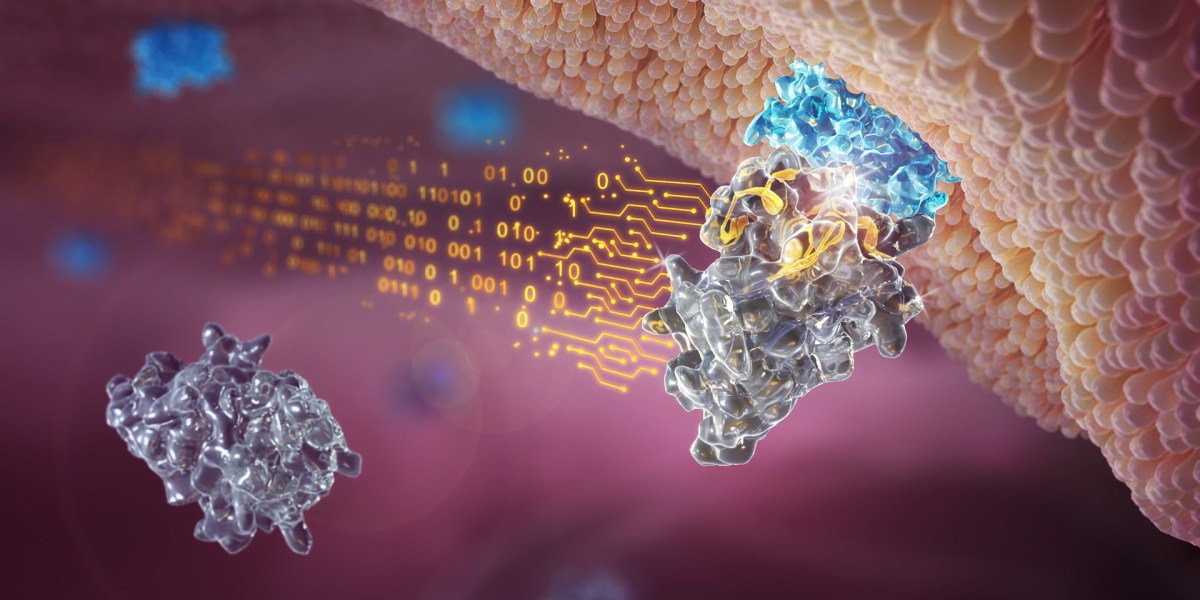
AI is now embedded throughout this process. AstraZeneca, a major pharmaceutical company, follows what Puja Sapra, senior vice president and head of R&D biologics engineering and oncology targeted discovery, describes as a "build-measure-learn loop." AI generates or prioritizes candidate molecules computationally, predicting which designs are most likely to succeed, so scientists can focus lab resources only on the top-ranked candidates. This produces a tighter feedback cycle with fewer dead ends, faster iteration, and opens the possibility of targeting diseases once considered untreatable by medicine. "Everything we do, whether it's design, make, test, or analyze, is now computationally enhanced," Sapra says. "The cycle times are getting shorter while productivity and innovation increase."

Beyond timeline acceleration, AI is being applied to discover entirely new classes of medicines. Traditional biologics target one disease pathway; the next generation can hit multiple targets simultaneously or precisely deliver therapeutic payloads to specific cells. This demands optimization across many variables—potency, stability, manufacturability, and safety—simultaneously, a task that far exceeds what human teams can systematically explore. "Drugging the undruggable is becoming a reality," Sapra says. "These technologies will eventually enable us to develop medicines against targets once thought impossible to reach."

According to McKinsey, generative AI combined with other computational tools could cut drug discovery timelines by as much as 50%. However, every AI model is only as good as its training data. Sapra emphasizes that AstraZeneca's "differentiator" is proprietary, multimodal datasets including molecular structures, binding measurements, safety profiles, and manufacturing outcomes. "We've built an intentionally diverse portfolio across multiple disease areas and drug types," she explains. "All of that data empowers us to fine-tune frontier AI models with richer, more representative training sets." The company has invested in deep screening technologies to generate datasets required to constantly refine and validate models.

To consolidate this infrastructure, AstraZeneca is building a "lab of the future" facility in Kendall Square, Cambridge, Massachusetts, where AI and robotic automation form a continuous, closed-loop discovery system. "Where a self-driving car uses sensors and models to navigate its environment, this system uses AI to make predictions, robotic systems to execute experiments, and instruments to generate data," Sapra explains. That data feeds directly back into the models, accelerating each cycle. Eventually, automated high-throughput systems will evaluate thousands of molecular interactions weekly, generating "AI-ready data at a scale that traditional workflows cannot match." Robotic sample handling, automated quality checks, and integrated data pipelines are expected to significantly accelerate early drug development timelines.

The ultimate vision is what the field calls "de novo" design: AI generating entirely new protein sequences that precisely fit desired drug properties, including structure, safety prediction, behavior in the human body, and manufacturability. "The field is making great progress toward a completely AI-generated biologic, designed from scratch all the way to a clinical candidate," Sapra says. "I believe it will come. It's a matter of time." However, several prerequisites remain: richer and more standardized training data across the industry, robust evaluation benchmarks for AI-generated candidates, and teams with expertise at the intersection of machine learning and biology. Safety prediction—determining whether a computationally generated molecule will be safe in the human body—may be the most consequential and least discussed challenge. AstraZeneca is tackling this through "virtual clinical trials" using advanced cell systems and micro-scale organ models paired with AI, positioned as "a critical missing piece in closing the loop between AI-generated designs and clinical-ready candidates."

A parallel shift is toward agentic AI systems that simultaneously generate molecule candidates and predict efficacy and safety, connecting disease-level insights directly to molecule design and bridging previously separate data silos. Throughout this transformation, Sapra emphasizes that human oversight remains central. "With more autonomous systems, human oversight remains at the heart of this approach—ensuring explainable and ethical AI for the benefit of patients," she says. Scientists will work hand-in-hand with model systems, testing molecules and feeding data back to the models for continuous improvement. AstraZeneca's engineering teams include data scientists, automation specialists, and AI engineers designing systems as "thinking partners" rather than black boxes, tackling hard problems such as multimodal data fusion, closed-loop optimization, uncertainty quantification, and interpretability at the point of clinical decision-making. Through combining world-class AI and engineering talent with deep scientific expertise, these teams aim to develop and design potentially life-changing treatments.

Context & Analysis

Biologic drug discovery has traditionally been a high-cost, time-intensive process requiring scientists to manually explore vast numbers of molecular combinations to find the rare few candidates that bind to the right target, remain stable in the human body, and can be manufactured at scale. AI is fundamentally changing this by automating the early filtering and prioritization stages, allowing human expertise to focus on the most promising candidates. According to McKinsey's estimate cited in the article, generative AI combined with computational tools could cut drug discovery timelines by as much as 50%—a significant acceleration in an industry where development cycles have historically stretched over years.

The competitive advantage in AI-driven drug discovery increasingly hinges on proprietary data. AstraZeneca emphasizes that its "differentiator" is high-quality, multimodal datasets including molecular structures, binding measurements, safety profiles, and manufacturing outcomes built across multiple disease areas. This concentration of data ownership mirrors broader AI dynamics: frontier models are only as good as their training data, and companies with rich experimental datasets—whether from internal screening or high-throughput automation—can fine-tune more effective models. The company is investing in deep screening technologies to generate datasets "at scale," signaling that the bottleneck is not model architecture but data volume and quality.

A critical remaining challenge is safety prediction. The article frames this as "one of the hardest problems in de novo design"—determining whether a computationally generated molecule will be safe in the human body. AstraZeneca is addressing this with "virtual clinical trials" using advanced cell systems and organ-scale models paired with AI, positioning this as "a critical missing piece" in closing the loop between AI-generated designs and clinical-ready candidates. The implication is that automation and AI-driven molecular design can outpace the ability to validate safety, creating a bottleneck that must be resolved before fully autonomous de novo design becomes clinically viable.

FAQ

How does AstraZeneca's AI-assisted drug design process work?
AI generates or prioritizes candidate molecules computationally, predicting which designs are most likely to succeed. Scientists then focus lab resources only on the top-ranked candidates, creating a tighter feedback cycle with fewer dead ends and faster iteration.
Where is AstraZeneca building its automated drug discovery system?
AstraZeneca is building a "lab of the future" facility in Kendall Square, Cambridge, Massachusetts, where AI and robotic automation will form a continuous, closed-loop discovery system that uses AI to make predictions, robots to execute experiments, and instruments to generate data.
What is the end-goal vision for AI in biologic drug discovery?
The field calls it "de novo" design—AI would generate entirely new protein sequences from scratch, designing the structure, predicting safety, how the molecule will behave in the body, and how to manufacture it. AstraZeneca says the field is making progress toward this but key prerequisites remain: richer standardized training data across the industry, robust evaluation benchmarks, and teams bridging machine learning and biology.

Get the latest AI in Healthcare news every morning

AI-summarized, only the topics you pick — one digest a day via Email, Slack, or Discord.

Free · takes 30 seconds · unsubscribe anytime

Discussion

No comments yet. Be the first to share your thoughts!

Log in to join the discussion

Related Articles

Stay ahead with AI news

Get curated AI news from 200+ sources delivered daily to your inbox. Free to use.

Get Started Free

Free · takes 30 seconds · unsubscribe anytime

1 minute a day. The AI essentials.

200+ sources · Email / LINE / Slack

Get it free →