What happened
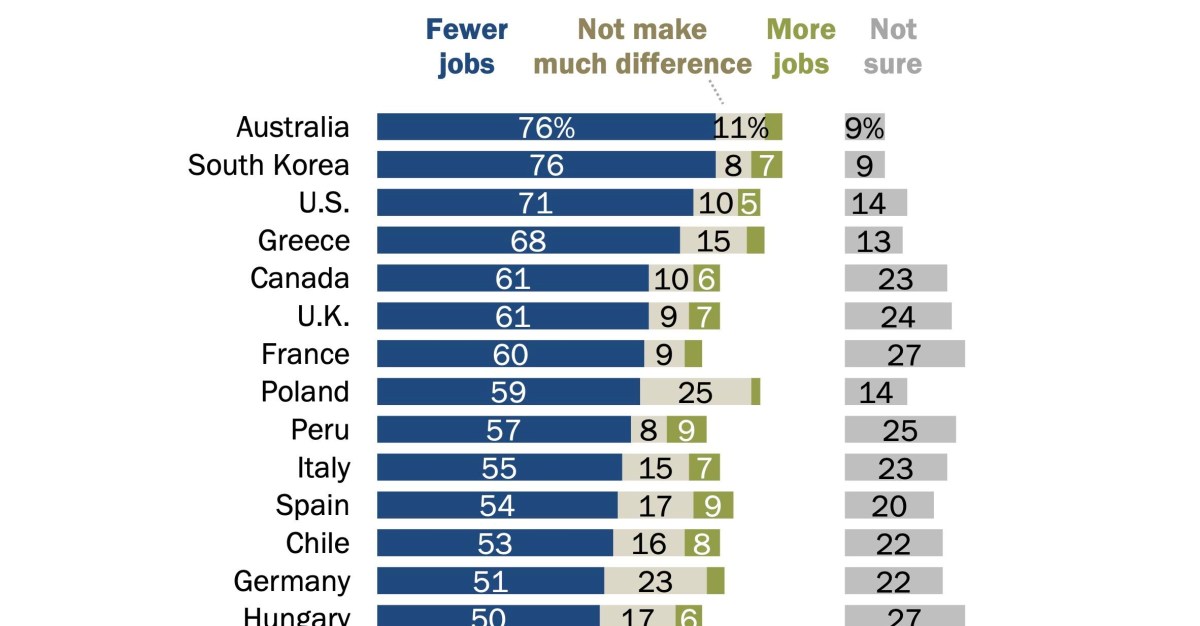
Pew Research surveyed 42,151 people across 37 countries and found that in 34 of the 37 countries, more people believe AI will lead to job losses over the next 20 years than create new ones.
Why it matters
The results suggest that public anxiety about AI's effect on employment is now the dominant view worldwide, not a fringe worry, which is likely to shape how workers and voters respond to the technology.
What to watch
The survey was conducted from February 8th to May 13th, well ahead of recent warnings such as Anthropic CEO Dario Amodei's claim that AI could eliminate half of entry-level white-collar jobs — so the mood may already have shifted further.
WHO IT HITSPolicymakers, employers and recruiters who must anticipate workforce disruption now face a public that has already made up its mind: in most surveyed countries, people expect AI to destroy more jobs than it creates. For corporate leaders planning AI rollouts, this sentiment is likely to shape employee trust and hiring debates.
Summaries like this, in your inbox every morning.
The Pew Research survey, fielded from February 8th to May 13th, captured global opinion before several recent high-profile warnings about AI's impact. Its most striking finding — that in 34 of 37 countries people expect AI to destroy more jobs than it creates over the next 20 years — underscores how broadly that fear has spread. People in wealthier countries, including Australia, South Korea, and the US, are especially likely to hold this view, and the survey suggests older people are more concerned about AI's impact on daily life than younger people.
The responses also show a link between AI anxiety and views on inequality: respondents overall are more likely to say AI will widen the rich-poor gap, with the politically left-leaning in wealthier countries most inclined to agree. Younger adults are the most conflicted group, reporting both excitement and concern, but their worry has risen sharply in several countries over the past year.
What happens next may hinge on whether those fears are borne out in actual labor markets. The survey's finding that AI job-loss fears dominate in most countries could pressure employers and policymakers to address workforce transitions more directly. But the fact that a global median of 41 percent still feel equally concerned and excited suggests the public mood is not uniformly negative, and could shift if AI's benefits become more visible.
For example, today's edition would include:
AI-summarized, only the topics you pick — one digest a day via Email, Slack, or Discord.
Free · 30 seconds with Google · unsubscribe anytimeWhat is AIToday? →
Ask AI anything about this article. Q&As are published on this page for other readers too.
SK Hynix showcased PIM, HBF and SALT-KV technologies at AI Infra Summit 2026 in Santa Clara, moving beyond the…

Musk, Zuckerberg and Nvidia's Jensen Huang privately pushed back in Oval Office meetings against a Google Deep…

Camtek, which holds about 60% market share in advanced packaging inspection and metrology, said CEO Rafi Amit…

Microsoft AI CEO Mustafa Suleyman published a companion essay this week criticizing Anthropic's model welfare…

Emerald AI launched the AI Energy Management Alliance with Google, Nvidia, Anthropic, and utilities AES, Const…

Huawei moved the Ascend 960DT AI chip launch to Q1 2027 from Q3 2027, a spokesperson said at Huawei Connect, w…