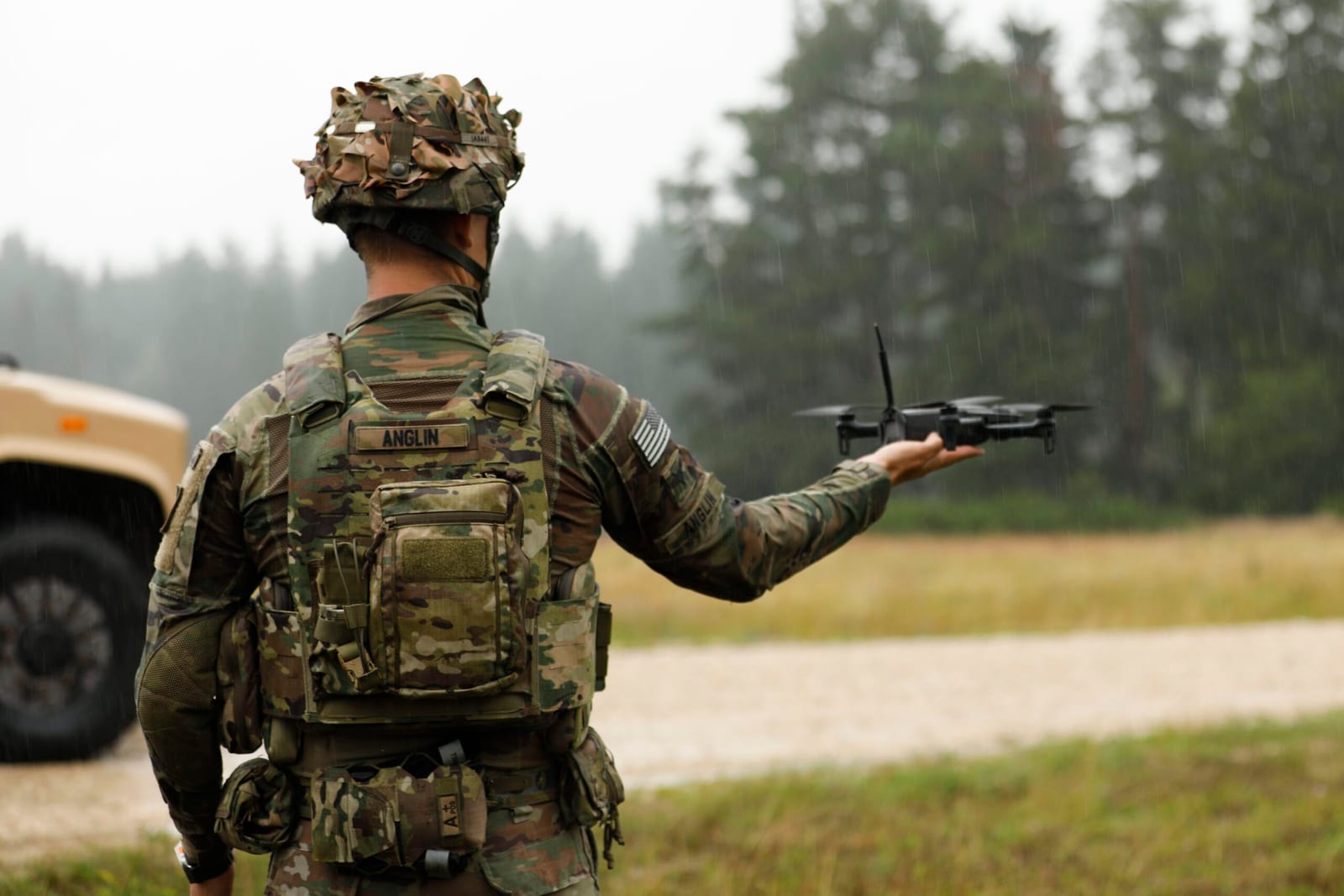
What happened
DIU launched the Low Cost ISR (LC-ISR) Challenge on September 29, 2026, with responses due October 14, offering a $100 million prize and initial follow-on pool plus up to $250 million budgeted for scaled production.
Why it matters
The government is signaling real, funded demand for affordable surveillance drones instead of one-off concepts, which shows manufacturers and investors where military purchasing may head.
What to watch
The extra $250 million is not guaranteed — DIU says spending depends on government requirements and program execution. Early fiscal 2027's accelerated fly-off pays $250,000 to successful participants.
WHO IT HITSDrone makers and their investors get a rare, clearly-funded demand signal for cheap, easy-to-deploy surveillance aircraft; the competition explicitly invites companies in allied countries to demonstrate systems directly to U.S. defense buyers, subject to security screening.
Summaries like this, in your inbox every morning.
The LC-ISR Challenge fits a pattern DIU has been building: connecting commercial technology to government requirements faster than traditional defense acquisition programs. The body notes that programs such as DIU competitions and the Department of Defense's Replicator initiative have sought to move commercial autonomous systems into military use while expanding production capacity, and that DIU's commercial solutions catalog shows past UAS projects moving from prototype programs into systems available for government purchase.
What separates this competition is its affordability lens. DIU will weigh mission effect against total lifecycle cost — the aircraft, sensors, personnel, operations and sustainment — and asks applicants to explain how unit costs could decline as production increases. That manufacturing readiness requirement sits alongside aircraft performance, not behind it.
The international invitation carries a subtext. The body points out that U.S. policy increasingly emphasizes domestic drone manufacturing and reducing dependence on foreign supply chains, yet this solicitation casts a wider net for mature technology. For manufacturers in allied countries, the competition could be a route to demonstrating systems directly to U.S. defense customers, though security requirements and conditions attached to later procurement are likely to shape who ultimately benefits. The larger question is whether the up-to-$250 million follow-on spending materializes — DIU ties it to government requirements and program execution, not to winning the challenge alone.
Pick your industry and the AI tools you use, and get news related to your work every day.
Free · 30 seconds with Google · unsubscribe anytimeWhat is AIToday? →
Ask AI anything about this article. The AI reads this article, earlier AIToday articles, and Wikipedia, and cites its sources. Q&As are published on this page for other readers too.
HBM is approaching half the cost of a GPU-HBM CoWoS package, prompting the question of whether memory remains…
DeepSeek is bringing more of the software it uses to develop its AI models to Huawei Technologies' Ascend 950…
Among respondents at companies with 1,001+ employees, 50.0% said AI is used company-wide, and 46.0% flagged AI…

Nvidia released the Open Agent Safety Platform on September 28, days after CEO Jensen Huang called warnings fr…
Oracle invoked "force majeure" to delay payment on its Project Jupiter data center, and its 2056 bonds then tr…

McDonald’s is increasingly using AI to guide menu prices in the U.S