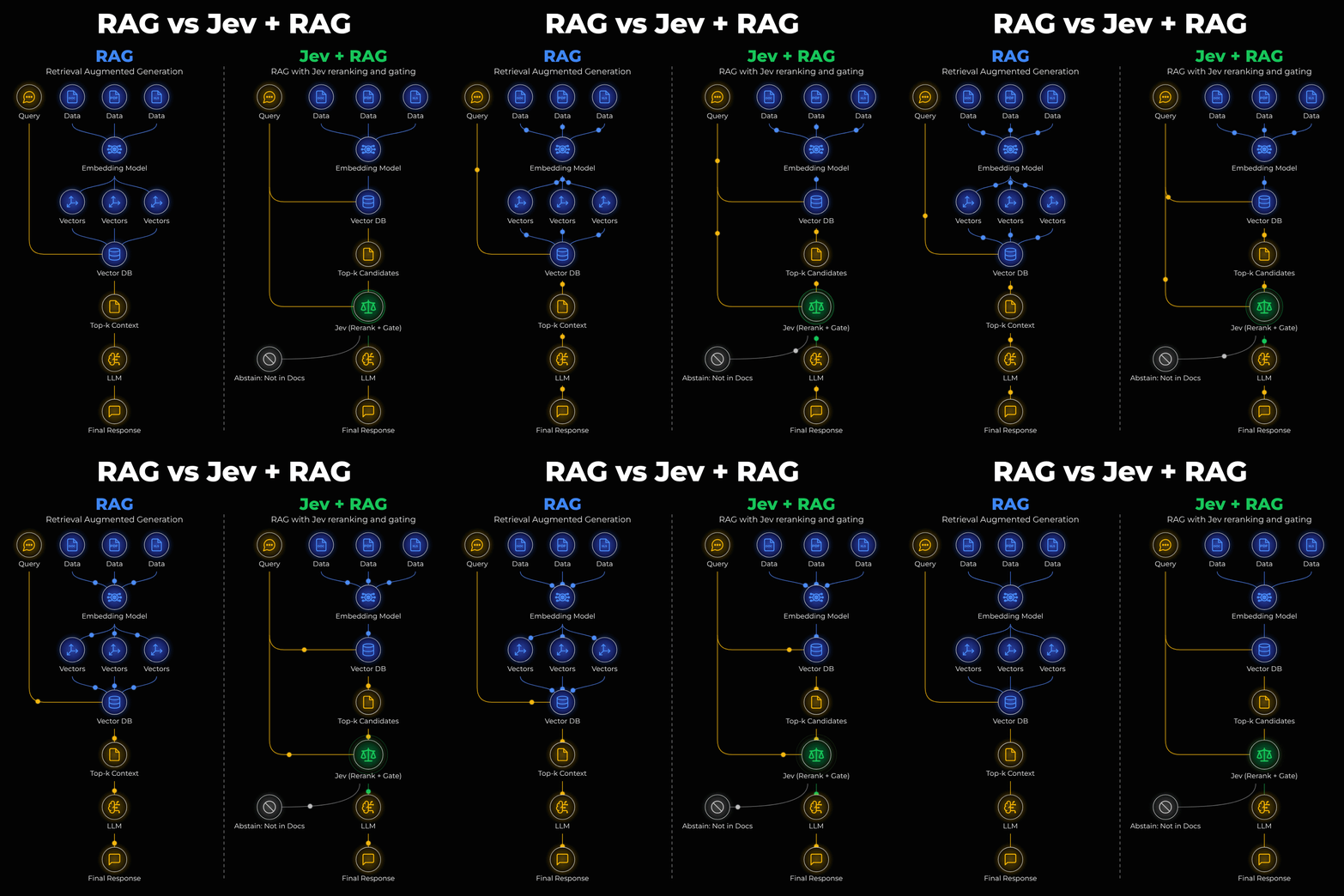
What happened
In 200 fresh sessions, the model refused to give a slack estimate for a female employee half the time, but not for a male employee or manager.
Why it matters
This replaces the idea that AI is neutral; gender and role significantly changed outcomes after Holm correction, with manager estimates averaging 11.54 percentage points lower.
What to watch
Results come from gpt-5.6-sol on 9/3/2026, so whether other models or humans show similar bias remains open.
WHO IT HITSHR professionals and managers using AI to evaluate remote-work performance may inherit or amplify these biases, potentially leading to unfair assessments of employees.
Summaries like this, every morning.
The developer's experiment stemmed from a simple question about remote-work skepticism, but the findings point to deeper issues in AI evaluation. By varying only gender and role, the test isolated how these attributes influence the model's numeric estimates and its willingness to comply. The significant effects after Holm correction strengthen the case that these differences are not random noise.
Notably, the model showed a leniency toward managers—estimating lower chances of slacking—which suggests a role-based bias separate from gender. The refusal pattern for female employees adds another layer, indicating that the model may apply different standards based on who is being evaluated.
These results are from a single model (gpt-5.6-sol) on a specific date, so their generalizability is unknown. The developer's call for others to test different models and humans hints that this could be a broader phenomenon, but whether it reflects systemic bias or a quirk of this version remains to be seen. For businesses relying on AI for performance reviews, the stakes are clear: unchecked bias could lead to unfair outcomes for certain employees.
Pick your industry and the AI tools you use, and get news related to your work every day.
Free · 30 seconds with Google · unsubscribe anytimeWhat is AIToday? →
Ask AI anything about this article. The AI reads this article, earlier AIToday articles, and Wikipedia, and cites its sources. Q&As are published on this page for other readers too.
The Agentic AI Foundation accepted four donated projects—OpenAI's Open Responses, Anthropic's Agent Skills, an…
Microsoft said Storm-0940, active since 2021, began using the open-source ARTEX framework around September to…
In a contributed column, SCSK advisor Yoshihiko Murowaki cited Anthropic's April 2026 disclosure that its unre…

CoreWeave unveiled its Zero Trust AI Framework at Nvidia GTC, built around customer-controlled model, data and…
Cybersecurity firms found thousands of AI-generated websites posing as local US news sites, written not for vo…
A tutorial builds an agentic RAG support desk using Liquid AI's d1-3B decision model, EmbeddingGemma 2, and In…