What happened
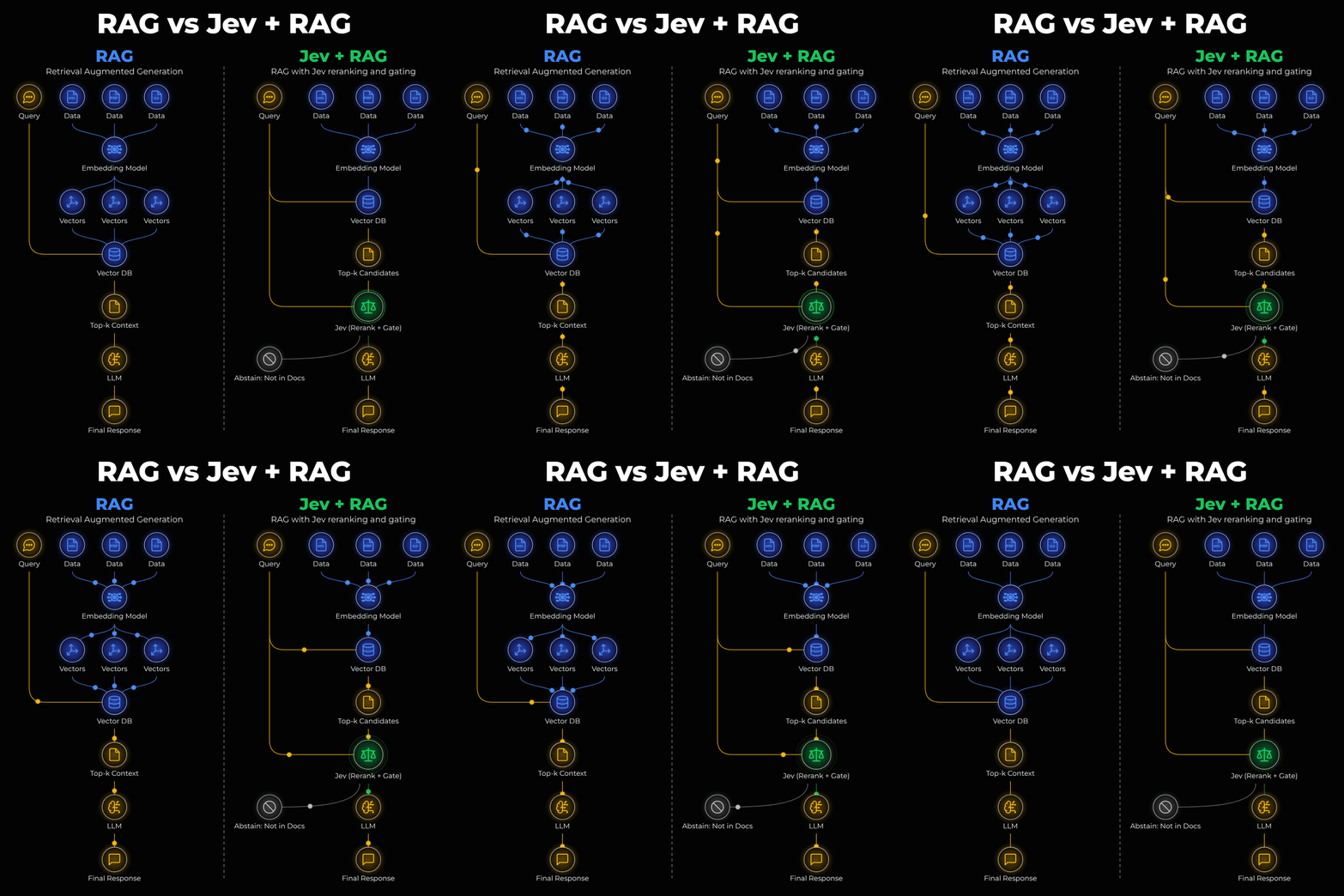
A tutorial builds an agentic RAG support desk using Liquid AI's d1-3B decision model, EmbeddingGemma 2, and InsForge; d1-3B reranks passages and gates answerability before generation.
Why it matters
The decision gate had the highest accuracy across four question types and was the only pipeline that held full performance on image-only questions, suggesting decision models can judge evidence visually.
Summaries like this, in your inbox every morning.
The tutorial positions decision models as a solution to two problems in agentic RAG: knowing when retrieved evidence is insufficient and acting on that decision. Unlike generative models, decision models return structured judgments such as relevance scores or probabilities, which the application uses to generate a response or escalate to a human.
The build uses InsForge for backend, database, auth, and human-review workflow, EmbeddingGemma 2 for multimodal embeddings, and Liquid AI's d1-3B for scoring passages and assessing answerability. A FastAPI server in Lightning AI Studio hosts the embedding and decision models, which fit on a single NVIDIA L4 and use about 7.2 GB of GPU memory.
The evaluation compared three RAG pipelines on 75 labelled questions across four cases. The decision gate had the highest accuracy and was the only pipeline that held full performance on image-only questions, while the BGE reranker avoided wrong answers but struggled with image-based questions, escalating most of them. This suggests decision models can do more than rank passages; they can also judge whether visual evidence supports an answer, though the results are from a single tutorial test.
Pick your industry and the AI tools you use, and get news related to your work every day.
Free · 30 seconds with Google · unsubscribe anytimeWhat is AIToday? →
Ask AI anything about this article. The AI reads this article, earlier AIToday articles, and Wikipedia, and cites its sources. Q&As are published on this page for other readers too.
The Agentic AI Foundation accepted four donated projects—OpenAI's Open Responses, Anthropic's Agent Skills, an…

Microsoft said Storm-0940, active since 2021, began using the open-source ARTEX framework around September to…
In a contributed column, SCSK advisor Yoshihiko Murowaki cited Anthropic's April 2026 disclosure that its unre…

Cybersecurity firms found thousands of AI-generated websites posing as local US news sites, written not for vo…

Google Flow puts Gemini Omni, Veo and Nano Banana in one web app, letting beginners chat through a storyboard…
Microsoft announced in September 2026 that Copilot now combines Chat, Cowork, Code and Autopilot in one interf…