What happened
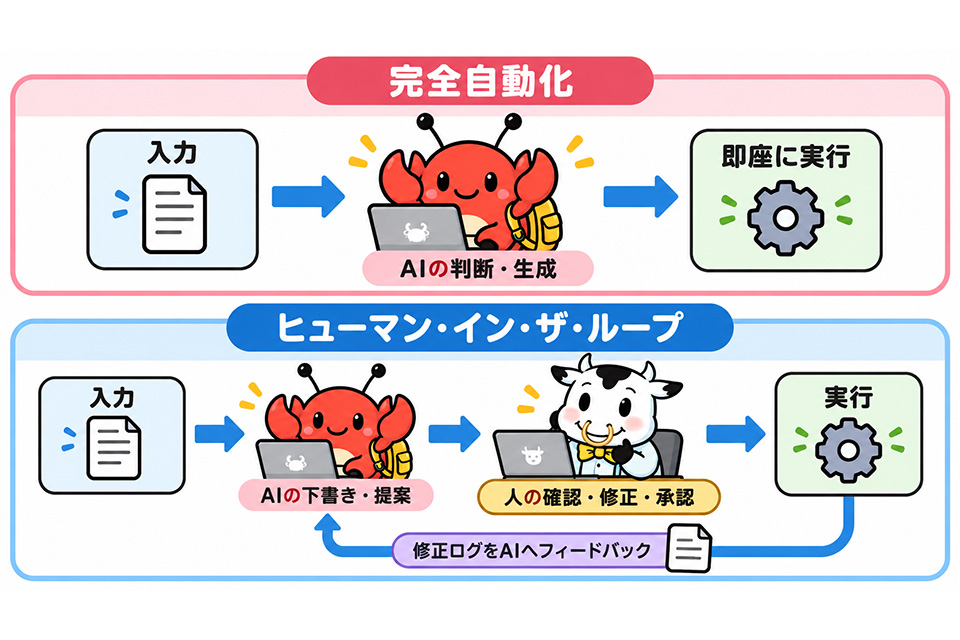
The article lays out Human-in-the-Loop (HITL), where humans confirm, evaluate, or approve steps inside AI processing, and notes it should apply to hard-to-reverse actions like payments, external sending, and deleting key data.
Why it matters
Guardrails and hallucination prevention cannot block every error, so a designed human check appears to be the practical way to keep speed while protecting quality and safety.
What to watch
The design hinges on where the human line is drawn in each workflow, since AI edits do not automatically improve the model without a logging and feedback mechanism.
WHO IT HITSTeams building or signing off on AI-assisted workflows — especially those handling payments, outbound emails, contracts, or data deletion — need to define which steps a person must approve before they go live.
Summaries like this, in your inbox every morning.
The article arrives as generative AI moves from drafting into doing work. It points to AI agents and agent workflows, both covered in earlier installments, as examples of AI carrying out tasks on its own. Against that backdrop, the question it raises is whether work where failure is unacceptable — sending email to customers, confirming contract terms, processing payments or orders — should be handed over entirely.
The piece ties this to two earlier concepts: hallucination and guardrails. Even with guardrails in place, it says, AI cannot be counted on to prevent every error or unexpected action. HITL is presented as the middle ground: automate the parts AI handles well, such as summarizing long documents or drafting routine replies, and keep human confirmation before actions that cannot be easily reversed. Responsibility for problems, the article notes, still rests with people.
Its second thread is improvement rather than only protection. Records of human corrections and choices can feed evaluation and refinement, and reinforcement learning from human feedback is cited as a representative use of human judgment in AI development. The stakes, then, hinge on whether organizations actually design that boundary inside their workflows — deciding what AI owns and where human responsibility begins — rather than treating full automation as the goal.
Pick your industry and the AI tools you use, and get news related to your work every day.
Free · 30 seconds with Google · unsubscribe anytimeWhat is AIToday? →
Ask AI anything about this article. The AI reads this article, earlier AIToday articles, and Wikipedia, and cites its sources. Q&As are published on this page for other readers too.
At Team ‘26 Europe, Atlassian unveiled Agentic Multiplayer Protocol, giving every AI agent an admin-assigned i…

Meta and enterprise AI startup Sierra are leading Walmart, Stripe, Shopify, Genesys, Instinct and Rocket in de…
Gartner forecasts that 70% of AI agents developed by vendors' forward-deployed engineers (FDE) will be abandon…

Massachusetts Rep. Lori Trahan rolled out the draft "CLAIM Act," which would make it easier for third parties…

A coalition of nearly 40 groups, led by Guardrails Action, wrote to Congress and 2028 candidates demanding ind…

OpenAI published 372 mathematical results from an internal frontier model on GitHub, including improvements to…