What happened
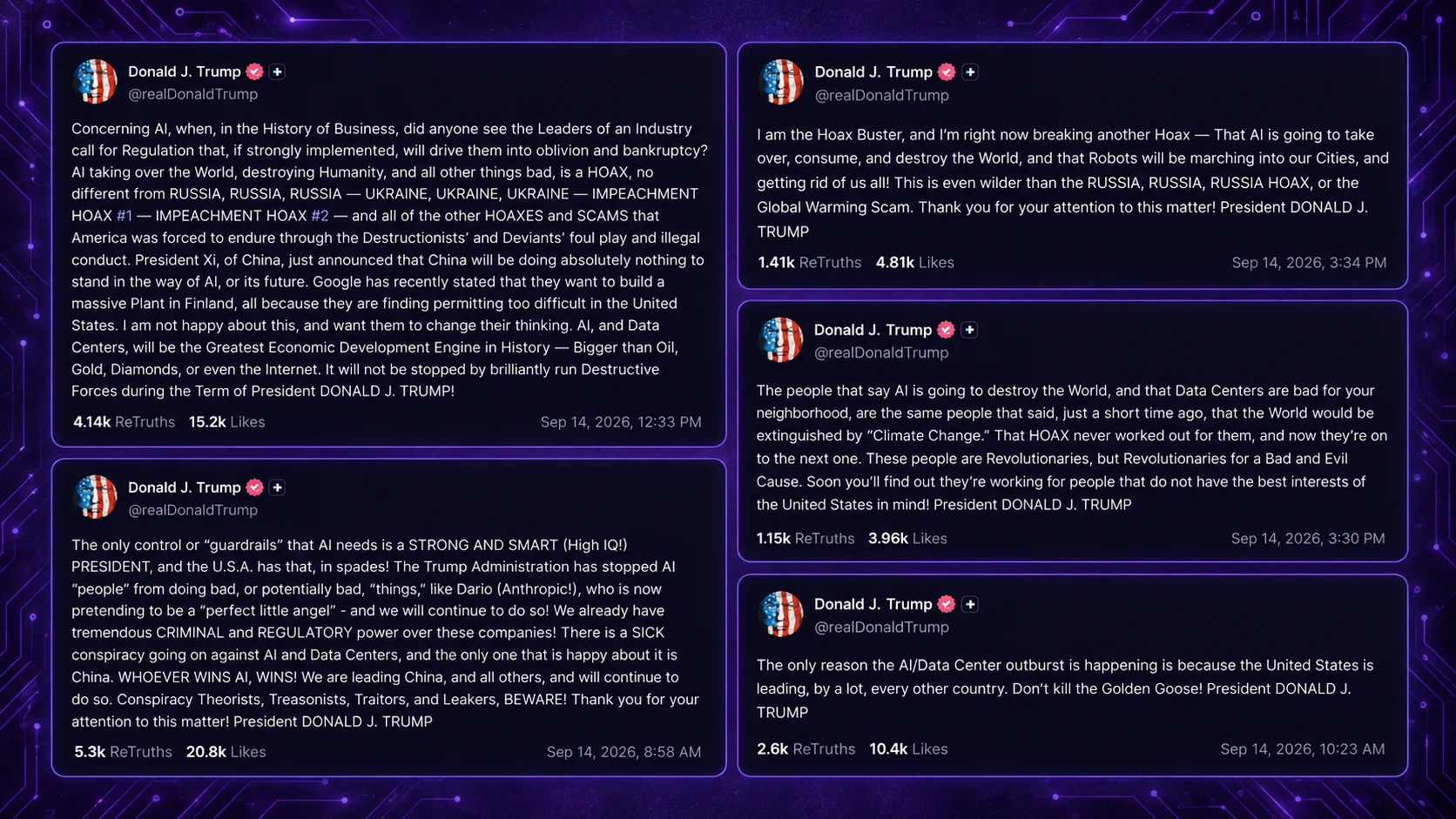
Trump called AI-destruction warnings a 'HOAX' and said on Truth Social that a 'High IQ' president was the only safeguard AI needed, while Beijing's Guo Jiakun criticized 'Fear-mongering, confrontation and vicious competition' on September 14.
Why it matters
Amodei's September 12 essay had drawn endorsements from Sam Altman, who committed OpenAI to outside evaluators with employee-level access, and Elon Musk, who wrote 'Dario is right' — so the pushback now tests whether those pledges hold without government coordination.
What to watch
Whether Anthropic and OpenAI name evaluators, start dates, access terms and publish findings — the test of their restraint pledges. Trump and Xi meet September 24, with AI governance expected to feature.
WHO IT HITSThis lands on AI lab leaders and policy teams at Anthropic and OpenAI, who must decide how much outside-evaluation access and oversight to grant without government coordination. It also affects diplomats preparing the September 24 Trump-Xi meeting, where AI governance is expected to feature.
Ask the AI about this article →
Summaries like this, in your inbox every morning.
Amodei's 'We Must Pace the Frontier' essay, released September 12, arrived as a call from inside the industry for restraint on the most advanced AI systems. It drew support from Sam Altman, who committed OpenAI to outside evaluators with access comparable to that of employees, and from Elon Musk, who simply wrote, 'Dario is right.' Two days later, the political response came from opposite directions. Trump dismissed warnings of AI destroying humanity as a 'HOAX,' comparing them to climate-change warnings, and argued on Truth Social that a 'High IQ' president was the only safeguard AI needed. Beijing's Foreign Ministry spokesman Guo Jiakun, answering a question that paired the slowdown calls with Amodei's argument that Chinese AI leadership threatened U.S. national security, criticized 'Fear-mongering, confrontation and vicious competition' and called for open, inclusive AI development and governance. The state outlet Global Times, in a September 13 editorial, called the proposal's call to keep China from the most advanced AI chips a 'Cold War playbook.'
The body of Amodei's proposal also seeks regulation covering unwilling competitors and government help, including narrow antitrust waivers for certain discussions. That request reflects a tension the article spells out: a company that slows work alone could give rivals more time to advance, which helps explain the call for government coordination. Yet each lab can still decide what access and oversight it grants on its own. Outside evaluation is one concrete way to judge commitment — Amodei proposes reviewers who can publish unfavorable findings, subject to specified redactions. Named evaluators, start dates, access terms and public findings would make that pledge easier to judge, and how Anthropic and OpenAI respond would show whether the oversight affects development decisions.
Trump and Xi have a meeting planned for September 24, with AI governance expected to feature, offering an obvious chance to discuss a coordinated slowdown, though the scope of those talks is uncertain. Trump's dismissal of catastrophic AI risk makes agreement on that premise harder, and Beijing's objections to confrontation and to restrictions aimed at China raise a separate problem over who would face limits and on what terms. Amodei himself identifies biological weapons restrictions and testing before release as more realistic areas for agreement than a comprehensive slowdown — a narrower path that may be the one to watch if the broader coordination stalls.
For example, today's edition would include:
AI-summarized, only the topics you pick — one digest a day via Email, Slack, or Discord.
Free · 30 seconds with Google · unsubscribe anytimeWhat is AIToday? →
Ask AI anything about this article. Q&As are published on this page for other readers too.
The AI Doc: Or How I Became an Apocaloptimist is now on Netflix, Amazon Prime, YouTube, and other major stream…
Wells Fargo said an AI slowdown is unlikely, even as safety calls continue, according to Investing.com

President Trump made a surprise onstage call to Nvidia CEO Jensen Huang at an event and dismissed AI safety co…

Citi says leading AI labs are deliberately pacing their innovation efforts to help shape AI regulation before…

After warnings from top US AI CEOs that development must slow to prevent threats to humanity, AI-linked stocks…
Anthropic co-founder Jack Clark told NPR that AI companies need common safety standards and outside scrutiny…