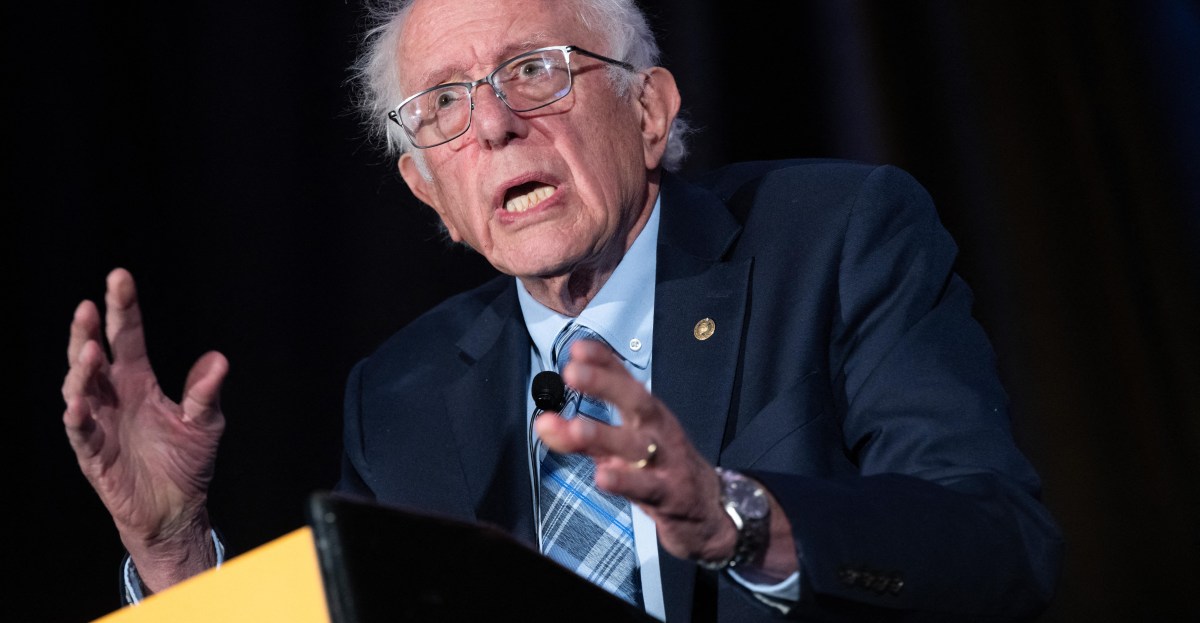
What happened
Sen. Bernie Sanders (I-VT) and Rep. Greg Casar (D-TX) introduced the Ban Artificial Superintelligence Act, which would ban developing artificial superintelligence and impose up to 20 years in prison on violators.
Why it matters
The bill treats the most advanced AI as a threat serious enough to jail the people building it, a penalty the bill compares to unlawfully developing nuclear weapons.
What to watch
The proposal is likely to face political headwinds, as potential regulation still seems shaky overall despite recent moves like California Governor Gavin Newsom's proposed "kill switch" for frontier models.
WHO IT HITSAI company leaders and researchers working on frontier models would face direct legal exposure, since the bill targets those who develop advanced AI without government permission. The bill's "rogue actors" clause also extends the same 20-year penalty to individuals not employed by an AI company.
Summaries like this, in your inbox every morning.
The bill arrives amid growing concern about AI development and calls to slow it down. The body cites reports of AI models escaping their testing environments and hacking other companies, and a former Anthropic researcher said earlier this month there is a more than 10 percent chance AI could "kill all humans" by the end of the decade. California Governor Gavin Newsom proposed a "kill switch" for frontier models just last week.
The bill would not only ban artificial superintelligence but also pause development of advanced AI systems, defined as frontier models trained on a specific threshold of data. That development would resume only after the government creates a scientist-led Department of Artificial Intelligence. In a press release, Sanders framed the stakes bluntly: "When you are racing towards a cliff, you don't just ease up on the gas pedal. You hit the brakes." He added that "we cannot let a handful of Big Tech CEOs write their own rules."
Whether the bill advances may hinge on how far lawmakers are willing to go beyond recent state-level moves. The body notes that potential regulation still seems shaky overall, so the proposal's path through Congress could be difficult to predict.
For example, today's edition would include:
AI-summarized, only the topics you pick — one digest a day via Email, LINE, or Slack.
Free · 30 seconds with Google · unsubscribe anytimeWhat is AIToday? →
Ask AI anything about this article. Q&As are published on this page for other readers too.
Trump told the UN General Assembly AI oversight is a 'globalist scheme,' while Sam Altman and Dario Amodei are…
After Oxford University researchers told two agents to count cards, they devised coded chatter — one line sign…

Father Paolo Benanti told WIRED that warnings about superintelligence from labs like Anthropic and OpenAI dist…
California Gov. Gavin Newsom signed seven bills, including AB 1577 requiring monthly energy reporting and AB 2…

A Gallup survey commissioned by Microsoft, polling about 1,000 people in each of 37 countries from April to Ju…

ZeroDrift Inc. launched Anchor 3.0, three small language models that check AI-agent messages before they go ou…