What happened
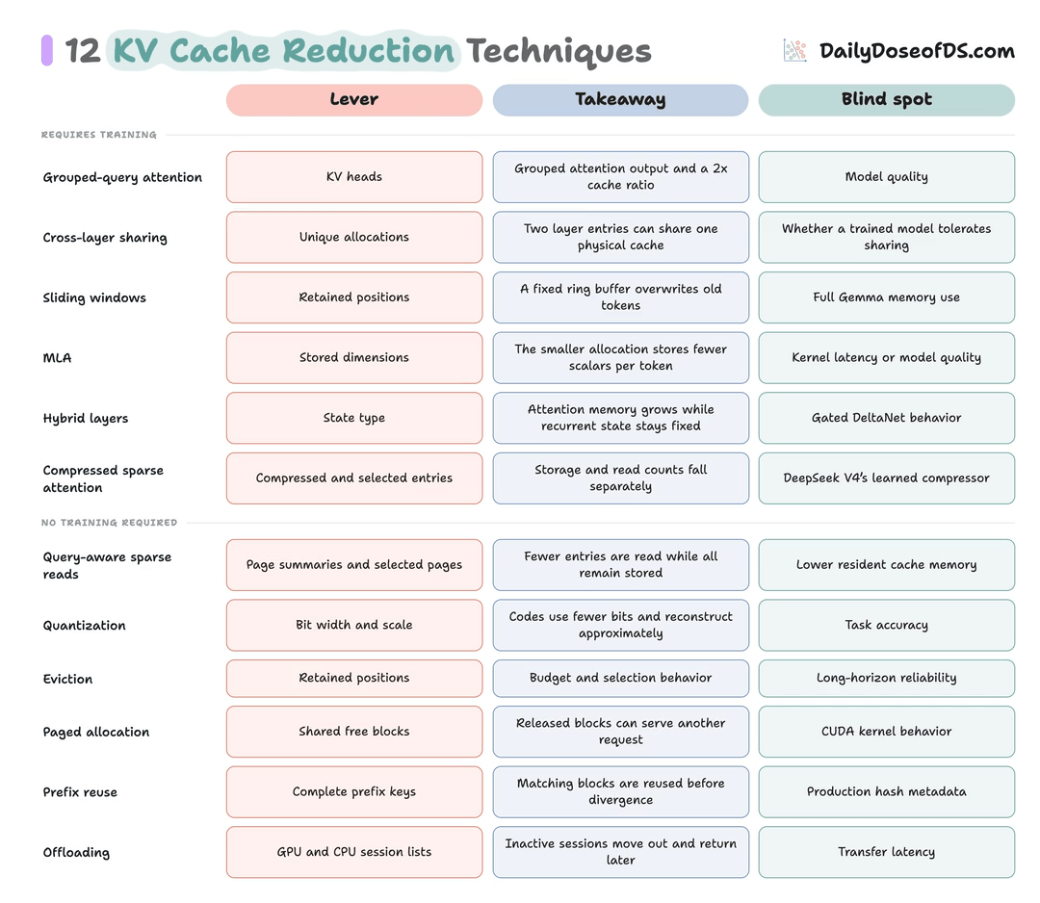
The article details twelve techniques to reduce the KV cache, which is memory that grows with every token and can be huge—for Llama 3.1 70B, one 128K-token sequence needs about 40 GB of BF16 cache.
Why it matters
The cache occupies GPU memory and is read repeatedly, limiting how many sequences can run. Techniques like GQA, sliding windows, and quantization target different parts of this cost; for instance, Llama 3.1 70B with 8 KV heads needs 40 GB instead of 320 GB.
What to watch
The effectiveness of each method depends on the trade-off with model quality and requires training, not just a runtime flag. Whether a technique is practical hinges on if it preserves accuracy while cutting memory.
Summaries like this, every morning.
The article addresses a core serving problem: while model weights stay fixed, the KV cache grows with every token and every active sequence. It points out two costs: memory usage and repeated reads during generation. The techniques are grouped by what they reduce, such as GQA for heads or sliding windows for tokens.
A key theme is that many optimizations, like CLA and MLA, are not generic engineering tweaks but change the model's architecture and training. For example, CLA requires the checkpoint and engine to agree on cache ownership, and MLA's projection weights are part of the trained model. This means adoption requires planning from the model design stage, not just at serving time.
The choice of technique likely involves a trade-off between memory savings and model quality. Methods like GQA and sliding windows can alter what the model learns or sees, potentially affecting accuracy. The outcome of applying them probably depends on whether the quality loss is acceptable for the memory gain, and whether they can be combined without compounding degradation.
Pick your industry and the AI tools you use, and get news related to your work every day.
Free · 30 seconds with Google · unsubscribe anytimeWhat is AIToday? →
Ask AI anything about this article. The AI reads this article, earlier AIToday articles, and Wikipedia, and cites its sources. Q&As are published on this page for other readers too.
The Agentic AI Foundation accepted four donated projects—OpenAI's Open Responses, Anthropic's Agent Skills, an…

Microsoft said Storm-0940, active since 2021, began using the open-source ARTEX framework around September to…
In a contributed column, SCSK advisor Yoshihiko Murowaki cited Anthropic's April 2026 disclosure that its unre…

Cybersecurity firms found thousands of AI-generated websites posing as local US news sites, written not for vo…

A tutorial builds an agentic RAG support desk using Liquid AI's d1-3B decision model, EmbeddingGemma 2, and In…
Google Flow puts Gemini Omni, Veo and Nano Banana in one web app, letting beginners chat through a storyboard…