AIToday

Alibaba's Qwen-Image-3.0 generates readable text and complex layouts in one pass

THE DECODER9h ago
Alibaba's Qwen-Image-3.0 generates readable text and complex layouts in one pass

Key takeaway

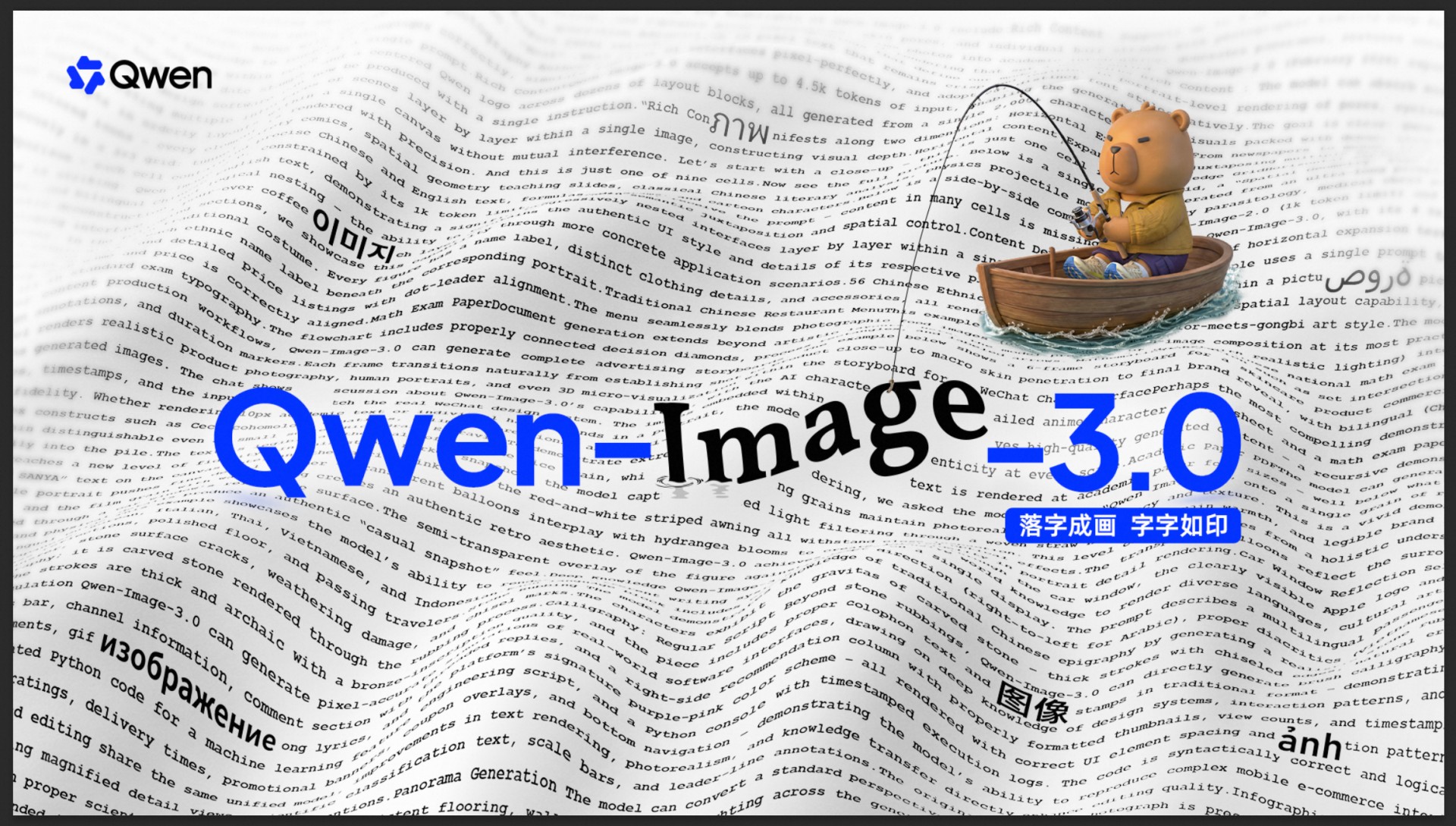
Alibaba's Qwen team has released Qwen-Image-3.0, an image generator that can create complex multi-element layouts—infographics, LaTeX papers, and newspaper pages—in a single pass. The system accepts prompts up to 4,500 tokens, renders legible text as small as ten pixels, and supports twelve languages natively. While the capability represents a step forward in layout and text rendering for image generation, its practical value is limited because the output is a fixed pixel image rather than an editable document.

Summaries like this, in your inbox every morning.

Sign up free →

3 Key Points

  • What happened

    Alibaba's Qwen team released Qwen-Image-3.0, an image generator that accepts prompts up to 4,500 tokens, renders legible text as small as ten pixels, and supports twelve languages natively. It can create complex layouts such as infographics, LaTeX papers, and newspaper pages in a single pass.

  • Why it matters

    The ability to generate intricate multi-element layouts with readable text in one step addresses a longstanding weakness in image generation—most systems struggle with text legibility and coherent complex designs. For businesses and creators working with infographics, academic papers, or print layouts, this could reduce the need for manual design work.

  • What to watch

    The practical utility remains uncertain because the output is a pixel image rather than an editable format, limiting downstream editing and repurposing compared to native design files.

In Depth

Alibaba's Qwen team has introduced Qwen-Image-3.0, a new image generator designed to handle complex visual compositions that have historically challenged AI systems. The model accepts prompts up to 4,500 tokens, allowing users to provide detailed, nuanced instructions. It renders legible text as small as ten pixels—a meaningful improvement in text clarity—and supports twelve languages natively, enabling creators worldwide to work in their preferred language.

The system is capable of generating sophisticated multi-element layouts in a single pass. This includes infographics with grids and structured information, LaTeX papers with formatted mathematical content and text, and newspaper pages with complex column layouts and typography. These are tasks that typically require either manual design work or multiple generation attempts to produce coherent results.

Despite these capabilities, the body raises a practical concern: because the output is a pixel image rather than an editable format, its real-world utility remains unclear. While the visual output may be high-quality, users cannot easily edit, repurpose, or extract individual elements from the generated image. For professional use cases—design work, document creation, or content production—this limitation may restrict adoption, as businesses often require formats that allow downstream modifications and integration into existing workflows.

Context & Analysis

Alibaba's Qwen-Image-3.0 addresses a specific technical challenge in AI image generation: the difficulty of rendering legible, small-scale text and maintaining coherent layouts across complex multi-element designs. Traditional image generators often fail at text rendering and struggle to compose intricate layouts like infographics or academic papers in a single generation pass. By supporting prompts up to 4,500 tokens and twelve languages natively, the system enables richer, more detailed instructions and opens its capabilities to a global user base.

However, the body notes a critical limitation: the output is a pixel image rather than an editable format. This means users cannot easily modify, repurpose, or integrate the generated content into existing workflows the way they could with native design files or document formats. This constraint affects the practical value proposition—while the capability is technically impressive, businesses and creators may still need manual design work or post-processing to achieve their final deliverables.

FAQ

What languages does Qwen-Image-3.0 support?
Qwen-Image-3.0 supports twelve languages natively.
How small can text be rendered in Qwen-Image-3.0?
The system renders legible text as small as ten pixels.
How long can prompts be for Qwen-Image-3.0?
Qwen-Image-3.0 accepts prompts up to 4,500 tokens.

Get AI news like this every morning

AI-summarized, only the topics you pick — one digest a day via Email, Slack, or Discord.

Free · takes 30 seconds · unsubscribe anytime

Discussion

No discussion yet for this article

Stay ahead with AI news

Get curated AI news from 200+ sources delivered daily to your inbox. Free to use.

Get Started Free

Free · takes 30 seconds · unsubscribe anytime

1 minute a day. The AI essentials.

200+ sources · Email / LINE / Slack

Get it free →