What happened
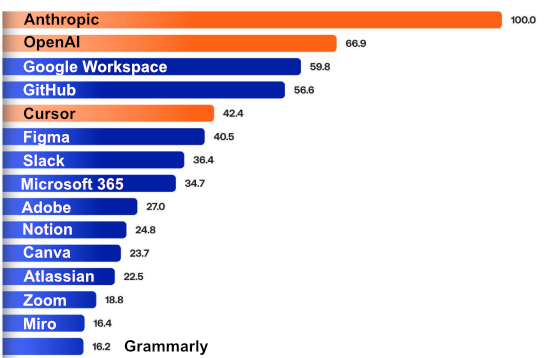
Okta, an identity management platform provider, analyzed anonymized access data from over 20,000 companies and found that Anthropic has the highest growth rate in enterprise AI tool adoption over the four-year period from June 2022 to June 2026, with a score of 100 compared to OpenAI (66.9), Google Workspace (59.8), GitHub (56.6), and Cursor (42.4).
Why it matters
Microsoft 365 currently leads in total enterprise account count, but Google Workspace is rapidly catching up. Meanwhile, Anthropic's enterprise accounts are projected to grow sharply from January 2026 onward, while OpenAI and Cursor's growth is moderating—signaling a shift in how enterprises are adopting and distributing their AI spending across multiple vendors. About 57% of enterprises are now using two or more AI platforms simultaneously, choosing tools based on what works best for their needs.
What to watch
The analysis covers foundation models, developer tools, enterprise search, collaboration and productivity, voice transcription and meeting AI, and creative suites—but excludes vertical-specific business systems, AI via cloud infrastructure, and cybersecurity AI. Okta's data spans the largest publicly visible cohort of enterprise AI adoption to date.
Summaries like this, in your inbox every morning.
Okta's analysis, based on data from over 20,000 enterprises, offers one of the largest real-world windows into enterprise AI adoption trends. The divergence between growth rate and absolute account count tells a clear story: while Microsoft 365 maintains the largest enterprise footprint (benefiting from deep Office integration), newer or more specialized AI vendors are growing faster. Anthropic's four-year growth rate of 100—more than 50% higher than OpenAI's 66.9—reflects rapid adoption of Claude among enterprises since the model's launch, while OpenAI's slower relative growth may reflect market saturation or switching behavior as enterprises evaluate alternatives.
The finding that 57% of enterprises use multiple AI platforms simultaneously signals a structural shift away from "best-of-breed" consolidation and toward a composable AI stack. Companies are no longer waiting for one vendor to solve all AI needs; instead, they are choosing Anthropic for certain tasks, Microsoft for others, Google for still others. This fragmentation is particularly visible in the diverging trajectories after January 2026: Anthropic accounts are projected to accelerate sharply, while OpenAI and Cursor show moderating growth—a sign that enterprises are actively rebalancing their AI portfolios. The scope limitations (excluding vertical-specific systems, cloud-delivered AI, and security AI) mean this data captures primarily horizontal AI tools, not the full enterprise AI market, but within that segment, the competitive intensity and specialization are clear.
For example, today's edition would include:
AI-summarized, only the topics you pick — one digest a day via Email, LINE, or Slack.
Free · 30 seconds with Google · unsubscribe anytimeWhat is AIToday? →
Ask AI anything about this article. Q&As are published on this page for other readers too.
Rosenblatt initiated coverage of Sandisk with a Buy rating and a $2,400 price target

Visa's Sara Craven told PYMNTS that just 11% of small- to medium-sized businesses qualify as agent-ready, vers…

Applied Materials trades near US$444.57 at about 38.1x earnings, below the semiconductor sector average of rou…
JPMorgan Chase CEO Jamie Dimon told CNBC-TV18 that hyperscaler AI spending has more than doubled from about $3…

Heartland Advisors' Q2 2026 investor letter said Texas Instruments' data center power management revenues rose…
GE Vernova CEO Scott Strazik told analysts the company expects to be "mostly sold out through 2030", with 2031…