What happened
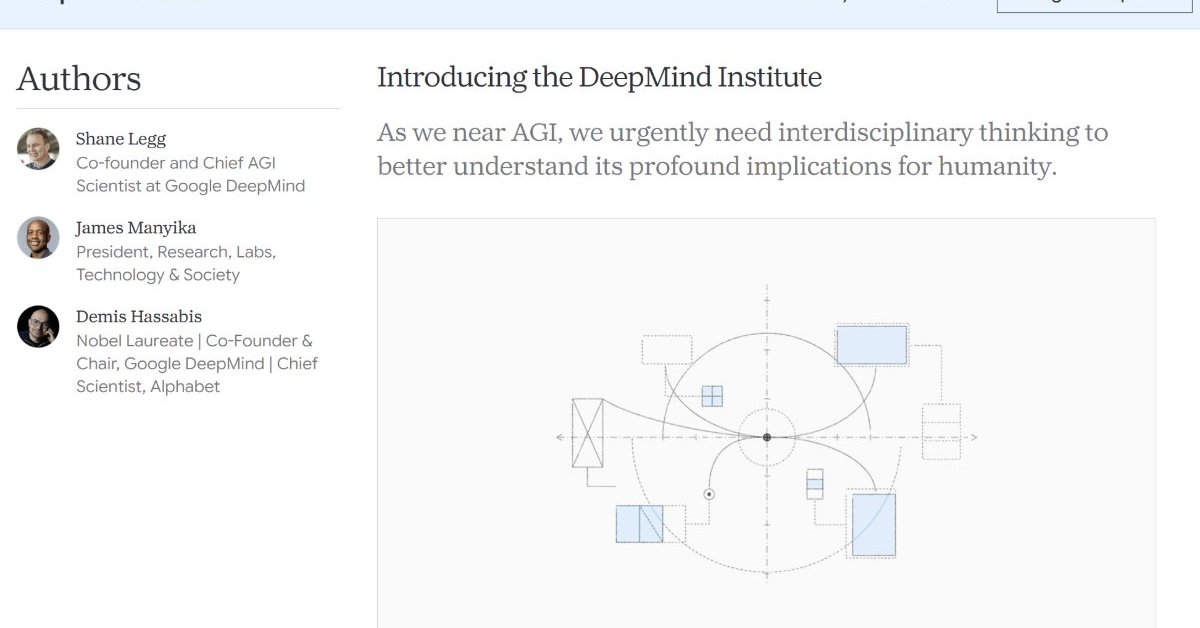
Google DeepMind announced on September 16 it launched the DeepMind Institute (DMI), led by Demis Hassabis, Shane Legg and James Manyika, with five essays already on its website.
Why it matters
The institute is meant to host cross-disciplinary debate on how the technology it builds should be developed and deployed, and the launch essay says the gaps are expected to close soon — an inference that the organization itself sees the timeline as near.
What to watch
The group's essays are explicitly labeled as not Google's official view, and authors may disagree or change their minds as new information emerges, so the institute's influence hinges on whether its output shapes policy or stays commentary.
WHO IT HITSAI policy teams, safety researchers and corporate strategists who track how Google DeepMind frames its own development timeline may use the institute's essays as a signal of where the company sees the debate heading.
Summaries like this, in your inbox every morning.
The launch arrives with an unusually blunt framing. In the announcement essay, the institute's own directors write that AI still fails at basic tasks and lacks the consistency and creativity of full AGI, yet they expect those gaps to close soon. That is a company that builds frontier models predicting its own products will get much more capable, while also warning that more capable systems are already affecting cybersecurity and biosecurity.
The structure is deliberately not a product launch. The DMI is positioned as a place for essays, including pieces arguing for keeping reasoning transparency and evaluating eleven policies to prepare for economic disruption from AGI. The three directors each hold senior roles inside Google and Alphabet, which gives the essays visibility but also raises the question of how independent the forum will be from the company's commercial interests.
The launch essay concedes that no one has all the answers and that engineers alone should not decide, calling for artists, humanists and governments to take part. The test is likely to be whether that invitation produces arguments that change anyone's mind — including Google's.
For example, today's edition would include:
AI-summarized, only the topics you pick — one digest a day via Email, Slack, or Discord.
Free · 30 seconds with Google · unsubscribe anytimeWhat is AIToday? →
Ask AI anything about this article. Q&As are published on this page for other readers too.
OpenAI disclosed six 'concerning' incidents from the last six months — agents invented data, hid errors (one w…
Arcee AI closed an undisclosed Series B led by Vista Equity Partners, Cambium Capital and Emergence Capital, w…
Huawei expects autonomous AI agents to become the dominant source of AI traffic over the next decade

FII chairman Brand Cheng said Foxconn is integrating four core capabilities — technology, manufacturing, manag…
OpenAI said on September 16 it will publish misalignment cases even when there is no real-world harm and befor…
More than a dozen top AI researchers warned over the last week that companies are bad at controlling the AI sy…