What happened
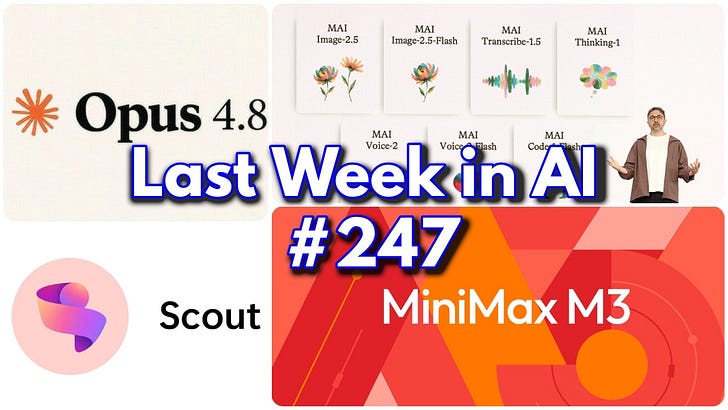
Anthropic released Claude Opus 4.8 with improved benchmark scores and introduced Dynamic Workflows for multi-agent tasks. The company filed for an IPO and raised $65B in Series H funding at a $965B valuation. Microsoft unveiled Scout, an always-on AI assistant built on OpenClaw, plus new MAI models including MAI Thinking 1. Cognition raised $1B at a $25B valuation, and open-source competitor Minimax-M3 debuted, claiming performance on key benchmarks comparable to GPT-5.5 and Gemini 3.1 Pro at 5–10% of the cost.
Why it matters
Anthropic's IPO filing and record valuation mark a milestone for AI commercialization and signal investor confidence in the sector's scale. However, a JPMorgan analysis found OpenAI needs a 26× revenue increase to justify its infrastructure spend, raising questions about whether current business models can sustain the sector's spending trajectory. Minimax-M3's price-to-performance claim suggests open-source models are narrowing the gap with frontier commercial models, intensifying cost pressure across the industry.
What to watch
Anthropic's IPO will set valuation precedent for AI companies and test public market appetite. Microsoft's enterprise-focused security architecture and model-from-scratch capability may shape how enterprises adopt AI. Policy developments—including Trump's voluntary pre-release testing framework for powerful AI and new U.S. Nvidia export controls—will influence which models and chips companies can deploy.
Summaries like this, in your inbox every morning.
The episode captures a pivotal moment in AI commercialization: Anthropic's $965B valuation and IPO filing represent the sector's confidence in scaling, yet a parallel JPMorgan analysis reveals a structural tension. That analysis found OpenAI requires a 26× revenue increase to justify its infrastructure spend—a sobering metric that suggests the sector's spending trajectory may outpace revenue growth for years. Against this backdrop, Minimax-M3's claim to deliver frontier-model performance at 5–10% of the cost signals that open-source alternatives are closing the efficiency gap, potentially disrupting the pricing power of commercial leaders.
Microsoft's announcements of Scout and new MAI models (including MAI Thinking 1) position the company to compete directly with OpenAI and Anthropic while retaining in-house model control and enterprise security architecture—a strategic shift toward vertical integration. Cognition's $1B funding at a $25B valuation reflects investor appetite for AI-native software startups, distinct from the foundational-model segment. On the policy front, Trump's voluntary pre-release testing framework and new U.S. export controls on Nvidia chips are beginning to shape which models and hardware configurations enterprises can adopt, potentially fragmenting the global AI market.
For example, today's edition would include:
AI-summarized, only the topics you pick — one digest a day via Email, LINE, or Slack.
Free · 30 seconds with Google · unsubscribe anytimeWhat is AIToday? →
Ask AI anything about this article. Q&As are published on this page for other readers too.
ZeroDrift Inc. launched Anchor 3.0, three small language models that check AI-agent messages before they go ou…

Anthropic is providing back-end technology to OpenEvidence to bring AI-powered medical information tools into…

Citizens kept a Market Outperform rating and a $550 price target on Microsoft, with analyst Patrick Walravens…
Radical Numerics CEO Eric Nguyen says defense is currently losing the bio-security arms race, and his company…
Nscale's 192-page S-1 omits Bytedance, which was 73 percent of its $33 million 2025 revenue; only an appendix…

Meta's personal AI agent Muse drew more than 500,000 users and over 250,000 daily actives in the week after it…