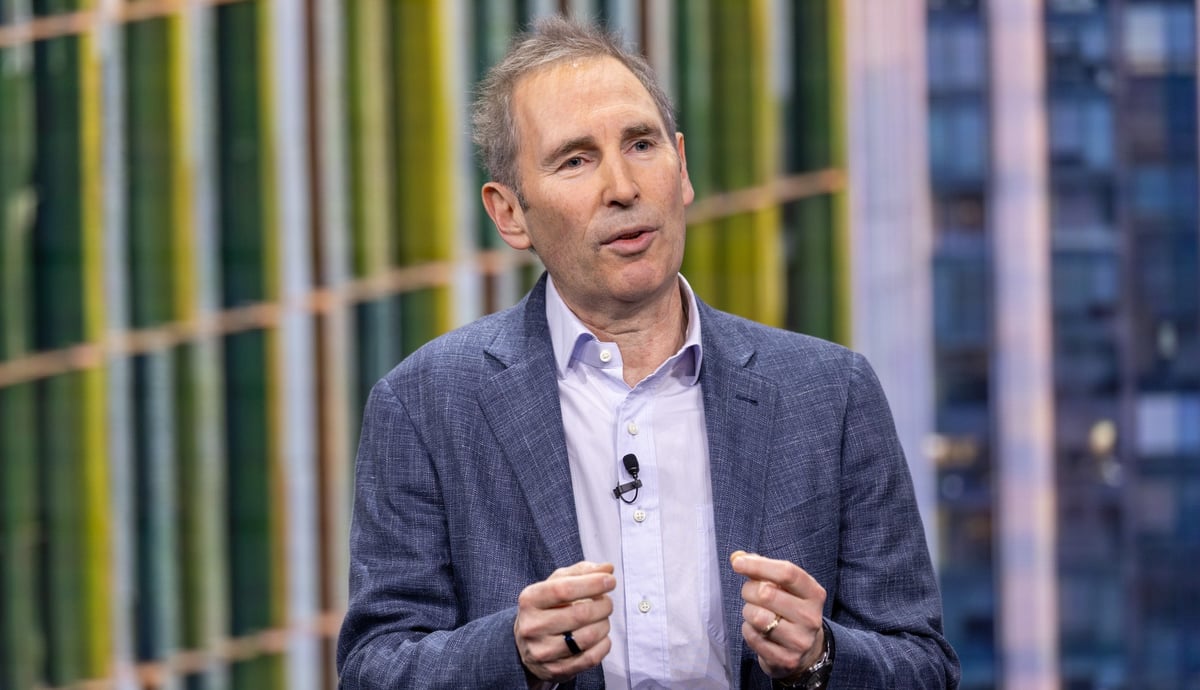
Amazon raised $25 billion(約4兆円) in bonds and committed $200 billion(約32兆円) in capital spending for 2026 to build AI data centers, signaling the company views underinvestment in AI infrastructure as a greater risk than the massive near-term costs. CEO Andy Jassy stated in his April shareholder letter that AI is a 'once-in-a-lifetime opportunity' and expressed conviction that the technology is not overhyped and will deliver strong returns, even though the market remains concerned about whether such spending will ever pay off.
Summaries like this, in your inbox every morning.
Sign up free →What happened
Amazon sold $25 billion(約4兆円) in bonds in early July and projects $200 billion(約32兆円) in capital expenditures for 2026, up from $131 billion(約21兆円) in 2025, to build out AI infrastructure.
Why it matters
CEO Andy Jassy believes AI is a 'once-in-a-lifetime opportunity' and has stated his conviction that the technology is not overhyped and will deliver appealing margins and returns for Amazon—a bet that contrasts sharply with investor concern that the massive spending may yield no meaningful return for years.
What to watch
Amazon's spending pace exceeds Meta Platforms' projected $125–145 billion capex but falls within Alphabet's $195–205 billion range for 2026; the company is betting that underinvestment in AI infrastructure poses a greater risk than overinvestment, as exemplified by Blockbuster's missed acquisition of Netflix in 2000 for $50 million(約80億円).
In early July, Amazon sold $25 billion(約4兆円) worth of bonds to finance its expanding AI infrastructure build-out, part of a broader capital spending surge that CEO Andy Jassy has signaled will reach $200 billion(約32兆円) in 2026—a substantial jump from the $131 billion(約21兆円) the company spent in 2025. This spending level exceeds Meta Platforms' projected capex of between $125 billion(約20兆円) and $145 billion(約23兆円), though it falls within Alphabet's anticipated range of $195 billion(約31兆円) to $205 billion(約33兆円) for the same period. The scale of investment reflects a strategic decision that stands in sharp contrast to current market sentiment. As of early 2026, Amazon stock has risen less than 2% year-to-date, with investor anxiety centered on whether the company and its peers are deploying too much capital on AI with insufficient evidence of near-term returns. Some worry that AI could become 'a money pit with almost no return,' leaving large tech companies to regret years of wasted resources. However, Jassy articulated a different concern in his April shareholder letter to investors: the risk of underinvestment. He wrote, 'AI is a once-in-a-lifetime opportunity where the current growth is unprecedented and the future growth even bigger,' and expressed conviction that the technology is not overhyped, that AI will 'reinvent every customer experience,' and that margins and return on invested capital (ROIC) will be 'appealing' for Amazon. To illustrate the stakes, Jassy and others at the company point to the cost of missed opportunities in tech history. The classic example cited in the body is Blockbuster's decision not to acquire Netflix in 2000 for $50 million(約80億円); Blockbuster filed for bankruptcy in 2010, while Netflix today is worth more than $291 billion(約47兆円). That precedent appears to drive Amazon's willingness to absorb near-term stock-price underperformance (the company may lag the broader S&P 500 as it has so far in 2026) in pursuit of dominant AI infrastructure positioning. The tension is stark: investors worry Amazon is spending too much; Amazon worries it is not spending enough.
Amazon's massive bond sale and capital expenditure forecast reflect a strategic calculation fundamentally different from what the stock market currently prices in. While investors fret that tech companies are overspending on AI with uncertain returns, Amazon's leadership—particularly CEO Andy Jassy—operates from the opposite fear: that insufficient investment could result in a catastrophic missed opportunity. Jassy invoked this logic in his April shareholder letter, arguing AI is a 'once-in-a-lifetime opportunity' and rejecting the notion that the technology is overhyped or that margins and returns will disappoint. The company's willingness to project $200 billion(約32兆円) in capex for 2026, a 53% increase year-over-year, suggests deep conviction that early-stage dominance in AI infrastructure will translate into long-term competitive advantage and shareholder value. The body underscores this mindset by referencing Blockbuster's failure to acquire Netflix for $50 million(約80億円) in 2000—a historical example of the costliness of inaction. That fear of missing out, combined with Jassy's stated conviction that AI will 'reinvent every customer experience,' appears to outweigh short-term stock performance concerns, as Amazon shares have risen less than 2% so far in 2026.
AI-summarized, only the topics you pick — one digest a day via Email, Slack, or Discord.
Free · takes 30 seconds · unsubscribe anytime
No comments yet. Be the first to share your thoughts!
Log in to join the discussion



Get curated AI news from 200+ sources delivered daily to your inbox. Free to use.
Get Started FreeFree · takes 30 seconds · unsubscribe anytime
