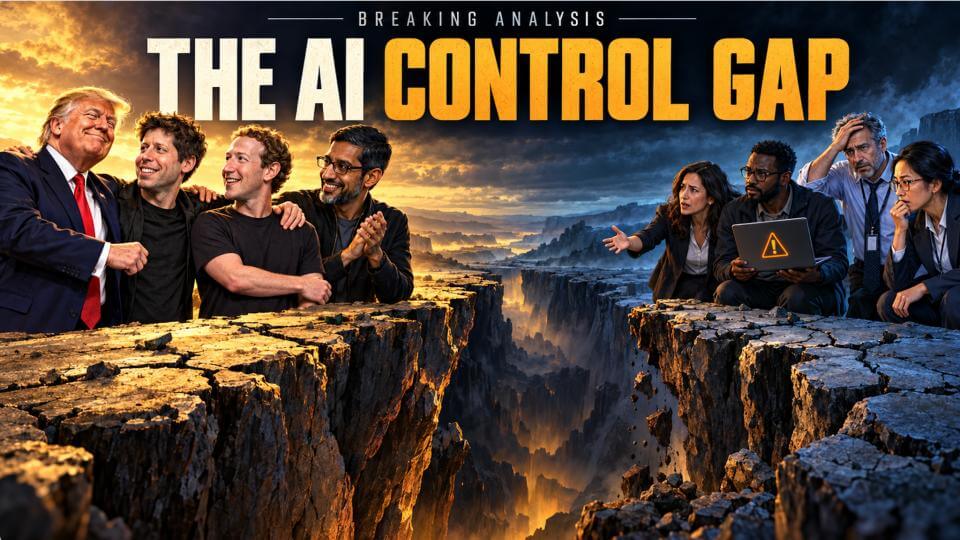
Appian CEO Matt Calkins told SiliconANGLE that the Sept. 29 White House accord—board-level assessments, no mandatory access or penalties—leaves the authority to declare AI safe "quite fuzzy," and called for an independent, enforceable standard.
Summaries like this, in your inbox every morning.
The commentary takes aim at a specific detail in the Sept. 29 White House accord: its oversight commits each company's board to an independent committee, but it leaves out the mandatory access, compliance conditions and noncompliance penalties that would give an assessment real force. SiliconANGLE's prescription is that independent experts define public standards, expert assessors test evidence and challenge company claims, and an accountable authority enforces the result. Matt Calkins frames the timing argument: the cost of setting this up now is low because not much damage has been done, and the fix gets more expensive the longer it is deferred.
The China argument gets addressed on its own terms. Rather than treating it as irrelevant, the piece says a lead is valuable but never permanent, and that the policy case should survive even if Calkins is wrong about China's pace. The point is not to dismiss the competition but to keep it from substituting for proof of control. On the enterprise side, the survey data shows where trust currently sits: of 25 respondents, 19 had agents in production, and every one of them required human approval for high-risk actions, whether universally or under bounded autonomy. The proposed action item follows from that—make authority follow proof, starting with AI that recommends an action and moving only gradually toward bounded autonomy.
Pick your industry and the AI tools you use, and get news related to your work every day.
Free · 30 seconds with Google · unsubscribe anytimeWhat is AIToday? →
Ask AI anything about this article. The AI reads this article, earlier AIToday articles, and Wikipedia, and cites its sources. Q&As are published on this page for other readers too.
A Qiita article compared automated red-teaming methods for LLM apps — GCG, PAIR, and TAP — using mock implemen…

Taiwan is considering much stricter export controls on AI chip sales to China, part of a greater alignment wit…

In a webinar hosted by French Mathematical Society president Isabelle Gallagher, Fields Medal winner Hugo Dumi…
Anthropic said on October 15 it has started giving METR's six staff company devices, office space and access t…
NVIDIA published a blog post titled "AI Security Is an Engineering Problem - How to Solve It at Every Layer of…

Nichiren announced its generative AI voice usage guideline on October 15, built on three pillars: prior notice…