
What happened
A Qiita author published an explainer showing that unscaled Attention (Attention(Q, K, V) = Softmax(QK^T)V) makes dot products vary wildly as dimensions grow — like d = 512 producing scores from 1000 to 3000 — and that Softmax then saturates to 100% and 0%, killing gradients.
Why it matters
When Softmax outputs stick at 100% and 0%, the gradient becomes nearly zero, so the model loses the signal on how to adjust weights and training stalls (vanishing gradient).
Summaries like this, every morning.
The explainer builds from the original Attention formula without scaling, Attention(Q, K, V) = Softmax(QK^T)V, and walks through two failure steps. First, as the dimension d grows, the dot product QK^T sums more terms, so its spread grows dramatically — compare d = 3, where scores stay within 10 to 20 points, with d = 512, where scores can range from 1000 to 3000. Second, Softmax receives these widely varying scores and pushes the largest to nearly 100% while the rest fall to nearly 0%, which flattens the gradient to almost zero and stops learning.
The natural question then is why divide by √d rather than by d. It argues that because positive and negative terms partially cancel, the actual spread grows with √d, not d; dividing by d would shrink too much. The coin-toss game makes this concrete: after 100 tosses, the expected distance from the start is about √100 = 10 steps, which is exactly the standard deviation. So dividing by √d restores the scores to a well-behaved size before Softmax, preventing vanishing gradients and keeping training going.
Pick your industry and the AI tools you use, and get news related to your work every day.
Free · 30 seconds with Google · unsubscribe anytimeWhat is AIToday? →
Ask AI anything about this article. The AI reads this article, earlier AIToday articles, and Wikipedia, and cites its sources. Q&As are published on this page for other readers too.
In a paper by Princeton University and Snowflake researchers, Soteria checked agent plans with the Dafny verif…

Bloomberg's Mark Gurman, summarized by MacRumors, said Apple's recent Siri layoffs targeted the assistant's ol…

Gomumari Inc. will begin providing its proofreading AI agent on November 23, 2026, at an initial build cost st…

The explainer lays out three layers — commerce (OpenAI/Stripe's ACP, Google/Shopify's UCP), delegation proof (…

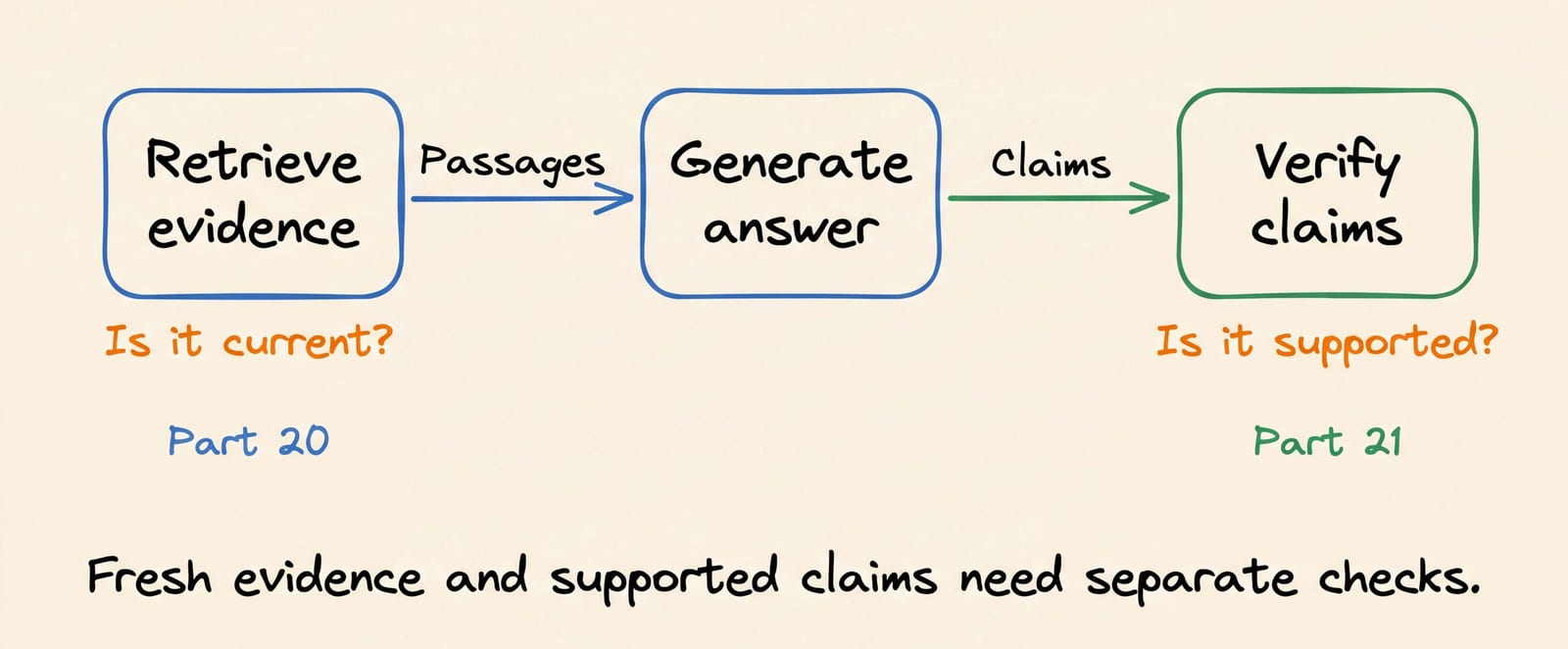
Parts 20 and 21 of the hands-on RAG Systems course are now available
Anthropic introduced Claude for Manufacturing on November 12, a plugin for Claude Team or Enterprise plans tha…