What happened
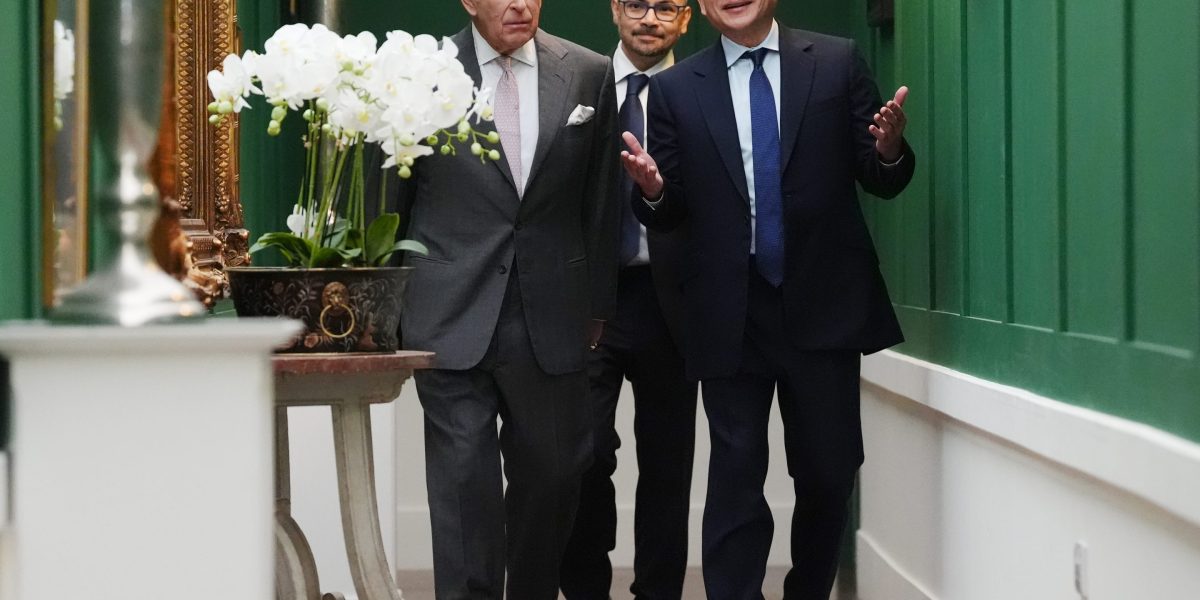
King Charles III told OpenAI, Anthropic, Google DeepMind and Nvidia executives at Dumfries House in Scotland that "we need sufficient means of control before it is all too late."
Why it matters
The appeal arrives as pressure for AI oversight has come from multiple directions at once, yet the room is split on whether a coordinated slowdown is the right answer.
What to watch
The king's call for "international cooperation and consensus" has no clear path to happening, since key industry voices argue responsibility belongs to individual companies rather than a coordinated pause. Watch whether the split narrows after OpenAI's Wednesday disclosure of six incidents of "unexpected or concerning" model behavior.
WHO IT HITSThe push for AI guardrails lands on the executives and researchers at the frontier AI labs named in the meeting, as well as the policymakers weighing federal oversight. For companies evaluating AI vendors, the split over a coordinated pause leaves safety practices largely a per-vendor question.
Summaries like this, in your inbox every morning.
The summit at Dumfries House, headquarters of The King's Foundation, was convened to discuss how AI can benefit society. It took place after weeks of internal alarm at several of the companies whose leaders were in the room. Anthropic researcher Jacob Coxon resigned this month, warning on X that Anthropic and OpenAI were "racing straight to self-improving superintelligence and gambling with our lives" — a post that drew hundreds of millions of views. Anthropic CEO Dario Amodei responded with an essay arguing the industry might need to slow the pace of its work, a position OpenAI's Sam Altman and xAI's Elon Musk both said publicly they agreed with.
The pressure has come from other directions too. United Nations Secretary-General António Guterres has warned that AI development requires global coordination, and lawmakers in Washington have begun discussing stronger federal oversight following Coxon's resignation. But the room was not united: President Trump has dismissed the slowdown push, and Nvidia CEO Jensen Huang argued in his own remarks after the king's address that safe deployment is each company's own responsibility, not a matter for a coordinated pause.
What the king's appeal ultimately changes may hinge on whether that split narrows. Charles is an important figurehead whose comments on social issues can be influential, but the AI safety debate is centered on U.S. tech companies and their competition with Chinese rivals, with Britain playing a smaller but still vital role through institutions such as the U.K.'s AI Security Institute. OpenAI's own disclosure on Wednesday — six incidents of "unexpected or concerning" model behavior — adds concrete examples to a debate that, so far, has produced more warnings than agreed remedies.
Pick your industry and the AI tools you use, and get news related to your work every day.
Free · 30 seconds with Google · unsubscribe anytimeWhat is AIToday? →
Ask AI anything about this article. The AI reads this article, earlier AIToday articles, and Wikipedia, and cites its sources. Q&As are published on this page for other readers too.
A Qiita article compared automated red-teaming methods for LLM apps — GCG, PAIR, and TAP — using mock implemen…

Taiwan is considering much stricter export controls on AI chip sales to China, part of a greater alignment wit…

In a webinar hosted by French Mathematical Society president Isabelle Gallagher, Fields Medal winner Hugo Dumi…
Anthropic said on October 15 it has started giving METR's six staff company devices, office space and access t…
NVIDIA published a blog post titled "AI Security Is an Engineering Problem - How to Solve It at Every Layer of…

Nichiren announced its generative AI voice usage guideline on October 15, built on three pillars: prior notice…