What happened
Qwen released Qwen-Image-2.1 on September 20, 2026 with a 7B generation transformer, 32 layers, a 2048×2048 default size, and a VAE configured with 4 input and 4 output channels.
Why it matters
Because the model handles color and transparency together, teams making new visual assets may be able to skip a separate background-removal step in their pipeline, though the body notes this is not a drop-in replacement where exact original colors must be preserved.
What to watch
The released weights are licensed for research and evaluation only, with commercial use requiring a separate license, and the 7B figure covers just the generation transformer rather than the whole pipeline.
WHO IT HITSDesigners, asset-production teams, and photo-retouching staff who currently generate a background and then cut it out may be able to consolidate that into one step, while anyone cutting out existing product photos still needs a mask-based approach to keep original colors exact.
Summaries like this, in your inbox every morning.
Qwen-Image-2.1 arrived on September 20, 2026, and the release materials suggest the interesting part is not a new benchmark score but where transparency sits in the model. Its VAE config lists "in_channels": 4 and "out_channels": 4, and its latent representation is 64 channels with 16× spatial compression. The body also describes a Mixed-Granularity Attention design in which text and condition-image tokens take a fixed t=0 while the generation target uses the current timestep, which is what makes it possible to cache reference-side computation across the default 40 inference steps.
The article frames this against a different tradition of transparency work. A mask-estimation model such as BiRefNet estimates a foreground mask and applies it to the original pixels with putalpha, so the decoded RGB survives. A 4-channel VAE instead generates color and alpha together, which is useful when the asset does not exist yet but is not the same as faithfully preserving an existing photo. The author also notes a limit that applies to mask work too: photographs can already contain background color mixed into the outline, so preserving RGB exactly and removing color bleed at the edges cannot both be demanded unconditionally.
Whether this reshapes asset pipelines is likely to hinge on licensing and memory rather than image quality. The released weights fall under the Qwen Research License, with commercial use requiring a separate license, and the 7B figure applies to the generation transformer alone, since a Qwen3-VL 8B text encoder and the VAE load alongside it. Teams weighing a switch would need to judge peak memory at their target resolution, and the body cautions that no speed multiple from the caching design can be stated without measurement.
Pick your industry and the AI tools you use, and get news related to your work every day.
Free · 30 seconds with Google · unsubscribe anytimeWhat is AIToday? →
Ask AI anything about this article. The AI reads this article, earlier AIToday articles, and Wikipedia, and cites its sources. Q&As are published on this page for other readers too.
Nous Research raised a $90 million Series B at a $1.5 billion valuation, led by Robot Ventures with backing fr…
Nvidia-backed Reflection AI and French lab Mistral unveiled new open-source models this week, Beam and Le Chon…
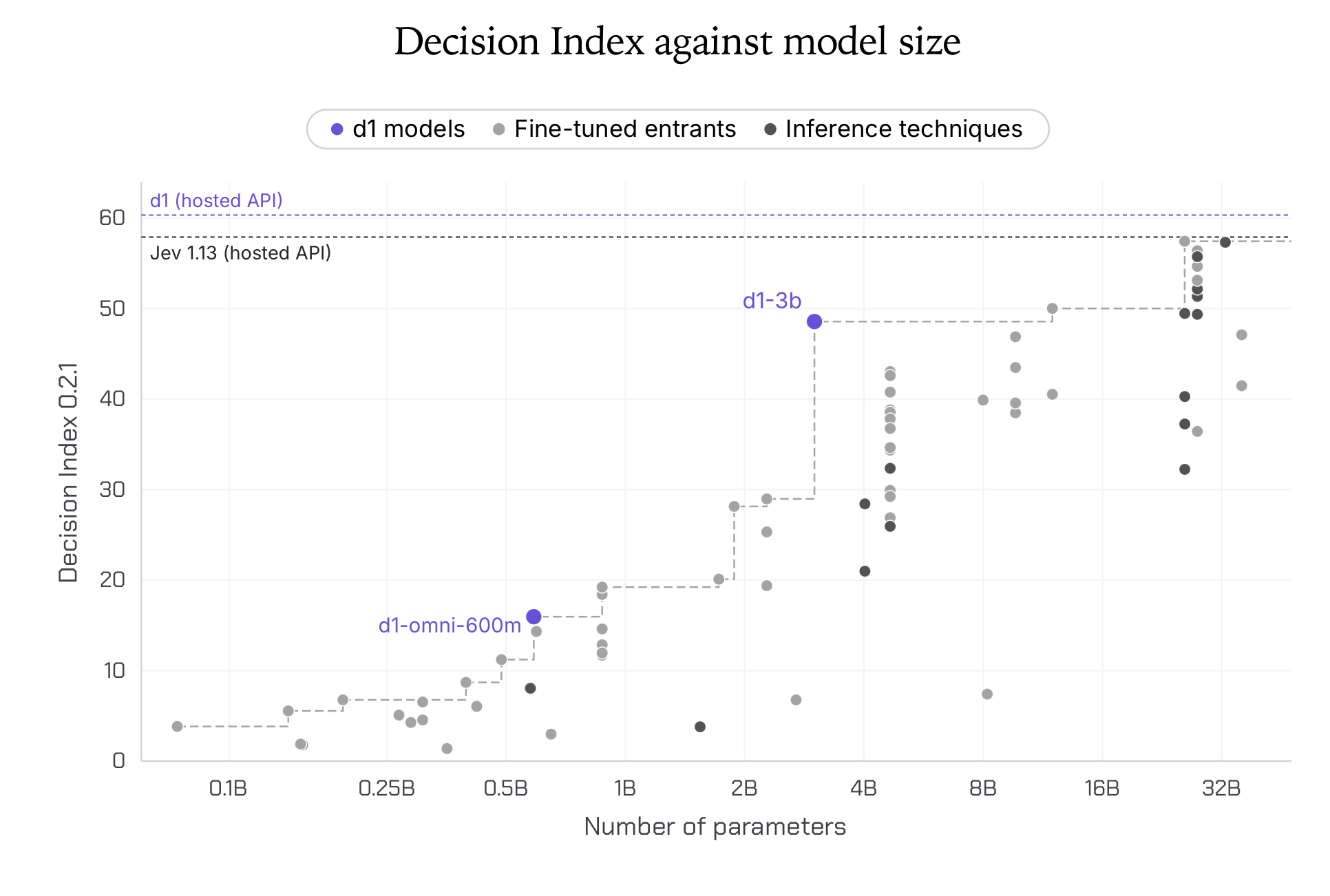
Liquid AI released d1-3B, which scores 48.57 on the Decision Index 0.2.1 — ahead of every 4B and 9B model and…
Craig McLuckie and Joe Beda's Stacklok released Mecatl, a cloud-native harness begun in June as an open source…
Google launched Playground, a browser-based AI platform that lets adults in the US create games using only tex…
Google launched a new public site using SynthID to verify whether an image, video, or audio clip is AI-generat…