What happened
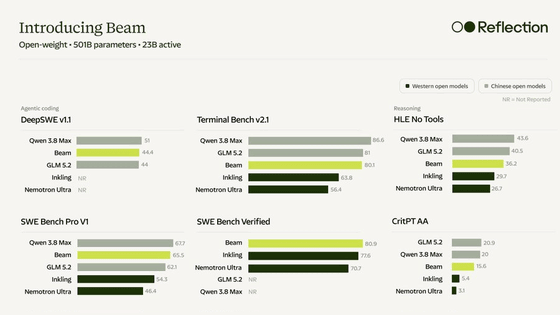
Reflection, a New York AI company with a $25 billion valuation, launched Beam, its first open model. It says Beam matches GLM-5.2 on benchmarks and runs three to four times more efficiently than rival Western open models.
Why it matters
Beam is a Western open model that its maker says reaches competitive performance at a lower token cost and inference time, positioning it as a workhorse for enterprises and developers. That could give buyers a cheaper alternative to other open models, though the benchmark claims are Reflection's own and not yet confirmed by outside evaluators.
What to watch
Whether Beam's claimed efficiency and benchmark parity hold up under independent testing, since Reflection conducted the benchmark tests itself. The company says it is already training a larger next model.
WHO IT HITSEnterprise AI teams and developers evaluating open models for coding and agentic tasks may gain a cheaper option, though the efficiency and benchmark claims come from Reflection's own tests and are not yet independently verified.
Summaries like this, in your inbox every morning.
Reflection's Beam arrives in a market where China's open models, such as Kimi K3 from Moonshot and DeepSeek's V4, have been the most widely used. By claiming benchmark parity with Z.ai's GLM-5.2, the company is positioning Beam as a Western open alternative that can compete on performance. Reflection says it made Beam efficient through high-compute reinforcement learning, delivering competitive results on coding and agentic tasks at a fraction of the token cost and inference time.
The company has moved quickly to secure the infrastructure to support its models. In June it signed a $6.3 billion compute deal with SpaceX for access to Nvidia GB300 chips, and in July it added a $1 billion deal via cloud provider Nebius. It also entered a partnership in May to supply models to the U.S. Department of Energy and the U.S. Department of War, signaling an early focus on public-sector customers.
How much Beam changes the open-model landscape may hinge on whether independent tests confirm Reflection's benchmark and efficiency claims, since the company conducted the benchmarks itself. If they hold up, Beam could become a serious option for enterprises drawn to open models for data control and cost reasons, even as proprietary models from OpenAI, Anthropic, and Google DeepMind continue to lead in performance.
Pick your industry and the AI tools you use, and get news related to your work every day.
Free · 30 seconds with Google · unsubscribe anytimeWhat is AIToday? →
Ask AI anything about this article. The AI reads this article, earlier AIToday articles, and Wikipedia, and cites its sources. Q&As are published on this page for other readers too.
Ghost AI raised $11 million, led by Andreessen Horowitz with Abstract, Audacious Ventures, Nova and SV Angel…

Moonshot AI closed its final private round at about a $50 billion valuation and is aiming for a Hong Kong IPO…

OpenAI told Fortune it is piloting a 'mission interview' for candidates on certain teams, starting with market…

Reactor said it added Nvidia's venture capital arm and Sapphire Ventures to its cap table, bringing its total…

OpenAI will roll out invisible text watermarks to all ChatGPT and Codex plan users in the EU within weeks, and…

Reflection announced Beam, a 501B-parameter open-weight model with 23B active parameters, claiming parity with…