What happened
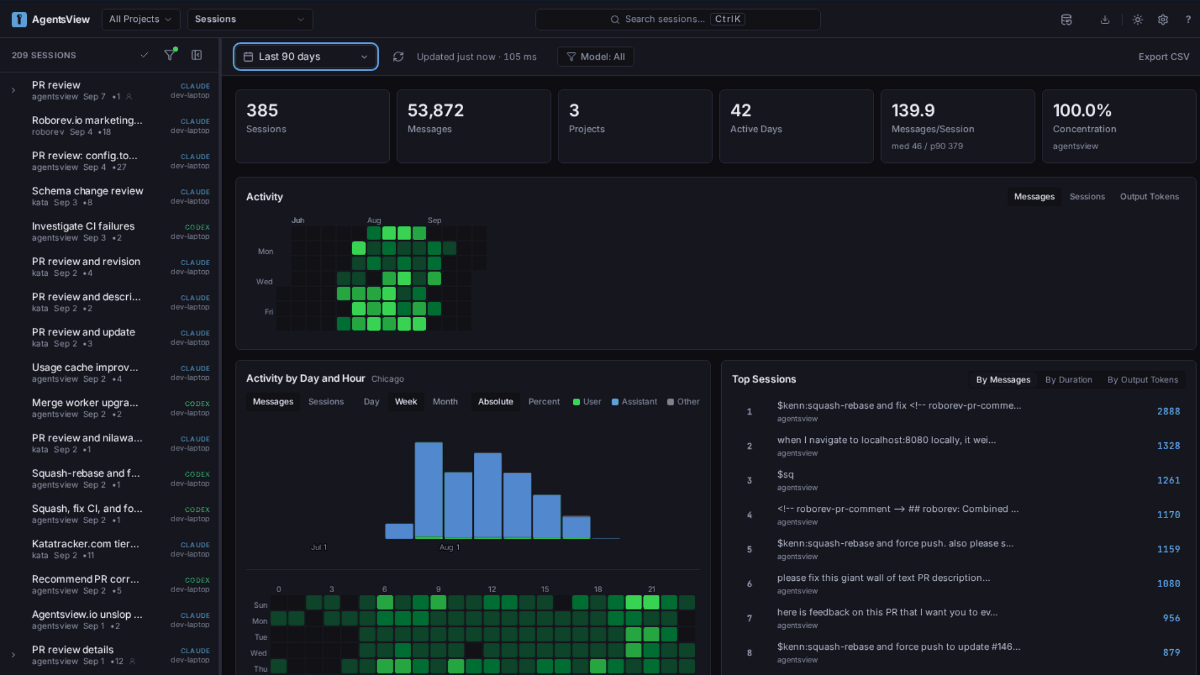
AgentsView automatically detects the local logs of Claude Code, Codex, Cursor, Copilot, Gemini and 60-plus other agents, then charts token use and estimated API-rate cost by model and by day.
Why it matters
Teams running several coding agents side by side get one dashboard for what each session did and what it would cost at API rates, instead of digging through separate histories, and it runs on the user's own machine.
Summaries like this, in your inbox every morning.
AgentsView is aimed at a specific side effect of AI-assisted coding: once a developer runs Claude Code, Codex, Cursor, Copilot or Gemini in parallel, their logs sit in separate places and there is no single view of how many tokens each one used or what that usage would cost at API rates. The tool addresses this by automatically collecting those local logs, so there is little setup work after installation, and by offering cross-agent full-text search, including working Japanese search.
Beyond usage charts and cost estimates, the dashboard shows when agents ran, how many ran at once, and active versus idle time, and an evaluation view scores tool-call failures, retries and context load. An experimental recall feature extracts reusable procedures and cautions from past conversations for the user to approve or hold. For teams, the MCP server lets an AI agent itself search past sessions, and histories from multiple PCs can be merged into PostgreSQL, with ClickHouse or DuckDB available for analysis.
The setup shown is Windows 11: a PowerShell install command followed by agentsview server and a browser at http://127.0.0.1:8080. Because everything runs locally, the data question shifts from which vendor holds the logs to the user's own machine and, optionally, their own PostgreSQL instance — something engineering leads overseeing several agents may weigh when deciding whether to adopt it.
Pick your industry and the AI tools you use, and get news related to your work every day.
Free · 30 seconds with Google · unsubscribe anytimeWhat is AIToday? →
Ask AI anything about this article. The AI reads this article, earlier AIToday articles, and Wikipedia, and cites its sources. Q&As are published on this page for other readers too.
Researchers gave models 1,600 synthetic work logs, each with a hidden flaw
OpenAI presented a 166-page potential Navier-Stokes proof in early September, saying it followed the approach…

A simulation of Crescendo, the multi-turn jailbreak by Russinovich, Salem and Eldan published at USENIX Securi…

Genomic foundation models like Evo 2, Genos and Google DeepMind's AlphaGenome learn correlations from DNA sequ…
Deutsche Bank Research predicts superintelligent AI could outperform human experts across virtually every cogn…

Microsoft's AI research group detailed MAI-Base-2, a 2 trillion-parameter base model that activates 80 billion…