What happened
On 2026年9月15日, TypeSafe AI published System One Model and opened early access to Jev, which returns only type-safe values rather than generating text.
Why it matters
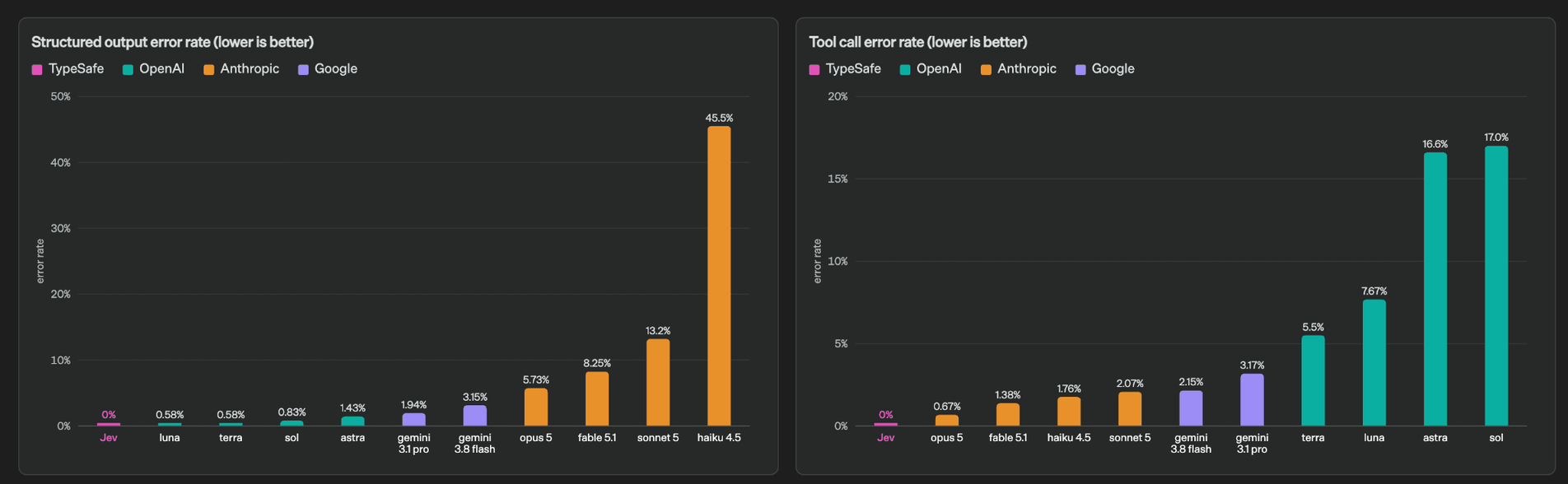
The company says Jev runs 40–200x faster on the same System One compute and produces no type or tool-call errors — the failures that break AI pipelines — which could make automation far more reliable.
What to watch
These figures are TypeSafe AI's own, and output tokens are currently offered free of charge, so the test is whether that pricing holds as developers adopt it.
WHO IT HITSDevelopers and business-automation teams integrating AI into pipelines and ERP systems — where one malformed output breaks the whole workflow — would likely be the first to test Jev.
Summaries like this, in your inbox every morning.
TypeSafe AI's approach departs from the architecture that has defined large language models. Conventional LLMs generate text token by token — a sequential sampling method where errors can accumulate and inference time scales with output length. Jev, by contrast, has its output structure fixed in advance and computes all outputs in parallel in a single query. The company says the result is 70〜500ミリ秒 for inference, compared with 3〜329秒 for conventional LLMs at equivalent quality.
The startup also introduced a training method it calls RLCD (Reinforcement Learning for Calibrated Decisions), which sits alongside RLHF and RLVR. Where those optimize for human-preferred dialogue or correct reasoning, RLCD optimizes for calibrated decisions. Jev outputs both a confidence score and uncertainty for every response, which could change how downstream systems decide whether to trust an AI's answer.
The stakes hinge on whether TypeSafe AI's benchmark claims hold up outside its own testing. The company used GPT-6 Astra and Fable 5.1 averages as the reference point and applied an OSS adapter to the comparison LLMs, but those results are self-reported and the model is only in early access. Developers working on automation — particularly those who have been blocked by type errors or hallucinated tool calls — are the audience the company is courting.
For example, today's edition would include:
AI-summarized, only the topics you pick: one digest a day via Email, LINE, or Slack.
Free · 30 seconds with Google · unsubscribe anytimeWhat is AIToday? →
Ask AI anything about this article. The AI reads this article, earlier AIToday articles, and Wikipedia, and cites its sources. Q&As are published on this page for other readers too.
Sakana AI said Jürgen Schmidhuber is joining as chief scientific advisor and will lead its new RSI Lab, which…
Microsoft's Azure revenue grew 43%, Microsoft Cloud revenue rose 27% to $59.3 billion, and Amazon's AWS second…
CrowdStrike trades near 177 times forward earnings and 167 times free cash flow, while Palo Alto Networks trad…

Nvidia CEO Jensen Huang called fears over AI's existential threats a "distraction" on The Ezra Klein Show, as…

Anthropic said Claude largely on its own found an unknown enzyme system, "ART," in DNA databases

The Forecasting Research Institute found AI reached gold-medal level at the International Mathematical Olympia…