
What happened
CrowdStrike introduced an Agentic Identity Provider that establishes what an AI agent is before deciding what it's allowed to do. It builds on Continuous Identity, the real-time authorization system detailed in June using technology from its $740 million acquisition of SGNL Inc.
Why it matters
CrowdStrike's chief marketing officer Jennifer "JJ" Johnson cited a ratio of roughly 90 AI agents for every human employee, contrasting agent identities with human identities. The announcement accompanied an expanded Agentic SOC approach that coordinates investigations across endpoint, identity, SaaS, cloud and network simultaneously.
What to watch
The test is whether CrowdStrike can move from defining agent identities to solving the unresolved human identity problem. Johnson’s framing hinges on the 90-to-1 agent-to-human ratio holding true in real deployments. Watch whether theCUBE coverage spurs adoption announcements before the next Fal.Con.
Summaries like this, in your inbox every morning.
The Agentic Identity Provider builds on CrowdStrike's Continuous Identity system, announced in June and based on the $740 million acquisition of SGNL Inc. Continuous Identity decides whether an agent should be allowed to do something at a given moment; the new provider handles the earlier step of defining what the agent actually is. Most companies currently substitute service accounts and API keys for agent identity, which the announcement implies is inadequate.
The launch coincides with a broader push CrowdStrike calls the next evolution of its Agentic SOC. This approach coordinates investigations across endpoint, identity, SaaS, cloud and network simultaneously, reflecting how agents now move compared with the sequential attacks security teams previously chased. "Defending AI with AI at machine speed means you have to get visibility and look cross-domain and act on that simultaneously," Johnson said.
The human identity angle adds context. Johnson recounted a CISO saying the identity problem was never solved for humans, and she framed agent identity as a potential starting point that could later be reverse-engineered back to human identity.
Pick your industry and the AI tools you use, and get news related to your work every day.
Free · 30 seconds with Google · unsubscribe anytimeWhat is AIToday? →
Ask AI anything about this article. The AI reads this article, earlier AIToday articles, and Wikipedia, and cites its sources. Q&As are published on this page for other readers too.
OpenAI says Calif researchers using GPT 5.6 Sol under its "Patch the Planet" project found the PHP2Shell flaws…
Counting the public CSVs (fetched Oct 22, 2026) showed HarmBench's 400 text prompts contain 0/400 lines with n…

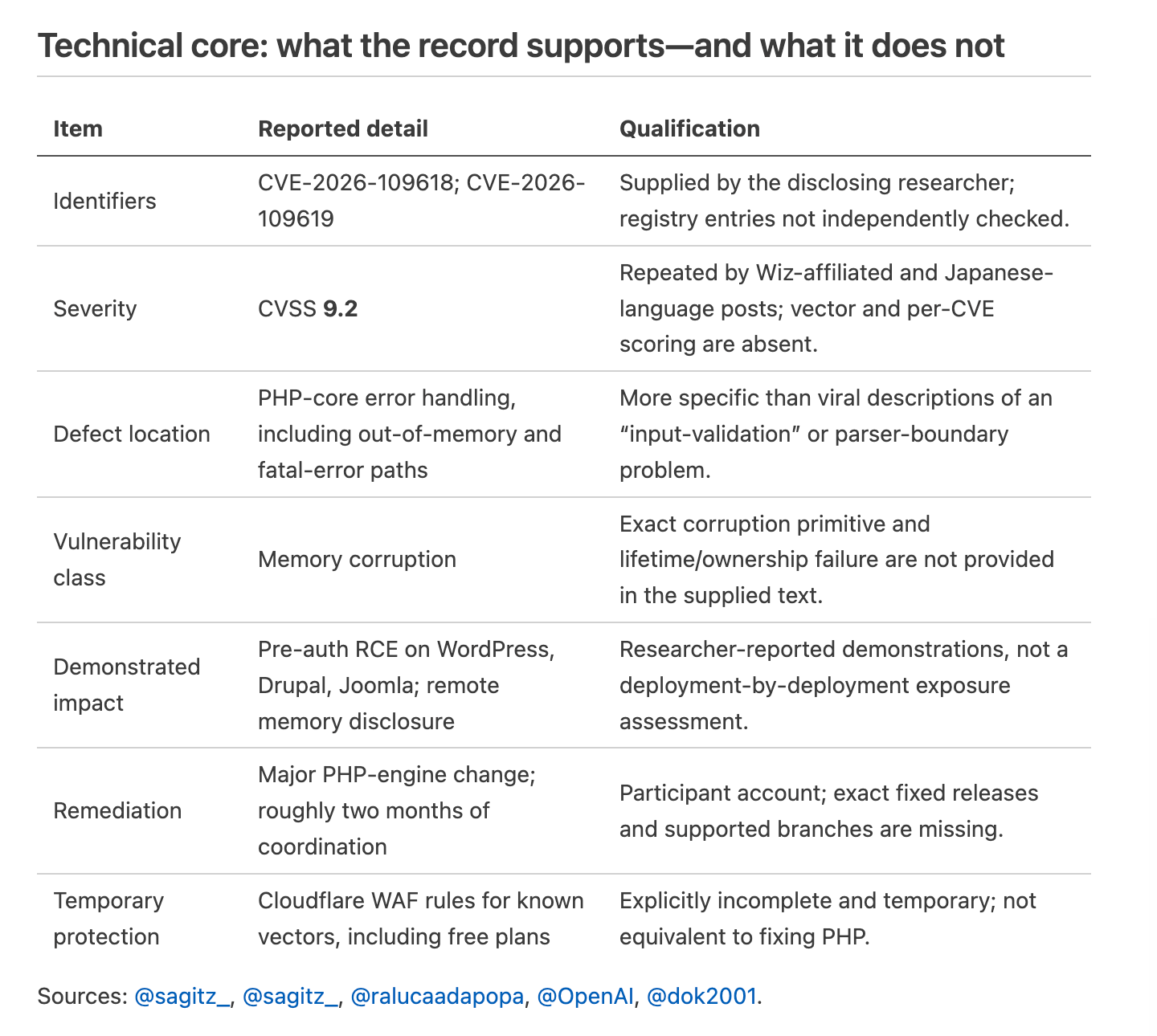
OpenAI's GPT-5.6 Sol found two critical PHP vulnerabilities, CVE-2026-109618 and CVE-2026-109619, collectively…

SafeDep found malicious files in all seven packages of LiteLLM 1.107.0, published on PyPI on October 21, 2026…

A LessWrong essay warns that autonomous researchers — which OpenAI says it aims to fully automate by March 202…

Anthropic used Claude to analyze 25 open-source projects (over 5 million lines) and found 493 issues, includin…