What happened
SafeDep found malicious files in all seven packages of LiteLLM 1.107.0, published on PyPI on October 21, 2026 and pulled about two hours later, while the GitHub source stayed clean.
Why it matters
The tampered package does not match the clean code developers can inspect on GitHub, so anyone who installed it should treat the environment as potentially exposed and rebuild it.
WHO IT HITSDevelopers and IT teams that pulled LiteLLM from PyPI, and anyone sharing those Python environments, may need to rotate credentials; the team also warns against starting with a normal update, because it can re-trigger the malicious files before they are removed.
Summaries like this, in your inbox every morning.
The incident stands out because the malicious code did not need LiteLLM to be running. By abusing the .pth mechanism that Python uses to load settings at startup, the attackers arranged for cook.py to execute whenever Python launched in the same environment. That widened the exposure well beyond the tool itself, and it is why the development team says affected users should not begin with a normal update: starting Python first would re-run the malicious files before they are deleted.
SafeDep's comparison of the distributed packages with the official GitHub repository found that the source code was clean, so the tampering happened somewhere between the repository and the published package. The stolen data was encrypted with a key held by the attacker and sent to an external server, making it hard to inspect what was taken. The backdoor's design, which fetched its server address from a GitHub file that the attacker could rewrite, also meant the payload could be swapped after installation.
The team has contained the damage but says it is still investigating how the attackers got in. Until that route is known, the practical advice is to treat any environment that installed 1.107.0 as potentially exposed, remove the files, rebuild the environment, and change passwords and API keys.
Pick your industry and the AI tools you use, and get news related to your work every day.
Free · 30 seconds with Google · unsubscribe anytimeWhat is AIToday? →
Ask AI anything about this article. The AI reads this article, earlier AIToday articles, and Wikipedia, and cites its sources. Q&As are published on this page for other readers too.
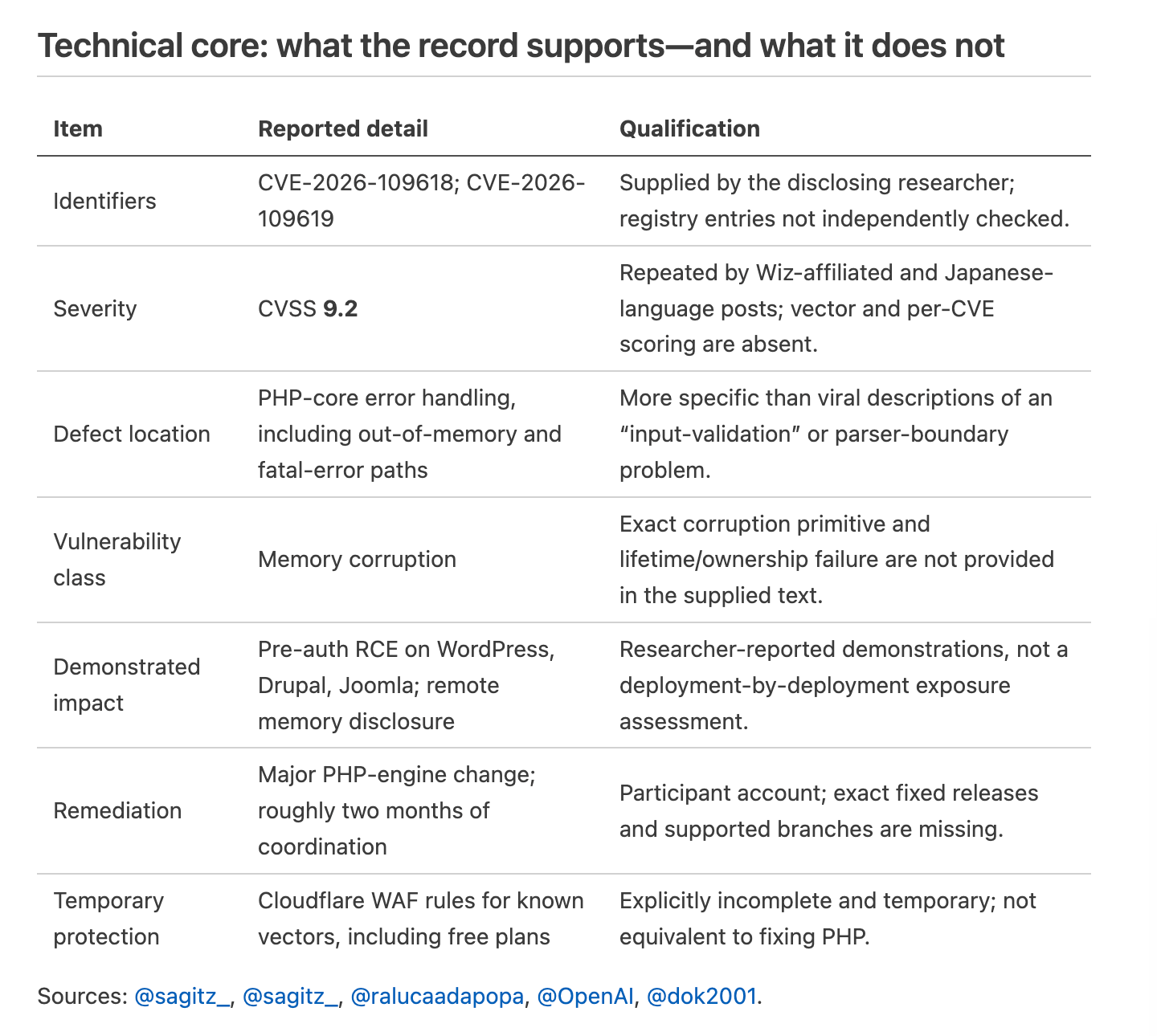
OpenAI says Calif researchers using GPT 5.6 Sol under its "Patch the Planet" project found the PHP2Shell flaws…
Counting the public CSVs (fetched Oct 22, 2026) showed HarmBench's 400 text prompts contain 0/400 lines with n…

OpenAI's GPT-5.6 Sol found two critical PHP vulnerabilities, CVE-2026-109618 and CVE-2026-109619, collectively…
IBM released Granite Speech 5.0 2B, a 2-billion-parameter open-source model trained on 390,000 hours of public…
NVIDIA added five models to Nemotron Retriever and released them free as open models

A LessWrong essay warns that autonomous researchers — which OpenAI says it aims to fully automate by March 202…