What happened
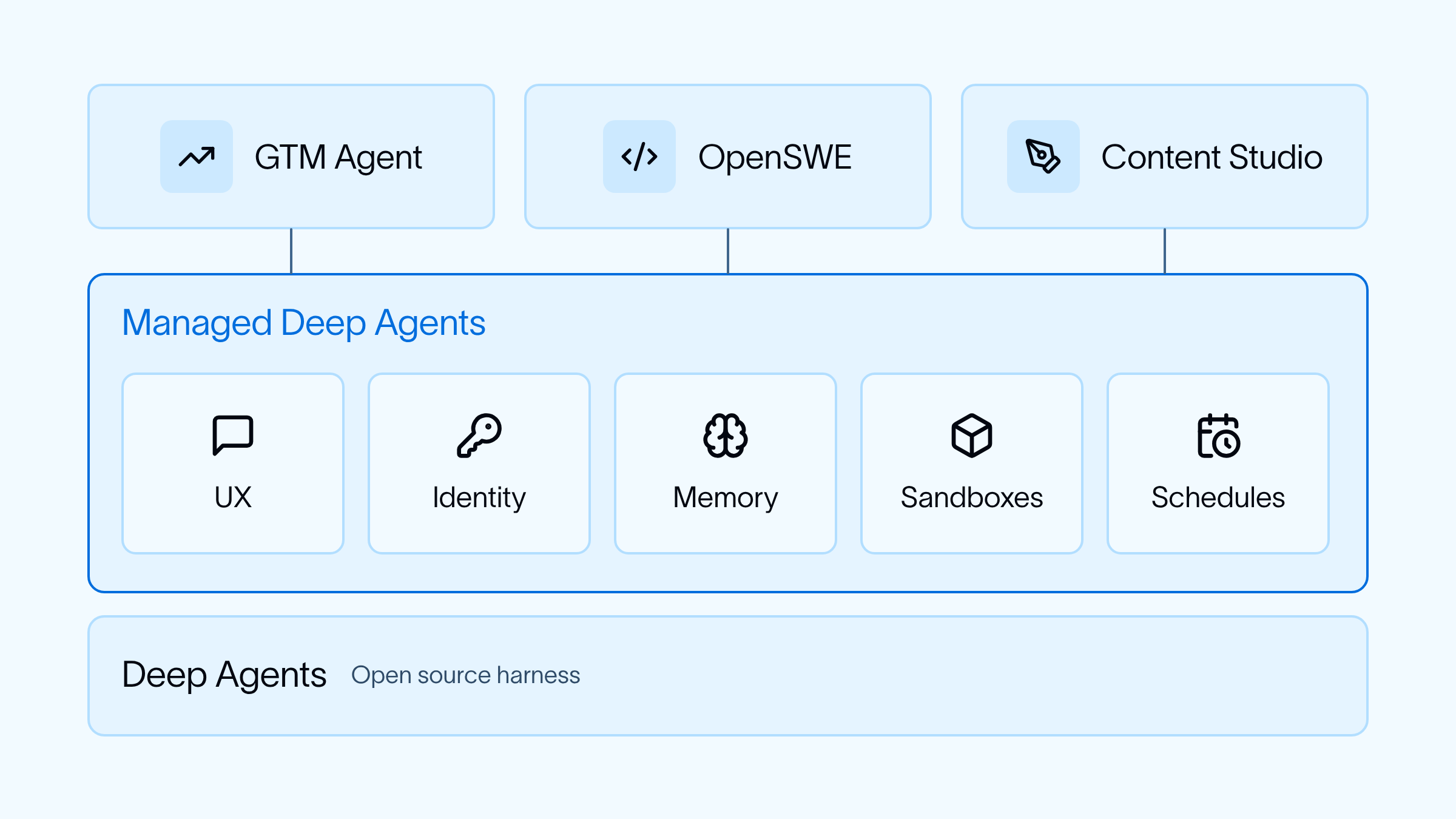
LangChain says its GTM Agent, OpenSWE and Content Studio all follow one recipe: they live in Slack, know who is asking, keep global and user memory, run code in a sandbox, and fire mostly on schedules.
Why it matters
The company says the hardest problem was identity — deciding when an agent acts on behalf of the person invoking it versus with its own fixed credentials. That choice, not raw model quality, is what shaped each agent's design.
Summaries like this, every morning.
LangChain's post is less a product launch than a field report from running internal agents in production, and its framing is notable: it treats the hard parts as workplace plumbing rather than model capability. The company describes two common industry approaches to agent identity — acting on behalf of the invoking user, or using a fixed set of credentials — and says it ended up mixing them agent by agent rather than picking one.
The three agents illustrate that split. OpenSWE opens pull requests under the user's GitHub handle but runs background code review with its own identity. GTM Agent uses a fixed identity for Salesforce so not everyone has to log in, but only offers its on-behalf-of email tools in DMs, not shared channels. Content Studio acts for the user in Notion while posting to the company Twitter account through fixed credentials, restricted to a whitelisted set of users.
LangChain also flags memory as the least explored area, with two tiers — global and user-level — and says it has a lot of work left there. The other primitives are more settled: agents execute code outside their own sandbox by connecting into it, and a large share of runs are scheduled or event-triggered rather than kicked off by a person, whether set up by the agent's developer (OpenSWE listening for new pull requests) or by the user (a daily brief that created its own cron).
Pick your industry and the AI tools you use, and get news related to your work every day.
Free · 30 seconds with Google · unsubscribe anytimeWhat is AIToday? →
Ask AI anything about this article. The AI reads this article, earlier AIToday articles, and Wikipedia, and cites its sources. Q&As are published on this page for other readers too.
Anthropic told investors on October 14 that its Q3 2026 revenue reached $16.8B and that it became profitable o…
Forced to name one candidate across nearly 500 US midterm races via developer APIs, xAI's Grok 4.7 chose the R…

Kazakhstan's AI minister Zhaslan Madiyev joined a US AI supply-chain group in Washington in June, then three w…

Apollo chief economist Torsten Slok examined the S&P 493 — the S&P 500 minus Alphabet, Amazon, Apple, Meta, Mi…

Google Cloud revenue grew 82% year over year to $24.8 billion last quarter, up from $13.6 billion a year earli…

Kazakhstan joined both camps — its AI minister Zhaslan Madiyev visited Washington in June, then Shanghai three…