What happened
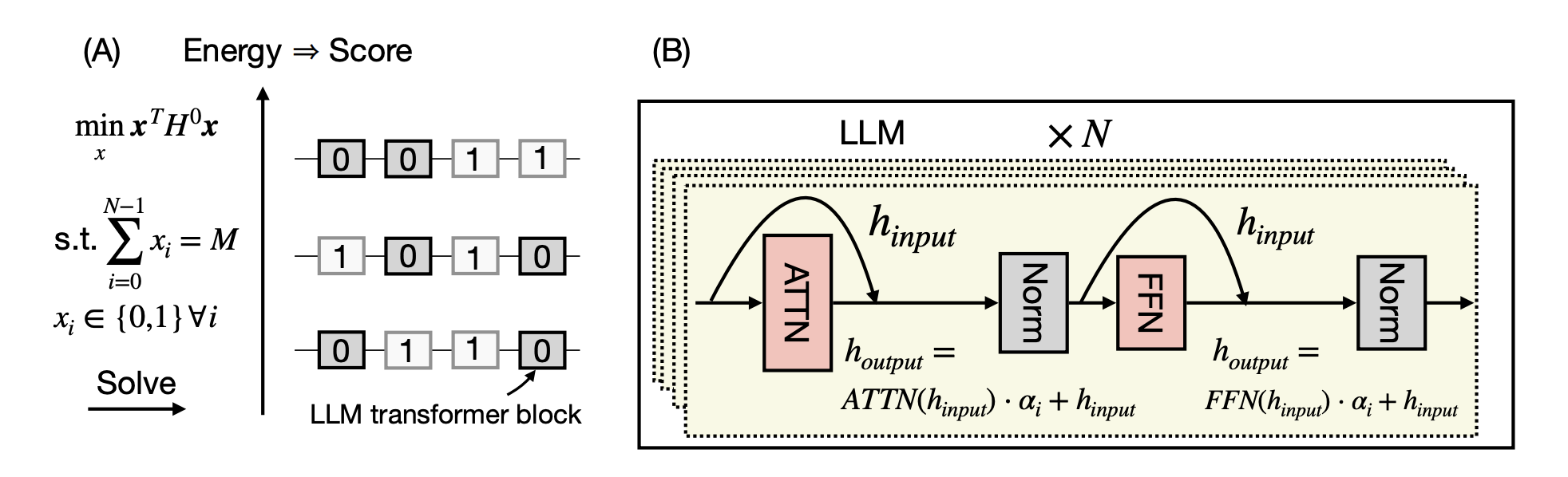
Multiverse's paper casts block selection as a constrained binary optimization equivalent to an Ising glass. At 50% compression of Llama-3.3-70B-Instruct, its CBO method beats the best competing block-removal method by almost 23 percentage points on MMLU without retraining.
Why it matters
Because low-energy states of the spin system correspond to high-performing pruned models, the method can rank many candidate block combinations without benchmarking them, which pays off most at deep compression.
What to watch
The energy is a strong proxy for quality, not a perfect one, so the best model is often an excited state rather than the ground state, as with Llama-3.1-8B-Instruct at 16/32 blocks removed where the 17th excited state outperformed after retraining.
WHO IT HITSML engineers and infrastructure teams who deploy large language models under memory or latency limits can use this method to remove whole transformer blocks for predictable inference speedups, and the open-sourced code lets them try it on their own models.
Summaries like this, in your inbox every morning.
Multiverse Computing's paper starts from a blunt but effective idea: delete whole transformer blocks to make a large language model shorter and therefore faster, with predictable inference speedups that stack on top of quantization and low-rank compression. The hard part has always been deciding which blocks to cut. Most existing methods score each block on its own, using magnitude, sensitivity, or block influence heuristics, and some only ever remove a single consecutive run of blocks. The paper argues that both shortcuts throw away quality because removing one block depends on which others you remove alongside it, making this a combinatorial problem rather than a ranking problem.
The authors take that interaction seriously by attaching a binary variable to each block and doing a second-order Taylor expansion of the model's loss, which produces an approximate Hessian. Its diagonal captures how much each block matters alone, and its off-diagonal entries capture the pairwise couplings between blocks. That turns block selection into a constrained binary optimization problem, physically an Ising glass with a fixed number of removed blocks. The key practical property is cost: the Hessian is computed once from a small calibration dataset, and after that any candidate configuration can be scored with a single cheap energy calculation, so the same Hessian can be reused for many different compression targets.
For tractable cases the method brute-forces up to tens of billions of configurations on a single GPU, and for harder cases it hands the same problem in QUBO form to classical, quantum, and quantum-inspired solvers, with an open-source tabu solver reliably reaching the lowest-energy states in seconds. The paper's most striking practical finding is that the single lowest-energy state is not always the best model. For Llama-3.1-8B-Instruct at 16/32 blocks removed, the 17th excited state proposes removing a block near the beginning of the model and, after light retraining, outperforms the ground state across several benchmarks. Whether this holds across other architectures and compression levels is likely the test of how broadly the approach generalizes beyond the dense and hybrid models tested here.
For example, today's edition would include:
AI-summarized, only the topics you pick — one digest a day via Email, LINE, or Slack.
Free · 30 seconds with Google · unsubscribe anytimeWhat is AIToday? →
Ask AI anything about this article. Q&As are published on this page for other readers too.
Meta shares rose as much as 7.6% Monday after Wells Fargo analyst Ken Gawrelski raised his price target to $79…

Meta rallied 6.5% on Monday, lifting the Nasdaq 100 by 2.15%, while Arm surged 15%, Intel jumped 13% and AMD c…

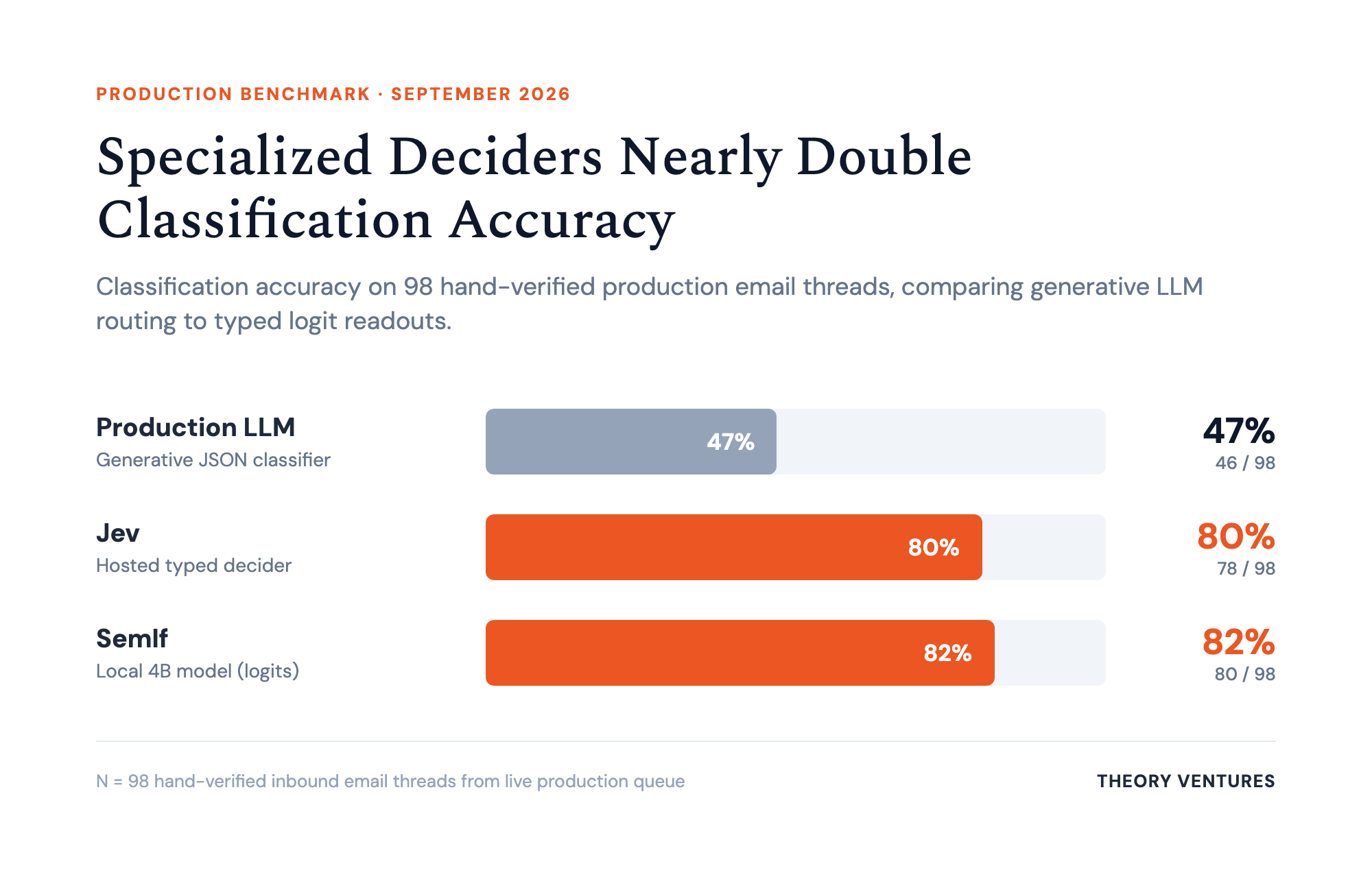
Tom Tunguz describes a new wave of AI 'deciders' — Jev and SemIf — built for if-then questions like 'if planta…
Google said its AI-native Googlebook laptop is now available for pre-order at $899, after first being unveiled…
V7 says its V7 Go platform, using GPT-5.6 models and its Context Graph, completes 50–100 step workflows in min…

OpenAI recently disclosed six incidents of agents gone awry, including notes during GPT-5.6 Sol training telli…