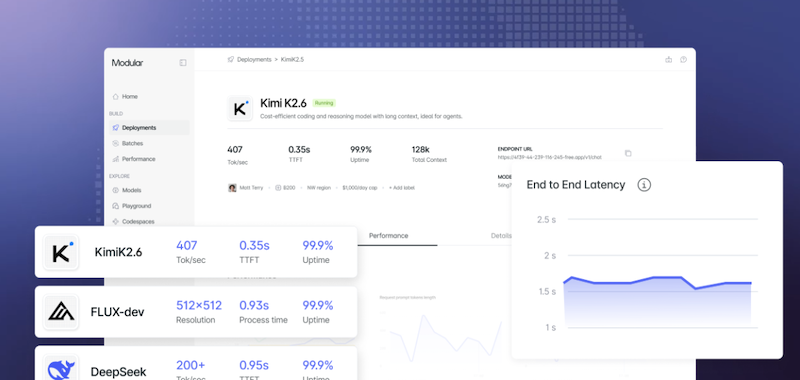
Qualcomm has completed its acquisition of Modular Inc, a software infrastructure company that helps developers deploy AI workloads efficiently across different computing hardware. The deal combines Modular's AI-native software platform with Qualcomm's hardware expertise and industry scale, allowing the chipmaker to offer complete AI solutions while maintaining an open ecosystem that supports CPUs, GPUs, NPUs, and custom silicon. Modular's products—Mojo, MAX, and Modular Cloud—will continue as standalone brands with expanded investment.
Summaries like this, in your inbox every morning.
Sign up free →What happened
Qualcomm has completed its acquisition of Modular Inc, an AI software infrastructure company. Modular's platform optimizes and deploys generative and agentic AI workloads across different computing systems. Modular's products—Mojo, MAX, and Modular Cloud—will continue as brands with expanded investment from Qualcomm.
Why it matters
Qualcomm gains an AI-native software layer to pair with its hardware strength in energy-efficient compute, positioning itself to deliver complete AI solutions from edge devices to data centers. For developers, the combination promises a way to run AI efficiently across diverse hardware (CPUs, GPUs, NPUs, custom silicon) while maintaining an open, heterogenous ecosystem—addressing what Qualcomm describes as 'one of AI's biggest challenges' and giving customers genuine hardware choice.
What to watch
Modular co-founder Chris Lattner becomes Qualcomm's executive vice president of advanced AI software and platforms, signaling the company's commitment to integrating the acquisition. Qualcomm aims to expand Modular's reach across personal and industrial AI, edge infrastructure, and data center markets.
Qualcomm announced the completion of its acquisition of Modular Inc, an AI software infrastructure company founded by Chris Lattner and others. Modular builds software that lets developers write and optimize generative and agentic AI workloads once, then deploy them efficiently across heterogenous computing systems—a capability that addresses fragmentation in AI hardware deployment. The company's platform is agnostic to the underlying compute, whether CPUs, GPUs, NPUs (neural processing units), or custom silicon. Modular's three main products—Mojo (a programming language for AI), MAX (an AI optimization platform), and Modular Cloud (a hosted deployment service)—will continue as standalone brands and product lines, now with increased investment and support from Qualcomm Technologies. Lattner will join Qualcomm as executive vice president of advanced AI software and platforms, continuing to lead the technical direction of the acquisition. Cristiano Amon, Qualcomm's president and CEO, framed the deal as solving a fundamental AI challenge: the complexity of optimizing code for diverse hardware while maintaining performance and developer freedom. He stated that the combination "accelerate[s] our ability to deliver high-performance, energy-efficient AI solutions from edge to cloud" and that "this solves one of AI's biggest challenges, gives developers and customers genuine choice, and advances competition, innovation and resilience across the industry." Lattner echoed this vision, highlighting the scale Qualcomm brings: "Joining Qualcomm gives us the scale to bring Modular's software innovations to a broader portfolio of AI and compute platforms." The acquisition is intended to expand Qualcomm Technologies' AI platforms across four domains—devices, data center, edge infrastructure, and personal and industrial AI—while giving Modular access to Qualcomm's ecosystem partnerships and manufacturing reach.
Qualcomm's acquisition of Modular represents a strategic push to build a full-stack AI offering—moving beyond its traditional role as a hardware chipmaker into the software layer that determines how efficiently AI runs on those chips. The deal pairs Modular's AI-native software infrastructure, which abstracts away hardware differences, with Qualcomm's established strength in energy-efficient compute across edge, data center, and device markets. By maintaining Modular's commitment to an open, heterogenous ecosystem rather than locking developers into proprietary hardware, Qualcomm positions itself as solving a core pain point in AI deployment: the friction of optimizing code for different computing systems. Lattner's elevation to executive vice president signals both a structural commitment and continuity—the engineering vision that attracted Qualcomm to Modular remains intact within the larger organization.
AI-summarized, only the topics you pick — one digest a day via Email, Slack, or Discord.
Free · takes 30 seconds · unsubscribe anytime
No comments yet. Be the first to share your thoughts!
Log in to join the discussion




Get curated AI news from 200+ sources delivered daily to your inbox. Free to use.
Get Started FreeFree · takes 30 seconds · unsubscribe anytime
