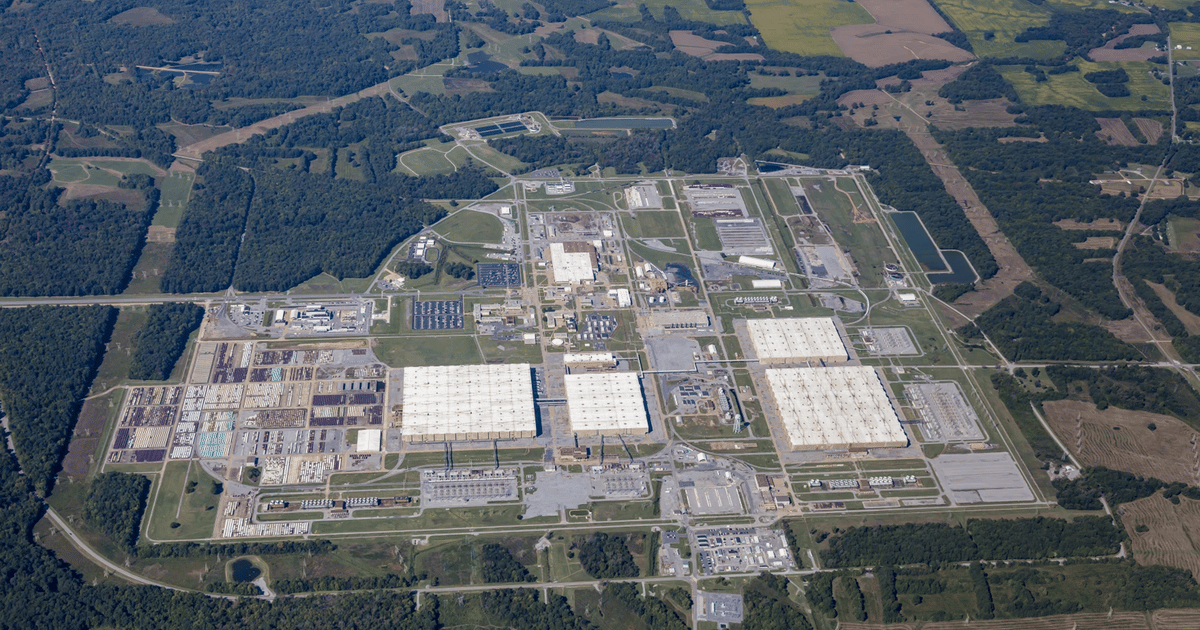
Brookfield and NextEra Energy plan to invest roughly $100 billion to build a massive AI data center campus at a Department of Energy site in Kentucky, with more than 1.2 GW of compute capacity and dedicated on-site power generation and storage.
The project represents a new model for AI infrastructure in which the data center brings its own power resources and infrastructure funding, avoiding cost shifts to existing utility customers while generating thousands of local jobs.
What happened
Brookfield and NextEra Energy announced plans to develop a major AI data center campus at the US Department of Energy's former Paducah Gaseous Diffusion Plant in Kentucky, targeting more than 1.2 GW of compute capacity paired with up to 2 GW of dedicated natural gas generation and up to 2.6 GW of battery storage on site. The companies said the total investment could reach roughly $100 billion over time.
Why it matters
The project demonstrates a shift in how large AI campuses are built—bringing dedicated power generation, storage, and infrastructure funding alongside the data center itself, rather than relying entirely on the grid. This approach aims to avoid shifting power upgrade costs to existing utility customers while creating approximately 8,000 construction jobs and 600 permanent operations jobs in the local community.
What to watch
The project remains subject to negotiation and execution of definitive agreements and regulatory approvals, including approval from the Kentucky Public Service Commission for the power service agreement. The announcement did not identify an anchor AI customer or a construction start date.
On Wednesday, the Paducah American Energy Hub coalition—led by Brookfield and NextEra Energy—announced plans to transform part of the US Department of Energy's former Paducah Gaseous Diffusion Plant in Kentucky into one of the nation's largest AI data center campuses. The two companies said the investment could total roughly $100 billion over time and would target more than 1.2 GW of compute capacity.
Under the structure, Brookfield will develop and operate the campus while NextEra Energy builds dedicated power generation and storage adjacent to the site. The current concept includes up to 2 GW of natural gas generation and up to 2.6 GW of battery energy storage, with capacity to support up to 1.8 GW of utility-delivered power by 2032. The partnership also includes Big Rivers Electric Power Corporation, Jackson Purchase Energy Cooperative, and Paducah Power System. The DOE selected Brookfield following a November 2025 Request for Offers to lease the land and develop the campus, and chose NextEra to build and own the dedicated generation resources. The project remains subject to execution of definitive agreements and regulatory approvals, including approval from the Kentucky Public Service Commission.
Brookfield CEO Bruce Flatt said in a statement: "Demand for critical infrastructure that accelerates innovation in the US and supports the economy will need to be met with capital, development capabilities, and additional power generation that benefits local communities. The Department of Energy's Paducah Site will be the seed of our plan to invest $100 billion in AI infrastructure." NextEra Chairman, President, and CEO John Ketchum framed the development as a proof of concept for AI infrastructure built without burdening the broader utility system: "The data center will bring its own power, pay for its own power infrastructure, and create good-paying jobs for local workers."
The project reflects a broader industry shift toward treating power generation and storage as integral components of hyperscale data center campuses rather than relying solely on external utility supply. Neil Osnato, founder of Persistence Analytics Group, cautioned that the dedicated resources do not provide equivalent firm capacity: "A gigawatt of battery capacity is not the same thing as a gigawatt of continuously available generation." He emphasized that planners must evaluate transmission requirements, fuel infrastructure, reserve obligations, and battery operating assumptions to understand what the campus can actually deliver during system stress.
The Paducah site offers strategic advantages including existing transmission access, water infrastructure, fiber connectivity, roads, and developable land—all of which accelerate development timelines compared to greenfield sites. The coalition estimates the project will generate approximately 8,000 construction jobs and 600 permanent operations jobs. Energy Secretary Chris Wright called it a potential blueprint for future AI infrastructure, stating: "It's difficult to overestimate the importance of this project. The planning and investment by NextEra Energy and Brookfield provide a crucial roadmap for future projects in the United States by revealing the ability to build world-leading infrastructure without passing costs on to surrounding communities." The announcement did not identify an anchor AI customer or specify a construction start date.
The Paducah project marks a significant shift in how major AI infrastructure is financed and built in the United States. Historically, large data center operators have relied on the grid to supply power and have expected utilities to upgrade transmission and generation capacity to meet their demand. The Brookfield-NextEra partnership inverts that model: the project brings its own generation, storage, and transmission funding directly to the site, reducing the burden on existing utility customers. This approach aligns with comments from Energy Secretary Chris Wright, who called it a "crucial roadmap for future projects" by demonstrating the ability to build world-leading infrastructure without socializing costs.
The site itself carries strategic advantages. The former DOE enrichment plant at Paducah already has transmission connections, water access, fiber networks, and available land—removing years of development friction compared to building on undeveloped sites. Brookfield will develop and operate the campus, while NextEra constructs the dedicated generation and storage; the arrangement also involves local utility partners (Big Rivers Electric, Jackson Purchase Energy Cooperative, and Paducah Power System) to provide wholesale and retail power service.
Experts caution, however, that the headline capacity figures deserve scrutiny. As analyst Neil Osnato of Persistence Analytics Group noted, adding 2 GW of gas generation and 2.6 GW of battery storage together does not equal 4.6 GW of firm capacity available during grid stress. Battery storage operates under different constraints than continuous generation, and the campus will still depend on utility grid support during peak demand or equipment failures. The real test will be whether the infrastructure delivers the promised capacity under stressed system conditions and what incremental costs remain unaccounted for.
AI-summarized, only the topics you pick — one digest a day via Email, Slack, or Discord.
Free · takes 30 seconds · unsubscribe anytime
The Monte Jade Science and Technology Association of Taiwan (MJ Taiwan) elected Maverick Shih, chairman of Ace…
ASE Technology Holding has raised its 2026 capital expenditure budget to a record US$10.5 billion, the second…
Apple became the world's most valuable company this month, surpassing Nvidia, which had briefly held the $5 tr…
The world is running short on high-bandwidth memory (HBM), the specialized chips that feed data to AI systems

Amazon shares jumped more than 12% before the bell on Friday after AWS posted 37% revenue growth to $42.2 bill…
Microsoft is reframing its artificial intelligence approach, moving away from the goal of building a single be…
The AI news that matters, in one minute each morning.
Sign up free