What happened
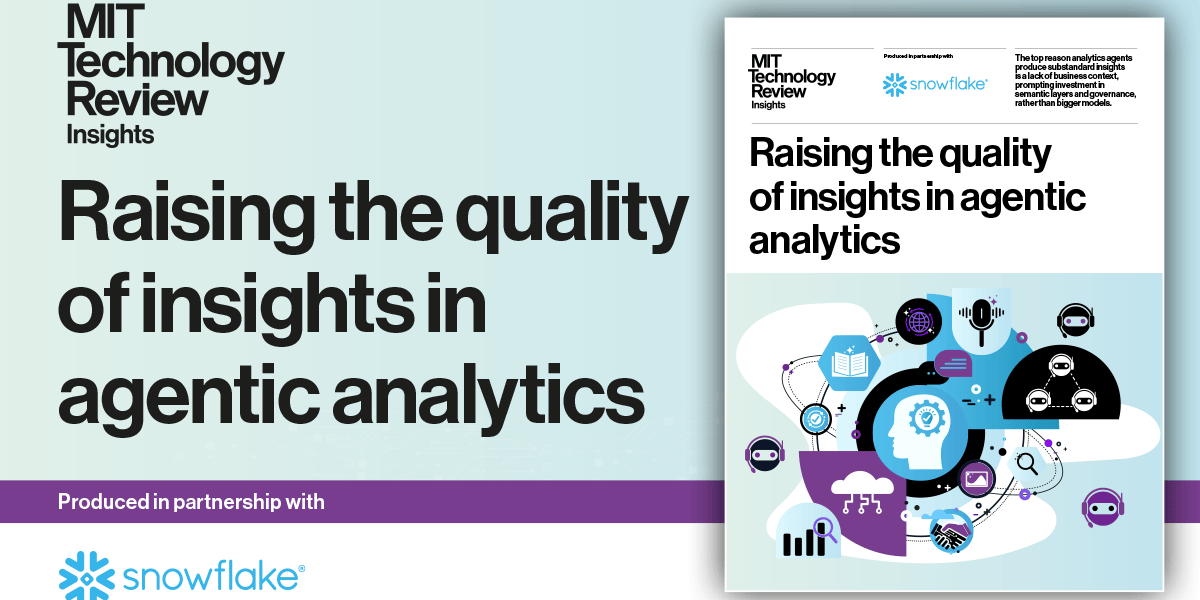
A survey report found that on average, 48% of insights generated by analytics agents lead to actions that improve the business, up from 37% a year ago. A small group of "insight leaders" exceeds 70%.
Why it matters
More than half of agent-generated insights still fail to improve the business, depriving organizations of their desired return on investment in agentic analytics, and flawed insights that trigger incorrect actions can cause reputational or financial damage.
WHO IT HITSData and analytics teams at enterprises using agentic analytics tools are most affected, as they must evaluate a high volume of agent-generated insights and act on those that are business-relevant.
Summaries like this, every morning.
The report, produced by MIT Technology Review's custom content arm Insights, surveyed organizations about the quality of outputs from their analytics agents. It frames the issue as a return-on-investment problem: if agents fail to produce insights that improve the business, the investment in agentic analytics does not pay off, and flawed insights that trigger incorrect actions can cause reputational or financial damage.
The findings suggest that quality is not uniform. The small cohort termed "insight leaders" achieves more than 70% of insights leading to business-improving actions, well above the 48% average, and rates the quality of their agents' insights higher than the overall respondent pool. The gap is particularly wide for prescriptive insights—those on which actions are based.
Respondents are prioritizing initiatives to improve insight quality, with 60% citing stronger AI and data governance and 45% adding a semantic layer to their data architecture. The experts interviewed for the report agree that the semantic layer is crucial for high-performing agents, though the body does not detail how these initiatives affect outcomes.
Pick your industry and the AI tools you use, and get news related to your work every day.
Free · 30 seconds with Google · unsubscribe anytimeWhat is AIToday? →
Ask AI anything about this article. The AI reads this article, earlier AIToday articles, and Wikipedia, and cites its sources. Q&As are published on this page for other readers too.
On 2026年10月25日, TUKURO began offering AITUKAO, a workspace for small and mid-sized businesses that runs ChatGP…

Anthropic PBC filed for an IPO with the SEC, while Intel fell almost 30% after earnings, Alphabet dropped more…
Super Micro stock is at $31.15, down 5% during the afternoon session, with results due November 3

OpenAI slashed its latest funding target to $20 billion from $30 billion after securing about $11 billion in c…

Klarna announced in February 2024 that within one month its OpenAI-based assistant handled two-thirds of custo…

LangChain CEO Harrison Chase says every agent builder he has spoken with is now thinking about proactive, alwa…