What happened
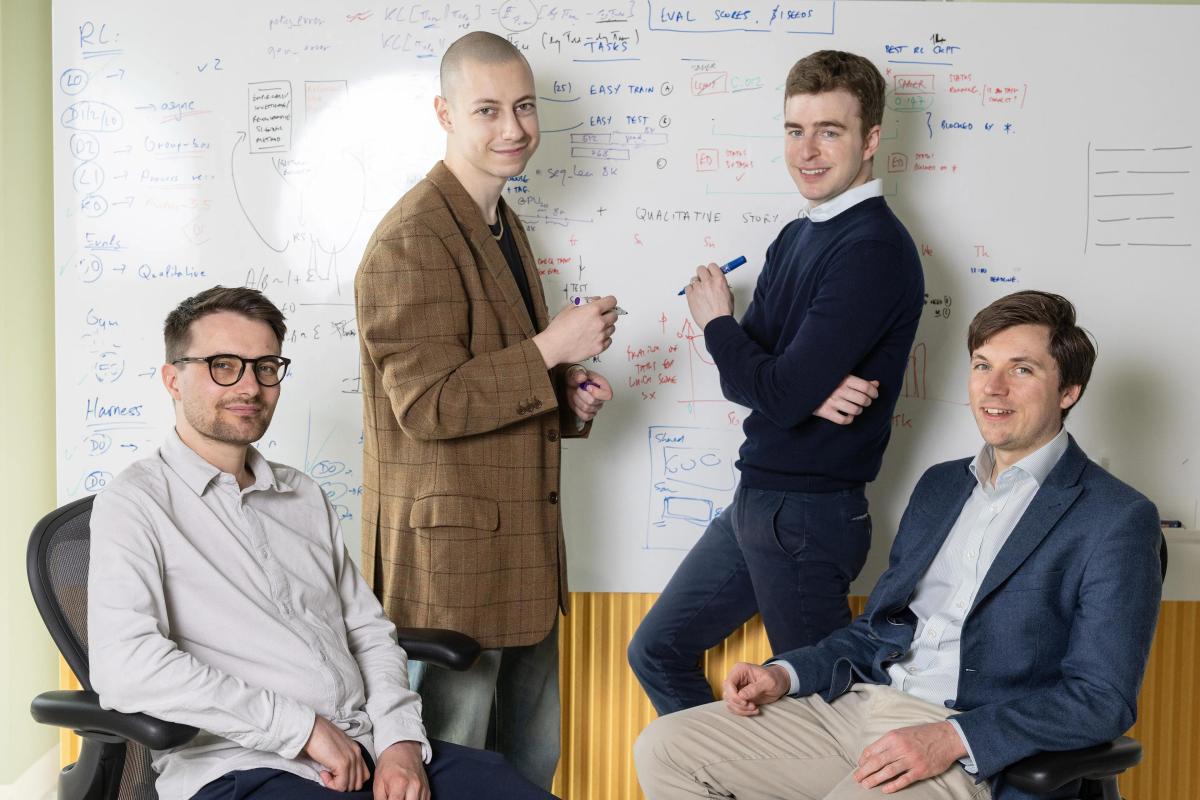
Inherent, a London-based AI lab founded by Google DeepMind alumni, released Faraday, an AI agent that outperformed Anthropic's Claude Opus 4.8 and OpenAI's GPT-5.5 at independently reproducing published scientific papers. Faraday runs on Qwen 3.6, a model with 27 billion parameters—vastly smaller than the frontier-scale systems it beat.
Why it matters
The startup emerged from stealth just weeks earlier with a $50 million seed round and is testing a novel training approach using reinforcement learning to teach AI systems 'research taste'—an instinct for which experiments are worth running and how to design them well. This method could generalize better to Inherent's longer-term goal of building AI agents capable of discovering new scientific knowledge, not just verifying existing results.
What to watch
Inherent plans to grow from its current dozen employees to about 20 to 25 by the end of the year, all based in its King's Cross office in London. The hiring push may attract departing DeepMind staff, particularly given recent uncertainty at the parent organization.
Summaries like this, in your inbox every morning.
Inherent's announcement arrives at a moment when larger AI labs—OpenAI, Anthropic, Google—dominate headlines with scale-focused announcements. The startup's claim to beat those systems on a specific scientific task using a fraction of their size speaks to an alternative strategy: specialized training methods rather than raw model size. The reinforcement learning approach Hughes describes—rewarding good outcomes rather than prescribing rules—is an explicit bet that this training method will generalize better to the longer-term goal of AI agents that can discover, not just replicate, scientific findings.
The founders' background at DeepMind is significant not just for credibility but for hiring. The article notes that Demis Hassabis's recent role change has left some DeepMind staff unsettled, and Inherent's aggressive hiring plan (targeting 20–25 people by year-end) may benefit from that churn. London's position as an AI hub—driven partly by DeepMind's presence in King's Cross—gives the startup a geographic advantage, though Hughes has criticized U.K. garden leave restrictions that slow hiring compared to U.S. rivals.
Pick your industry and the AI tools you use, and get news related to your work every day.
Free · 30 seconds with Google · unsubscribe anytimeWhat is AIToday? →
Ask AI anything about this article. The AI reads this article, earlier AIToday articles, and Wikipedia, and cites its sources. Q&As are published on this page for other readers too.
Cerebras chief strategy officer Andy Hock said that over the past two months, foundation labs and enterprises…
nFOX Lab launched the nFOX Platform for managing owned large language models and announced plans to open-sourc…

Oppenheimer said investors look forward to understanding the return on Meta's AI assistant Muse, which UBS ana…

DBS's CEO warned of "shortages of capital" for AI, while Volta's $5 billion data center faces tougher terms, C…
Anthropic told investors its Q3 revenue reached $16.8bn, up nearly 50%, after about $4.8bn in Q1 and $11.5bn i…

Bank of America CEO Brian Moynihan said 1,000 outside contractors joined 3,000 internal employees fixing vulne…