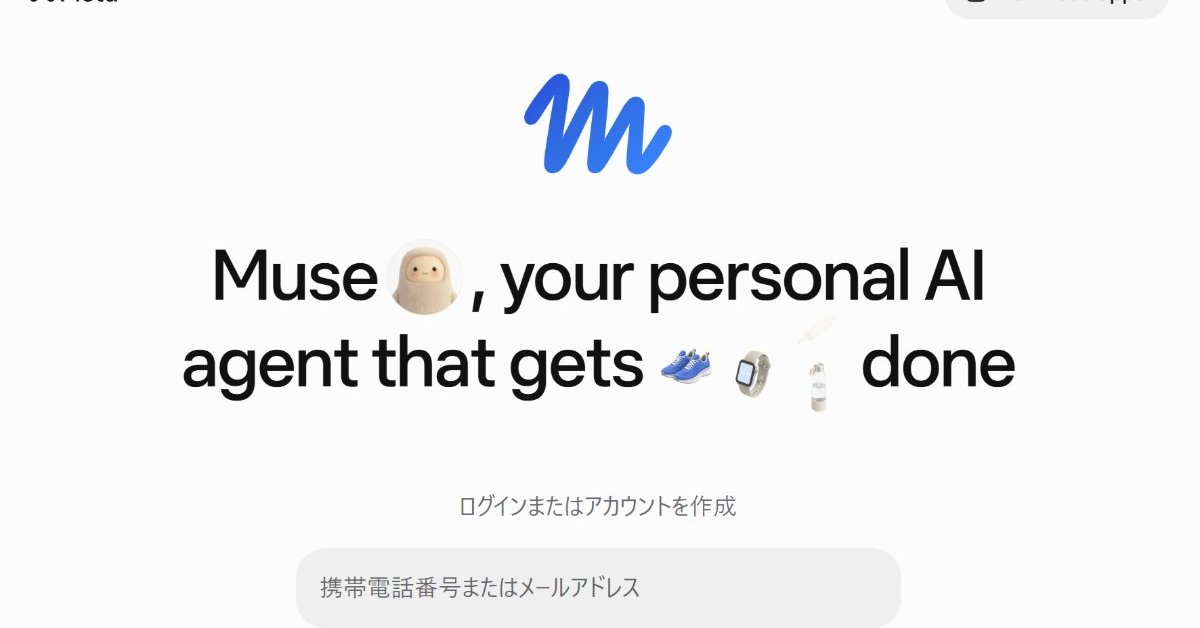
What happened
Meta announced Muse on September 8, offering iOS, Android, and web versions in the US, with free basic use and a subscription plan for heavier users.
Why it matters
Muse, powered by the 'Muse Spark 1.3' model, moves beyond chatbots by autonomously completing tasks like sending emails and making travel bookings, operating across its app and WhatsApp.
What to watch
Safety is a key test, as Meta acknowledges prompt injection remains unsolved and Muse may make mistakes. The company plans a 'Muse Confidential VM' by year-end.
WHO IT HITSIndividual consumers in the US who want an AI agent to handle personal tasks like email, shopping, and forms are the direct users. Businesses selling goods or services through these automations, such as retailers and travel providers, may see new types of AI-driven customer interactions.
Summaries like this, every morning.
Meta's announcement of Muse represents a significant step into the agentic AI space, moving from answering questions to performing actions. The company highlights its focus on accessibility, claiming it is the first personal AI agent built for billions of users, and it leverages its ownership of platforms like WhatsApp and Instagram for integration. The underlying model, 'Muse Spark 1.3', is described as their most powerful to date, and a vision for 'personal superintelligence' has been previously outlined by Mark Zuckerberg.
The technical architecture shows a strong emphasis on safety and user control, with a dedicated secure virtual machine and a separate 'Sentinel' agent to oversee actions. Acknowledging unresolved industry-wide issues like prompt injection, Meta has implemented multi-layered defenses and a bug bounty program. The success of Muse may hinge on how well it balances user autonomy with safety, and whether it can execute real-world tasks reliably enough to gain consumer trust.
Pick your industry and the AI tools you use, and get news related to your work every day.
Free · 30 seconds with Google · unsubscribe anytimeWhat is AIToday? →
Ask AI anything about this article. The AI reads this article, earlier AIToday articles, and Wikipedia, and cites its sources. Q&As are published on this page for other readers too.
SpaceX reported revenue up 161% with positive EBITA
On the Motley Fool podcast, Ray Dalio said an AI bubble could burst relatively soon, citing higher interest ra…
The author, who once settled on gradient boosting in scikit-learn for demand forecasting, says he could not an…
Mayor Zohran Mamdani announced that more than 38 previously allowed programs, including Amira and Google Gemin…

S&P Global reports Q3 on Oct

Vertiv and NVIDIA presented at GTC on how they can halve AI factory deployment time