JR East ran a generative AI trial at its ticket counters to test whether the system could suggest optimal travel routes to passengers.
The experiment revealed that while AI can sometimes generate good recommendations, it did not consistently match the quality and reliability of human ticket-counter staff, indicating that widespread adoption will face real technical and operational hurdles.
What happened
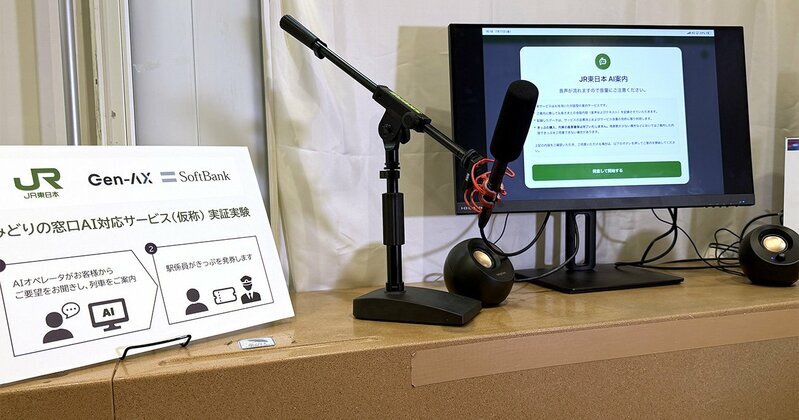
JR East (East Japan Railway Company) conducted a proof-of-concept trial using generative AI at its Midori no Madoguchi (ticket counter) service to propose optimal travel routes to customers.
Why it matters
The trial exposed significant practical barriers to deploying the technology at scale — the AI's suggestions, while sometimes impressive, fell short of human expertise in real-world scenarios, suggesting that full-scale integration will require substantial refinement before it can reliably serve passengers.
What to watch
The trial findings indicate that even where AI shows promise, the railway industry faces a steep engineering and training curve to move from proof-of-concept to operational deployment in customer-facing roles.
JR East conducted a proof-of-concept trial of generative AI at its Midori no Madoguchi (ticket counter) service to evaluate whether the technology could assist in proposing optimal travel routes to customers. The trial was designed to test whether AI could handle the complex task of route recommendation, which typically involves factors such as cost, travel time, number of transfers, and passenger preferences. During the trial, the AI system generated route suggestions and presented them to customers. In some cases, the AI's recommendations proved impressive and earned positive feedback — one observer reportedly remarked that the AI's output was so good that it made them feel they could not compete with it. However, the trial also revealed significant limitations. The AI's suggestions did not consistently match the quality and reliability of routes proposed by experienced human staff at the counter. The system struggled with edge cases, contextual reasoning, and the subtle judgment calls that seasoned employees routinely make. These findings expose a fundamental barrier to full-scale deployment: while generative AI can generate plausible route recommendations quickly, it lacks the refined domain expertise, error-checking capabilities, and adaptive learning that human ticket-counter employees possess. JR East's experience suggests that moving from a limited proof-of-concept to operational deployment at scale will require substantial additional work — including more sophisticated model training, integration with real-time operational data, extensive validation protocols, and ongoing human oversight — before the company can confidently replace or significantly augment human staff in this customer-facing role.
JR East's decision to test generative AI at its Midori no Madoguchi counters reflects a broader industry push to explore AI-driven customer service. The trial was designed to assess whether the technology could automate or augment the complex task of route planning — a service that requires balancing multiple factors such as cost, time, transfers, and passenger preferences. However, the results suggest that the gap between laboratory performance and real-world deployment remains substantial. The trial surfaced a critical tension: AI systems excel at pattern matching and rapid computation, but they struggle with the contextual judgment, exception handling, and nuanced customer interaction that human staff bring to the role. The findings imply that JR East and similar operators cannot simply deploy pre-built AI models at scale; they will need to invest in domain-specific training, validation workflows, and human-in-the-loop processes to ensure reliability and customer trust.
AI-summarized, only the topics you pick — one digest a day via Email, Slack, or Discord.
Free · takes 30 seconds · unsubscribe anytime
Ask AI anything about this article. Q&As are published on this page for other readers too.
Bank of America released a report concluding that artificial intelligence is unlikely to significantly displac…

IBM and Together AI have signed a $240 million agreement to build and operate an Nvidia-powered AI inference c…

Running a 122-billion-parameter model on three RTX 3090 GPUs with a 256K-token context, the author's AI agent…

Industry analysts and energy companies see artificial intelligence as a tool to increase oil extraction and re…

Healthcare investors are treating sector exposure as an indirect bet against artificial intelligence, with som…

NVIDIA and partners released multiple open-source AI models optimized for local execution throughout August, i…

The AI news that matters, in one minute each morning.
Sign up free