What happened
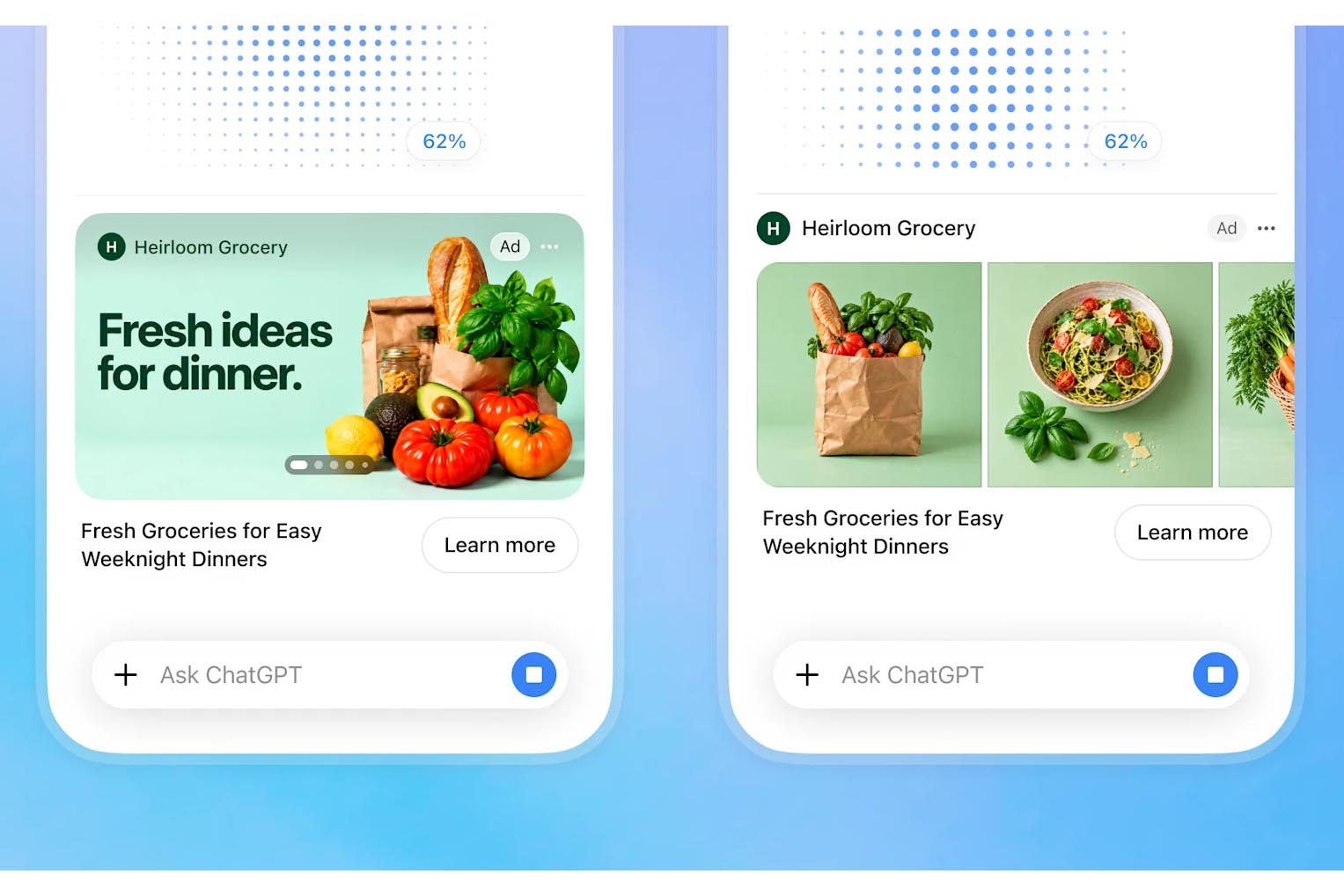
OpenAI is rolling out a new visual ad format shown while ChatGPT generates images, and will test it with selected US advertisers from late October, with clearer ad labels and separation from generated output.
Why it matters
Because the ads are marked and kept apart from the image, OpenAI says they will not influence ChatGPT's answers, which is likely to matter to brands wary of mixing paid placements with AI output.
What to watch
Measurement is the real test — OpenAI is linking conversion data through Hightouch, Tealium, LiveRamp, AppsFlyer and Adjust, and is working with DoubleVerify and Integral Ad Science on a suitability trial in a controlled test environment.
WHO IT HITSBrand marketers and performance-advertising teams that already run conversion tracking will be the first to test whether ChatGPT image-generation placements can be measured alongside their existing systems. Ad-suitability and brand-safety reviewers also have a new environment to assess.
Summaries like this, in your inbox every morning.
OpenAI's move puts advertising directly inside one of ChatGPT's most visual surfaces: the moment a user is generating an image. The company is pairing that placement with the plumbing advertisers expect before they spend — conversion data flowing in from their existing systems, reporting, and tracking from an ad click through to a result.
Two details in the arrangement are worth noting. The first is the separation between the ad and the generated image, with the ad clearly labeled; OpenAI says the ads do not influence ChatGPT's answers. The second is the control layer around where ads appear. OpenAI is offering an exclusion-phrase feature to advertisers that meet its conditions, and is developing a trial program with DoubleVerify and Integral Ad Science to evaluate conformity with brand placement standards. That evaluation is designed to happen in a controlled test environment, without access to users' private conversations.
The test's significance likely hinges on whether brands trust the separation between paid placement and model output, and on whether the conversion integrations prove the format actually drives purchases. Advertisers with strict placement criteria will be watching the exclusion-phrase tool and the DoubleVerify and Integral Ad Science trial closely.
Pick your industry and the AI tools you use, and get news related to your work every day.
Free · 30 seconds with Google · unsubscribe anytimeWhat is AIToday? →
Ask AI anything about this article. The AI reads this article, earlier AIToday articles, and Wikipedia, and cites its sources. Q&As are published on this page for other readers too.
Nittobo is expanding production of its T-Glass glass cloth, a material used in advanced chipmaking, as demand…
KDDI's ELYZA said on October 2 it set up "ELYZA RSI Research" to study recursive self-improvement, and CEO Yuy…
On The AI Investor Podcast, co-hosts Eric Bleeker and Austin Smith discussed the future of robotics and how ph…
On a recent episode of The AI Investor Podcast, Eric Bleeker and Austin Smith broke down Google's release of G…
Renesas Electronics released its first 100V enhancement-mode GaN power transistors—the RTP100E005G1FL, RTP100E…

Meta has begun offering parental controls in Meta AI, so parents can review the topics their teens asked about…