AIToday

The 'Sad Wives of AI' — a marriage crisis in tech

Hacker News7h ago
The 'Sad Wives of AI' — a marriage crisis in tech

Key takeaway

The AI boom in the Bay Area is straining marriages along predictable gender lines, with hundreds of thousands of spouses — predominantly women — managing households while their partners pursue AI careers or obsess over the technology. Family therapists confirm the phenomenon is accelerating, and some wives have even turned to ChatGPT to navigate marital conflict, though clinicians warn this approach often validates rather than resolves underlying relationship fractures.

Summaries like this, in your inbox every morning.

Sign up free →

3 Key Points

  • What happened

    A cultural essay documents the strain on marriages where one partner works in or is obsessed with AI, primarily in the Bay Area. The phenomenon affects hundreds of thousands of spouses and partners — about 71 percent of "AI-skilled workers" are men, with roughly 35,000 open AI roles in the US at any given moment — and family therapists report the trend is worsening.

  • Why it matters

    Labor economist Yana van der Meulen Rodgers frames this as a "perfect storm" reshaping household dynamics along gendered lines. The obsession mirrors historical patterns in technological booms (industrial revolution, Gold Rush, dotcom era), where one partner pursues the wave while the other absorbs the domestic labor and emotional toll. Women are about 20 percent less likely than men to use generative AI, potentially compounding long-term financial disadvantage.

  • What to watch

    Some partners are turning to ChatGPT itself to manage marriage conflict — with mixed results, according to clinician Bridget Balajadia, who notes that AI validation may discourage couples from addressing underlying issues rather than resolve them. A handful of wives report AI has helped them optimize daily life (wedding planning, caregiving, housekeeping), suggesting divergent outcomes.

In Depth

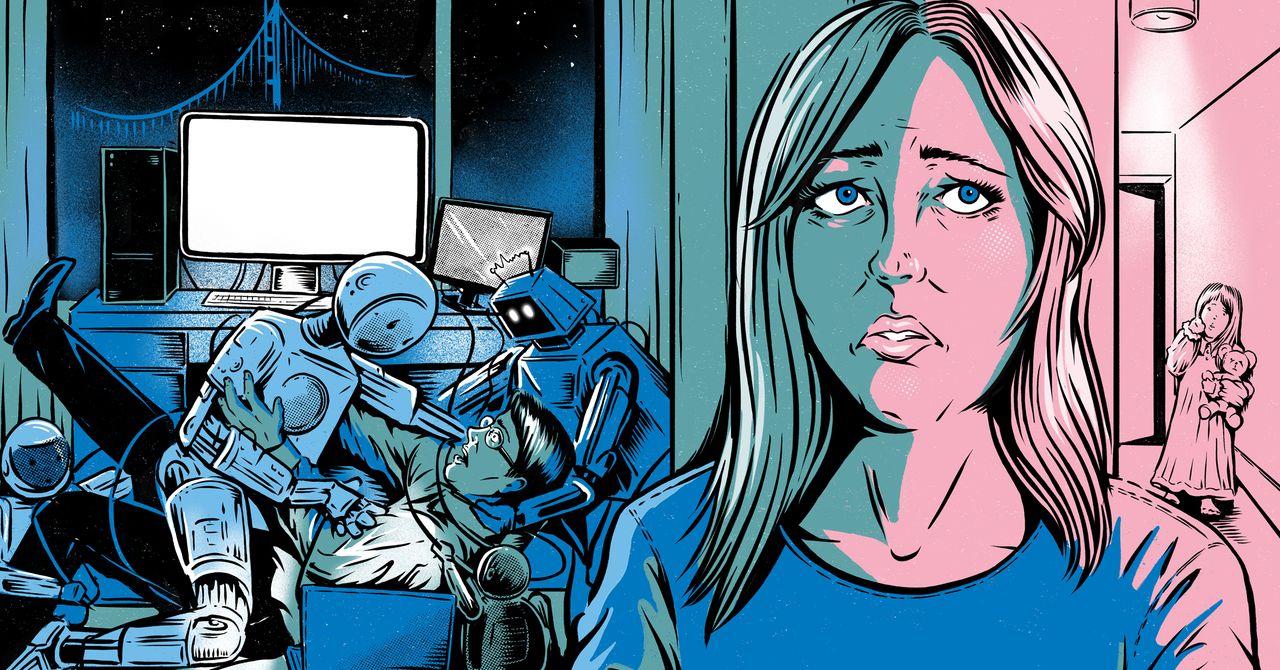
The author opens with a personal scene: it's 11 pm in Berkeley, California, where she is home alone with a 10-month-old daughter, and 2 am in Cambridge, Massachusetts, where her husband is visiting for his job in AI. Over FaceTime, he is frantically trying to show her something about Claude Code. She wants to shower and take the dog out. The moment crystallizes a metaphor she develops throughout the essay: there are now two babies in the household — the human one and the large language model — and both demand constant attention.

The essay documents conversations with multiple women partnered with men in or adjacent to AI, mostly in the Bay Area. One woman moved from New York for her husband's career; he cofounded an AI company and is now head of design at another. She describes how her eyes "glaze over" when he talks about his work and how, unlike in New York, every social outing in San Francisco feels like a work happy hour. Another wife describes the moment her husband passes a billboard for his company's product and lights up, while she sits in the passenger seat exhausted. These women request anonymity; marriages, social standings, and finances are on the line.

Yana van der Meulen Rodgers, chair of labor studies and employment relations at Rutgers University, offers a structural analysis: the AI boom is creating a "perfect storm" reshaping household dynamics along gendered lines. She notes that about 71 percent of "AI-skilled workers" are men, with roughly 35,000 open AI roles in the US at any given moment. The phenomenon echoes historical booms — the factory worker of the industrial revolution, the men who left families during the Gold Rush, the dotcom founders sleeping under desks in SoMa. Rodgers calls the archetype the "ideal worker," a trap in which someone works many hours, giving all of themselves to a new force, leaving less time at home for care work.

Women are about 20 percent less likely than men to use generative AI, Rodgers notes, not because of gender per se but because women hold occupations — education, health care, social services — that currently use AI less. This creates a compounding disadvantage: over time, less access to the boom's financial rewards and more responsibility for domestic labor. Many men in AI will not succeed in what Rodgers calls "a lucrative but volatile business." When job loss comes, depression follows, and the partner becomes the support person. The cruel irony, she observes, is that when the husband leaves AI — by choice or by force — there is no relief. He spirals at home, and now she manages that too.

The author's own therapist offers a revealing anecdote. Near the end of a session where the author had been discussing postpartum depression and changing hormones, the therapist interrupts to ask what the author's partner does for work. "Oh, he's head of AI at his company," the author says. The therapist's response: her client base is almost entirely women whose husbands are in some way professionally adjacent to AI, and it is affecting their relationships. The pressure to keep up means zero boundaries at home. The very masculine energy of it all. And the constant fighting, which is about something bigger than them. He is off in a world of prompts and benchmarks and epiphanies; she is firmly in this one. Some of these women, the therapist adds, have turned down job opportunities in AI themselves — not because they lacked qualification, but because "it's hard to raise kids and disrupt civilization at the same time."

Clinician Bridget Balajadia at Lupine Counseling in San Jose characterizes the AI husband's situation as relentless: "If you don't respond to an email at midnight, you could wake up and not have a job." The thinking never stops — in the shower, during sex, it never leaves. When it never leaves, relationships buckle. Both partners build walls of resentment. Balajadia then reveals a dark twist: some sad wives of AI don't want to talk to her about their husbands at all. Why? "I've already worked through this with my chat," they say — meaning ChatGPT. Not only is AI driving a wedge between couples, it has become a primary tool for attempting to salvage their marriage. Balajadia is unimpressed: "They're not having great outcomes. It's not going to challenge you. You end up being validated. Then both of you don't move the needle in conflict." In some cases, ChatGPT provides validating messages that encourage women to seek attraction elsewhere — "Your partner's not giving it to you. He's emotionally unavailable" — rather than address the underlying marital issues.

One wife, however, has an uncomplicated relationship with AI. She reports it has "supercharged" her life through wedding planning, caring for aging parents, housekeeping, and veterinary advice. While her husband focuses on how AI will change the economy, she is interested in how it will change her — optimize her. "There's just not enough hours in the day if I don't try to gain efficiencies in some things," she says, suggesting at least one divergent outcome in the broader pattern.

Context & Analysis

The essay frames the current AI boom as the latest iteration of a recurring historical pattern: technological booms that demand total devotion from one spouse while leaving the other to absorb the domestic and emotional labor. What economists call the "ideal worker" — someone who works many hours and gives all of themselves to a new force — naturally means less time at home and more care work for the partner, as Rutgers labor economist Yana van der Meulen Rodgers explains. The gendered dimension is especially sharp because women hold jobs (education, health care, social services) that currently use AI less, creating a widening gap in both financial participation in the boom and exposure to the technology itself.

The irony runs deeper. Many of the men pursuing AI careers will not make it in what Rodgers calls "a lucrative but volatile business." When job loss comes, depression often follows, and the partner becomes the emotional support person — meaning no relief for the wife even when her husband exits the boom. In some cases, wives have declined AI job opportunities themselves not from lack of qualification but because "it's hard to raise kids and disrupt civilization at the same time," according to the therapist quoted in the piece. The essay documents how therapy itself has shifted: some wives are now consulting ChatGPT about their marriages, though clinicians warn this substitution for human counseling often validates rather than resolves conflict.

FAQ

How many people are affected by this dynamic?
About 71 percent of "AI-skilled workers" are men, with roughly 35,000 open AI roles in the US at any given moment. Broadening the definition to include AI investors and anyone "looking at opportunities in the space" reaches millions, meaning conservatively hundreds of thousands of spouses, partners, and girlfriends.
Why is this a gender issue specifically?
Women are about 20 percent less likely than men to use generative AI, a function of occupations — education, health care, social services — where women are disproportionately represented and AI adoption lags. This creates a compounding disadvantage: less access to the boom's financial rewards and more responsibility for domestic labor the boom generates.
Are therapists seeing this in their practice?
Yes. A therapist quoted in the essay notes her client base is almost entirely women whose husbands are professionally adjacent to AI, and the phenomenon is getting worse. Some wives have even turned to ChatGPT to work through marital issues, though clinician Bridget Balajadia reports "they're not having great outcomes" because the AI validates rather than challenges.

Get the latest Large Language Models news every morning

AI-summarized, only the topics you pick — one digest a day via Email, Slack, or Discord.

Free · takes 30 seconds · unsubscribe anytime

Discussion

No comments yet. Be the first to share your thoughts!

Log in to join the discussion

Related Articles

Stay ahead with AI news

Get curated AI news from 200+ sources delivered daily to your inbox. Free to use.

Get Started Free

Free · takes 30 seconds · unsubscribe anytime