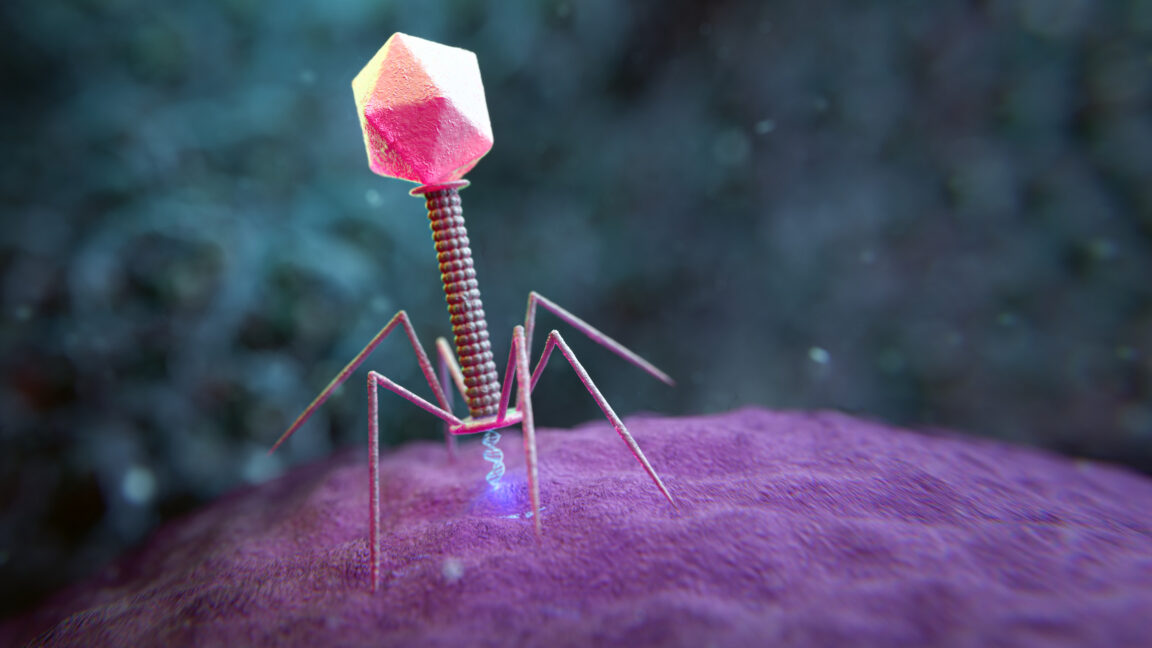
Researchers at Stanford University used large genome models to design new bacteriophages—viruses that infect bacteria—by prompting the AI with sequences from ΦX174, a well-studied virus. Of 285 candidate sequences the AI generated, 16 produced functional viruses in laboratory tests.
The AI-designed viruses carried substantial genetic changes that would normally be lethal; a cocktail of them outperformed natural bacteriophages at overcoming bacterial resistance in tests, suggesting potential medical value.
However, the authors caution that the same technique could theoretically be applied to viruses that infect humans if someone had access to sufficient computing power and training data.
What happened
Researchers at Stanford University used large genome models (called Evo 1 and Evo 2) to generate sequences of bacteriophages—viruses that infect bacteria—modeled on ΦX174. Of 285 synthesized sequences tested, 16 produced working viruses that could inhibit E. coli growth; nine came directly from the AI output, and seven acquired mutations after insertion into bacteria.
Why it matters
The AI-generated viruses demonstrated a capability that random mutation cannot easily achieve: nearly a quarter of the AI-designed sequences with more than 25 amino acid changes were viable, whereas random mutation at that level is essentially unworkable. In one test, a cocktail of the 16 AI viruses succeeded where natural bacteriophages failed at infecting otherwise resistant bacterial strains—a potential therapeutic advantage for phage-based treatments of antibiotic-resistant infections.
What to watch
The researchers deliberately excluded viruses that target complex cells (vertebrates) from the training data, but they warn that someone with sufficient computing resources could repeat this work with vertebrate viruses included. They are calling for better governance of genome models and custom DNA sequence ordering, though AI regulation has so far lagged behind the pace of development.
Researchers at Stanford University used large genome models to design entirely new viruses that infect bacteria, demonstrating both the promise and potential risks of AI applied to genomic design.
The team trained two large genome models—Evo 1 and Evo 2—on over 2 million bases of DNA sequences from bacteriophages, then fine-tuned them on sequences specific to the Microviridae family. They chose ΦX174, a bacteria-killing virus that infects E. coli, as their test case. ΦX174 is simple and well-characterized: it has 11 genes spread over about 5,400 bases, each with an identified function. Crucially, it begins with a short, consistent sequence of bases—a feature that allowed the researchers to use that sequence as a prompt to guide the AI model. After experimenting with different prompt lengths, they found that four to nine bases of the starting sequence worked best to generate novel but related viral genomes.
To filter out implausible outputs, the researchers imposed several constraints. Any virus missing or severely damaged spike proteins (the genes encoding proteins that allow the virus to infect bacteria) was discarded, as were sequences shorter than 4,000 bases or longer than 6,000, those containing runs of the same base longer than 10, and those with unusual frequencies of GC and AT base pairings. These pre-conditions left 302 candidate sequences; 285 were chemically synthesized and tested in bacteria.
In most cases, the synthesized sequences produced nothing. But 16 of the 285 generated functional viruses capable of inhibiting E. coli growth—nine from direct AI output and seven that acquired mutations after insertion. The viable viruses showed a striking pattern: those most similar to the original ΦX174 (98 percent sequence similarity or higher) had a 46 percent viability rate, whereas the overall rate was only 5.6 percent. Yet individually, the viruses were quite diverse. One lost an entire viral protein and compensated elsewhere in the genome; another added a new gene entirely. Many had genes that were longer or shorter than the original, and one replaced a ΦX174 gene with a gene from a distantly related virus.
The researchers performed a revealing statistical analysis. Random mutation has roughly a 20 percent chance of inactivating a virus per amino acid change, so any virus with fewer than 25 changes should have only a 2.3 percent chance of viability. Yet nearly a quarter of the AI-generated viruses with more than 25 amino acid changes were viable, including two with over 50 alterations. This demonstrates that the AI learned to make changes that preserve viral function far more effectively than random mutation could achieve.
The potential medical value became clear in a head-to-head test. Many bacterial strains have evolved resistance to natural bacteriophage families, including ΦX174. A cocktail of natural bacteriophages failed to infect resistant E. coli strains in the laboratory. By contrast, a cocktail of the 16 AI-designed viruses succeeded—the researchers suspect through DNA-swapping and the appearance of additional mutations among the AI viruses. While phage therapy has been explored for years as a treatment for antibiotic-resistant infections, it has not seen widespread public use despite growing drug resistance.
However, the authors underscore the risks. To mitigate danger, they deliberately excluded viruses that infect complex cells (vertebrates) from their training data, reasoning that if the models cannot learn those patterns, they cannot easily generate them. Yet they note that anyone with sufficient computing resources could repeat the work with vertebrate virus sequences included—a scenario that has prompted them to call for better governance of genome models and custom DNA synthesis, though AI regulation so far has struggled to keep pace with the field's development.
Large genome models apply the same machine-learning approach as large language models, but to DNA sequences instead of text. They are trained to predict the next base in a sequence by learning from millions of existing genomes. Because DNA uses only four letters (A, T, C, and G) but varies widely in how strictly the next base is constrained—some regions tolerate any base, others require precise sequences—the models must learn biological context that humans have not yet fully mapped. The researchers trained Evo 1 and Evo 2 on over 2 million bases of bacteriophage sequences and then fine-tuned them on the Microviridae family, to which ΦX174 belongs.
The Stanford team discovered that the AI could generate viable viral genomes by working within carefully set constraints: they filtered outputs to retain only those with spike proteins at least 60 percent identical to the original, between 4,000 and 6,000 bases in length, and free of runs of identical bases longer than 10. This filtering reduced 302 candidate sequences to 285 worth synthesizing and testing. Notably, the AI proved more effective than random mutation at producing functional variants; while random mutation has roughly a 20 percent chance of inactivating a virus per amino acid change, the AI generated viable viruses with over 50 amino acid alterations—a feat that random mutation would render essentially impossible. This suggests the AI learned implicit rules about viral fitness that allow it to explore sequence space more intelligently than chance.
AI-summarized, only the topics you pick — one digest a day via Email, Slack, or Discord.
Free · takes 30 seconds · unsubscribe anytime
Ask AI anything about this article. Q&As are published on this page for other readers too.
Silicon Motion announced a private placement of US$1 billion in aggregate principal amount of 0% convertible s…

Sundar Pichai, CEO of Alphabet and Google, announced on August 11 that the Gemini app's monthly active users (…

A new platform called frontier.fast has launched an open competition where anyone can submit code patches to m…

Anthropic announced it has signed the EU AI Act's Article 50(2) Code of Practice on Transparency of AI-Generat…

Researchers published findings showing AMIE (Video), a Gemini-based AI system, performed at or above the level…

A structured review of eight controlled empirical studies comparing unassisted human performance, AI-alone per…

The AI news that matters, in one minute each morning.
Sign up free