What happened
Amazon described a SageMaker AI system that renders each A+ Content page as a snapshot, scores it with a vision-language model and OCR, and feeds eight features into a CatBoost classifier. On 5,478 pages across 10 categories, the fused model achieved 0.94 accuracy and 0.95 F1, 14 and 11 points above a baseline that averaged the vision-language scores.
Why it matters
The approach matches expert quality judgments more closely than the averaged-score baseline, meaning Amazon can flag low-quality brand content at catalog scale without per-asset checks.
WHO IT HITSBrands and their in-house design teams selling on Amazon will be affected, because the system scores their A+ Content pages and returns prioritized fixes; Amazon described a worldwide A/B experiment that adjusted visibility of low-quality A+ Content and produced a statistically meaningful improvement in Ordered Product Sales (OPS).
Summaries like this, every morning.
The system starts from a pragmatic choice: rather than fine-tuning a vision-language model on a few thousand labeled examples, Amazon keeps the model and its rubric prompt fixed and trains a CatBoost classifier on the resulting scores. That keeps updates to a short CPU-only job, which matters as annotations accumulate or criteria change.
A second layer addresses what the vision-language model misses. OCR extracts each block of text and its position, producing readability signals for text density, character density, spacing, and overall readability. Fusing those with the model's four rubric scores lifted accuracy to 0.94, and swapping the vision-language backbone still produced gains of 0.16 and 0.15, suggesting the complementary signal travels across models.
Beyond the score, SHAP assigns each feature a value showing how far it pushed a prediction, and an LLM turns the most negative features into prioritized actions. A diffusion-based component then generates ready-to-use image assets aimed at the dimensions SHAP flagged. Amazon notes that content standards differ across categories, languages, and marketplaces, and it plans to evaluate more efficient backbones for a global catalog.
Pick your industry and the AI tools you use, and get news related to your work every day.
Free · 30 seconds with Google · unsubscribe anytimeWhat is AIToday? →
Ask AI anything about this article. The AI reads this article, earlier AIToday articles, and Wikipedia, and cites its sources. Q&As are published on this page for other readers too.
Hitachi Energy is expanding its partnership with Celonis, the process-intelligence leader, to scale AI use acr…

KJ Holdings, which runs the Kawaijuku Group, signed an MOU with Seoul-based IHFB in October 2026 to jointly st…
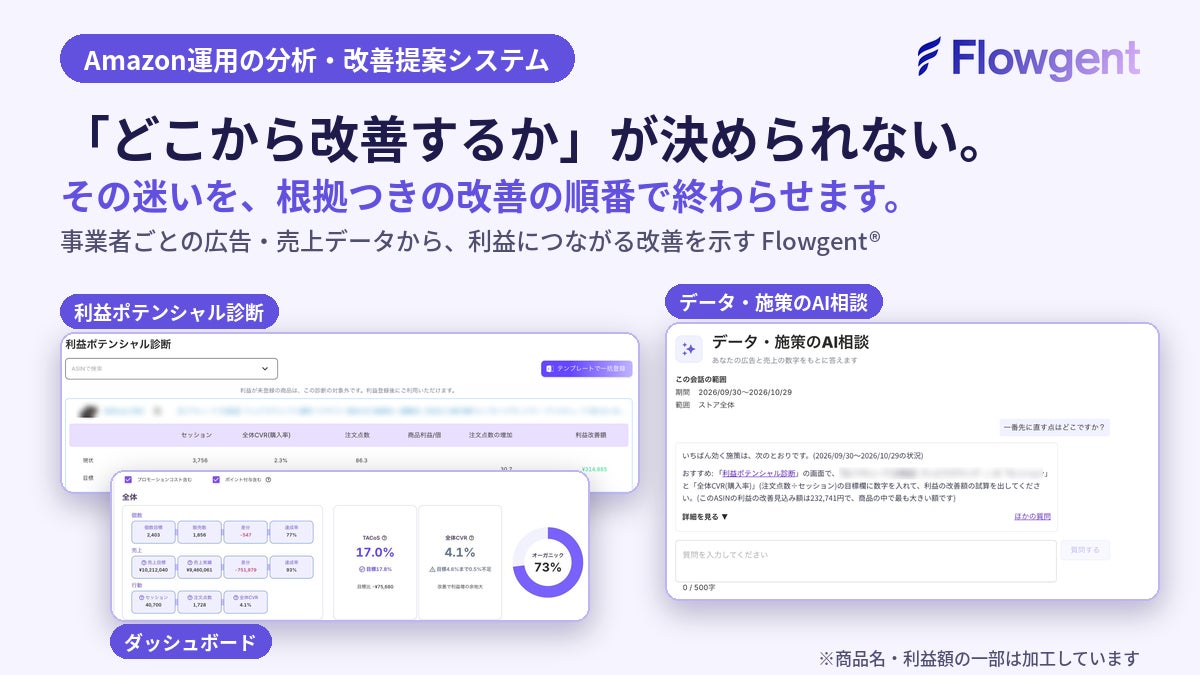
Spesia added an "AI consultation on data and measures" chat to Flowgent, its Amazon operations analysis system
For April–September 2026, Nomura Research Institute posted revenue of 4299億円, up 8% year on year, and operatin…
DXYZ and TIERO will run the 'Face-Only Shopping' demonstration for three days from November 21 to 23, 2026 at…

In Branding Works' October 2026 survey of ChatGPT and Gemini answers, 辻・本郷税理士法人 appeared in 50% of responses…

