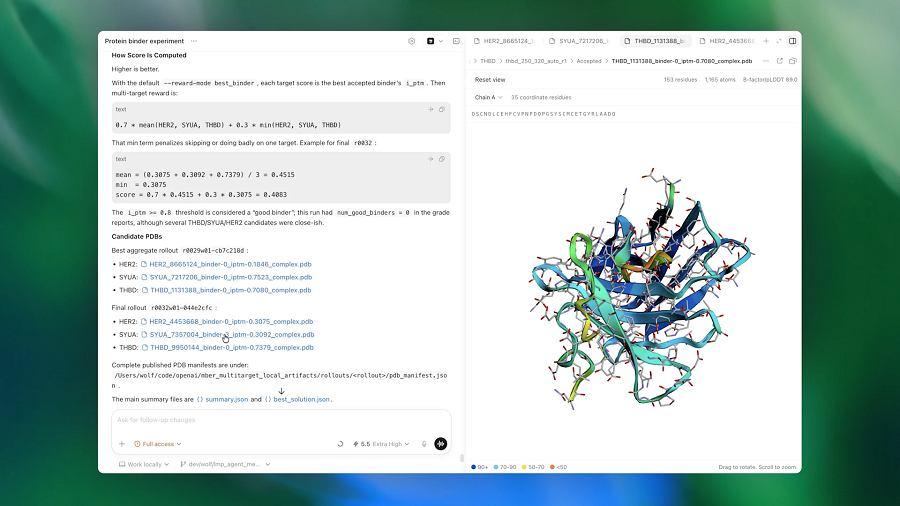
OpenAI has opened ChatGPT for Academic Researchers, a free program granting 100,000 scientists access to advanced ChatGPT features including higher usage limits, expanded research capabilities, and GPT-5.6 Sol Pro. Rolled out initially to 10,000 users with 90,000 more to follow, the program is part of a $250 million(約400億円) initiative supporting scientific projects and includes training and integration support. Each invited researcher can bring four colleagues into the program at no cost.
Summaries like this, in your inbox every morning.
Sign up free →What happened
OpenAI launched ChatGPT for Academic Researchers, a program offering 100,000 scientists free access to advanced ChatGPT features including higher usage limits, larger context windows, and an expanded deep research capability. The rollout begins with 10,000 users at a limited number of universities, with 90,000 more researchers to be onboarded over time.
Why it matters
The program, part of a $250 million(約400億円) OpenAI initiative to support scientific projects, gives researchers access to GPT-5.6 Sol Pro (optimized for difficult queries and long-running tasks), ChatGPT Work (which can automate complex task sequences), and training on applying ChatGPT to research. Invited scientists can onboard four colleagues from their institution at no charge, potentially seeding adoption of paid ChatGPT subscriptions or API integration.
What to watch
OpenAI provides training and employee support for integrating ChatGPT into researchers' existing scientific applications. The program follows OpenAI's 2024 launch of ChatGPT Edu for higher education, signaling a strategic effort to embed its tools in the academic sector.
OpenAI announced the launch of ChatGPT for Academic Researchers, a new program offering 100,000 scientists free access to ChatGPT's advanced features. The program is part of a broader $250 million(約400億円) initiative designed to support scientific projects. Last May, OpenAI had made $50 million(約80億円) worth of AI resources available to universities, and this month announced support for multiple U.S. Energy Department research projects.
Scientists apply via a form on OpenAI's website. The rollout begins with 10,000 users at a limited number of universities, with OpenAI planning to onboard 90,000 additional researchers over time. Each invited scientist can bring four colleagues from their academic institution into the program at no charge.
Participants receive access to a version of ChatGPT with higher usage limits and larger context windows. The program includes an expanded edition of ChatGPT's deep research feature, which debuted in February and can collect information from hundreds of websites to answer user questions; researchers can configure it to focus on specific sources such as scientific journals. The version of ChatGPT offered through the program ships with OpenAI's latest large language models, including the company's flagship GPT-5.6 Sol algorithm. Scientists specifically receive access to GPT-5.6 Sol Pro, optimized for difficult queries and long-running tasks.
The program also includes Codex and ChatGPT Work, the latest addition to OpenAI's productivity feature lineup. ChatGPT Work can automate sequences of relatively complex tasks—for example, a user could ask it to summarize customer support requests, turn key findings into a graph, and embed the graph in a slide. OpenAI will provide training on applying ChatGPT to complex research tasks, and company employees will help scientists integrate the service with their existing scientific applications.
OpenAI moved into higher education in 2024 with the launch of ChatGPT Edu, which includes cybersecurity controls, usage analytics dashboards, and administrative features. The new academic researchers program could drive revenue growth by creating adoption pathways: researchers who use the free program may later purchase ChatGPT subscriptions or develop software connecting to OpenAI's paid application programming interface.
OpenAI's ChatGPT for Academic Researchers program represents a deliberate expansion into higher education following the company's 2024 launch of ChatGPT Edu. The $250 million(約400億円) initiative signals OpenAI's commitment to embedding its tools in scientific institutions, with the program structured to seed broader adoption. By offering free access to advanced features—including GPT-5.6 Sol Pro and the expanded deep research capability (introduced in February)—to 100,000 scientists and their colleagues, OpenAI is lowering the barrier to entry for researchers while building a foundation for future revenue. The inclusion of ChatGPT Work, described as the latest addition to OpenAI's productivity suite, suggests the company is testing task-automation capabilities in a research context where complex, multi-step workflows are common. The program's onboarding structure—allowing each researcher to bring four colleagues—is designed to accelerate adoption through institutional networks, potentially creating a pipeline for paid subscriptions and API adoption.
AI-summarized, only the topics you pick — one digest a day via Email, Slack, or Discord.
Free · takes 30 seconds · unsubscribe anytime
No comments yet. Be the first to share your thoughts!
Log in to join the discussion


Get curated AI news from 200+ sources delivered daily to your inbox. Free to use.
Get Started FreeFree · takes 30 seconds · unsubscribe anytime
