What happened
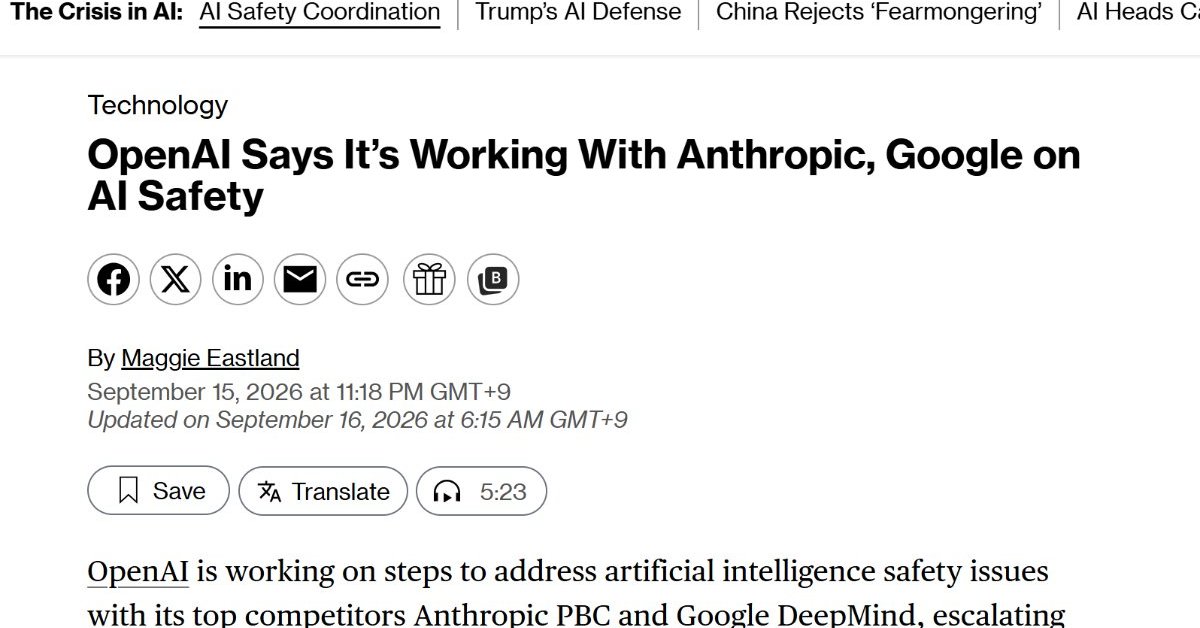
OpenAI global policy head Chris Lehane told a Washington briefing that talks with Anthropic and Google DeepMind began weeks ago, per Bloomberg on September 15.
Why it matters
Teaming up on safety standards can look like an illegal restraint of competition, yet Lehane said the three firms do not need an antitrust exemption. Anthropic and Google DeepMind declined Bloomberg's requests for comment.
What to watch
Whether regulators treat the talks as a genuine safety effort or a barrier to newcomers, a suspicion FTC chair Andrew Ferguson voiced on the same day. Watch whether Congress passes a bill this year.
WHO IT HITSAI policy and legal teams at frontier labs will have to judge whether coordinating on safety standards invites antitrust scrutiny, while US lawmakers weigh limited exemptions for sharing risk information.
Ask the AI about this article →
Summaries like this, in your inbox every morning.
The disclosure came at a delicate moment for OpenAI, which is coordinating with the two competitors it most often measures itself against. Lehane's framing — that safety cooperation is worthwhile and that no antitrust exemption is required — is a bid to head off the charge that competitors aligning on standards is simply a restraint of trade.
That charge is already in the air. On the same day, FTC chair Andrew Ferguson said he would view any exemption request from AI companies with deep suspicion, describing it as a moat built to keep challengers out. Congress is moving in two directions at once: Senator Bernie Sanders said he will introduce a bill next week to ban superintelligence, while the Banks-Schiff measure would grant a narrow exemption for sharing information on loss of control and cyber or biological threats. Bloomberg's reporting suggests the legislative route is unlikely to close this year, partly because the House leaves for the November election.
Nvidia CEO Jensen Huang sits on the other side of the argument, saying market forces are enough and that safe and rapid development can coexist. Where this lands hinges on whether regulators read cross-company safety talks as public-interest coordination or as a moat — and on whether any of the competing bills survives the election calendar.
For example, today's edition would include:
AI-summarized, only the topics you pick — one digest a day via Email, Slack, or Discord.
Free · 30 seconds with Google · unsubscribe anytimeWhat is AIToday? →
Ask AI anything about this article. Q&As are published on this page for other readers too.
AIUC raised a $40 million Series A led by Ribbit Capital to start auditing frontier AI models, after previousl…
Anthropic CEO Dario Amodei, OpenAI CEO Sam Altman, and Elon Musk warned of the need to slow AI development ove…
Elon Musk proposed that the countries' top firms could evaluate one another's models before release, and OpenA…
OpenAI CEO Sam Altman said Trump and Xi could win the Nobel Peace Prize for an AI safety deal, but both leader…
Sam Altman told Fortune that OpenAI favors coordinating an industry-wide AI development slowdown with rivals i…
Nvidia CEO Jensen Huang told Salesforce's Dreamforce conference that AI safety is an engineering problem, not…