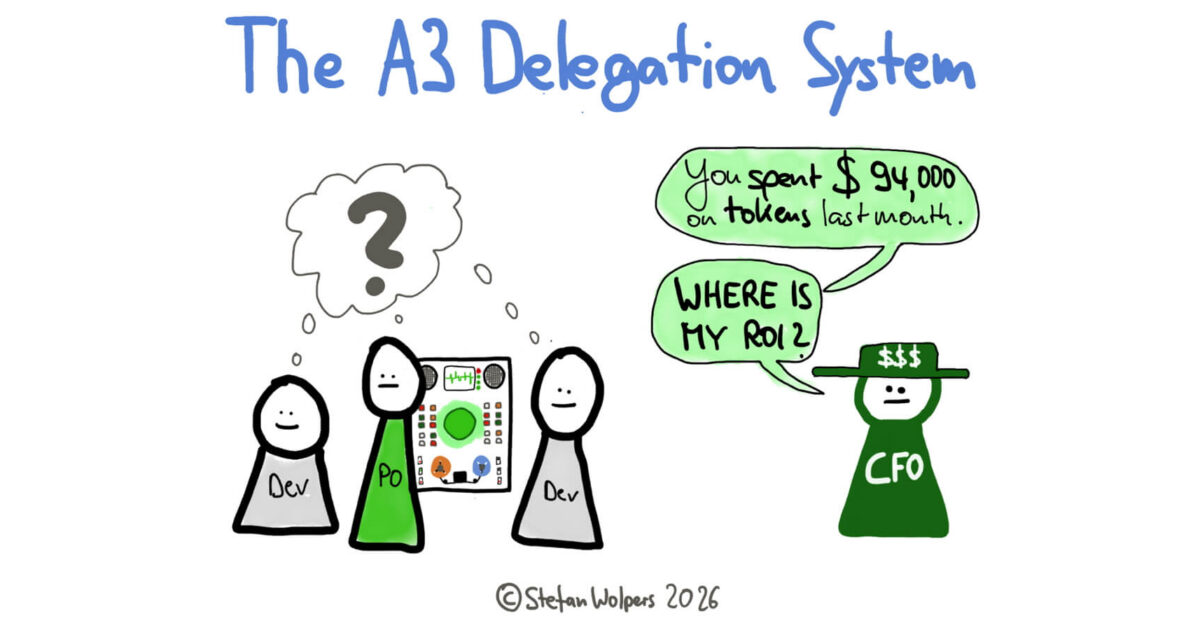
The A3 Delegation System is a framework that borrows Agile practices to help teams make clear, documented decisions about which work to hand to AI and how to audit those delegations over time. As companies shift from individual ChatGPT subscriptions to expensive API-based token costs, the need to route tasks to the right-tier model and prevent undocumented AI workflows from drifting has become critical; the system addresses this by defining what "done" means per task, tracking who verifies output, and catching delegation failures before they reach customers.
Summaries like this, in your inbox every morning.
Sign up free →What happened
Stefan Haas presented the A3 Delegation System at the 76th Hands-on Agile Meetup, a framework that applies Agile practices (Definition of Done, retrospectives) to AI workflows. The system uses a six-stage Delegation Lifecycle and a three-box framework (Assist, Automate, Avoid) to clarify what AI should do, document decisions, define acceptable output, and audit changes over time.
Why it matters
Teams delegating work to AI—reports, research, analysis, stakeholder communication—often lack clear answers to who decides what AI may do, what "good enough" means, who verifies results, and who checks whether delegation still works after model or workflow changes. Without this clarity, companies face AI debt: undocumented workflows, loss of knowledge when staff leave, exploding token costs (Uber, for example, spent its entire 2026 token budget within four months), and silent drift in output quality that nobody catches until it reaches customers.
What to watch
A hands-on workshop on the A3 Delegation System is scheduled for September 28–29, 2026, priced at $199. Participants will learn to apply the system to their own workflows, covering task inventory, team AI working agreements, monthly audits for output and sufficiency drift, and how to answer CFO, CTO, and procurement questions without extra reporting work.
Stefan Haas presented the A3 Delegation System at the 76th Hands-on Agile Meetup, a framework designed to prevent AI debt—the accumulation of undocumented workflows, unclear ownership, exploding token costs, and silent output drift that plagues teams as they scale AI use beyond individual experimentation.
The core problem Haas identifies is that while using AI tools personally is straightforward, delegating AI workflows to teams or organizations requires decisions that often remain in one person's head or nowhere at all: What may AI decide, and what must stay human? What does "good enough" mean for this work? Who verifies results before someone acts on them? Who checks whether the delegation still works after a model or workflow changes? Haas illustrates the risk with a story from his online course: a senior engineer built an important agent-based workflow that ran unattended and undocumented. When he left, no one understood why it worked, and the knowledge gap created stress when a prospective customer raised questions about the system. More broadly, companies are discovering that unmanaged AI workflows incur real costs—Uber, for instance, spent its complete 2026 token budget for API calls within the first four months of the year.
The A3 Delegation System provides six stages in a Delegation Lifecycle. It begins with the A3 framework—three categories for any task: Assist (AI drafts, you own the outcome), Automate (AI executes on explicit rules with a defined audit cadence), or Avoid (work that must remain human because failure damages trust). Haas stresses that the real risk is Assist quietly drifting into Automate because output has looked acceptable for four weeks without formal review. The system then moves through handover and documentation, Definition of Done (adapted from Agile and written separately for each task class across four levels: verification, provenance disclosure, data hygiene, and sufficiency tier), regular inspection against that Definition of Done, and finally a rollup that explains the return on token spend to finance and leadership. The framework includes a task inventory (a backlog of AI workflows—which most companies lack) and team AI working agreements that codify past decisions transparently for new hires and stakeholders.
One practical element is model routing by cost tier. Rather than defaulting to the most expensive frontier model, teams deliberately match each task to local, mid-tier hosted, or frontier models based on cost and stakes. Haas notes that converting markdown to HTML does not require the most powerful model available; using it would be a waste of money and would actually take longer. The system also includes monthly audits that track output drift, sufficiency drift, reversibility, and review creep—the gradual erosion of rigor when approvers rubber-stamp AI output in seconds instead of actually reviewing it. The artifacts and governance trail created during these audits answer due diligence questions from CFOs, CTOs, and procurement teams without generating extra reporting work.
Haas is offering a hands-on workshop called The A3 Delegation System Founding Workshop on September 28–29, 2026, at $199 per participant. Attendees will apply the system to their own workflows and leave with a clear understanding of how to implement it so that team members and stakeholders can understand, challenge, and continue the AI delegation work.
AI adoption at the team and organizational level reveals familiar Agile challenges—undocumented work, unclear ownership, and silent drift—taking new forms. One concrete example cited is a senior engineer who created an agent-based workflow that performed important background tasks but was never documented; when he left, no one understood why it worked or how to maintain it, creating risk for the organization. The shift from individual subscription models to enterprise API-based token pricing has made cost-awareness urgent. Uber's experience—exhausting a full year's token budget in four months—illustrates how quickly unguided AI use can become expensive. The A3 Delegation System addresses this by treating AI workflows as delegations that require the same rigor Agile teams apply to human work: explicit decision-making (the A3 framework of Assist, Automate, Avoid), clear Definition of Done per task class, regular audits for drift, and documented team norms. The framework acknowledges that frontier models are not always the right choice for every task—markdown-to-HTML conversion does not require Fable 5—and that cost-conscious routing by model tier protects both budget and proprietary data by keeping sensitive process information out of large cloud models.
AI-summarized, only the topics you pick — one digest a day via Email, Slack, or Discord.
Free · takes 30 seconds · unsubscribe anytime
No comments yet. Be the first to share your thoughts!
Log in to join the discussion




Get curated AI news from 200+ sources delivered daily to your inbox. Free to use.
Get Started FreeFree · takes 30 seconds · unsubscribe anytime
