What happened
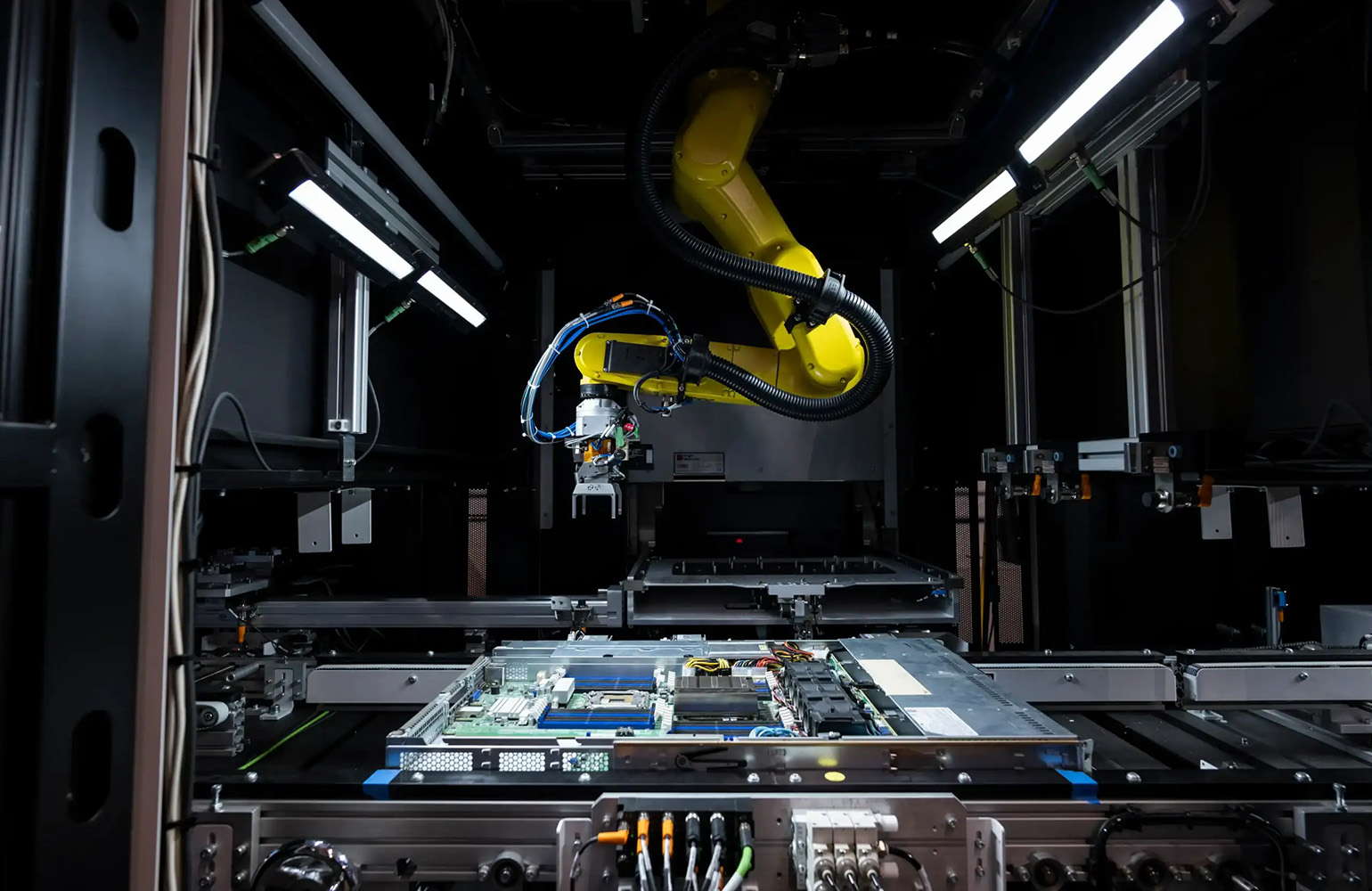
Teradyne announced a strategic investment in Bright Machines and a collaboration to integrate Teradyne robotics and test technologies into Bright Machines' manufacturing platform, targeting faster AI infrastructure production.
Why it matters
The partners say combining assembly, robot and material-movement data with electrical test results gives customers an end-to-end production data thread, which they see as a faster path from design into production.
What to watch
The pay-off hinges on whether integrating these data streams actually shortens the engineering effort to teach robots new tasks. Watch whether the technology lands at Bright Machines' and customer sites.
WHO IT HITSHardware and manufacturing engineers building AI infrastructure, along with the EMS and ODM providers that assemble it, could see a faster route from design into production if the integration reaches their lines.
Summaries like this, in your inbox every morning.
Teradyne's interest in AI infrastructure manufacturing is not new. In its most recent earnings statement, the North Reading, Mass.-based company marked its fifth consecutive quarter of growth and credited AI as a main driver of its revenue growth. Its subsidiary Universal Robots recently released its seventh-generation cobot arm, designed to take advantage of AI advances. The investment and collaboration with Bright Machines extend that push from components into production lines themselves.
Bright Machines brings a software-defined manufacturing platform spanning design, robotics, automation, inspection, material movement, production intelligence, and operations. Its CEO, Sviat Dulianinov, framed Teradyne's robotics and test technologies as complementary, and said the investment helps Bright Machines validate its approach. Teradyne's chief development officer, Shantnu Sharma, said the combination gives companies building AI infrastructure a faster path from design into production. Teradyne's chief AI officer, James Davidson, pointed to the engineering effort required to instruct robots, arguing that when a robot can pick up a new task in hours rather than weeks, high-mix, short lifecycle production becomes the default.
The stated case rests on connecting three distinct streams of information: assembly and inspection data, robot and material-movement data, and electrical test results. Teradyne claims that linking these with Bright Machines' product genealogy and manufacturing intelligence capabilities lets customers maintain an end-to-end production data thread from design decisions through assembly execution to electrical performance. Whether that translates into the speed the partners describe may depend on how quickly the combined systems are deployed at Bright Machines' and customer sites, and whether manufacturers reconfiguring lines in software as designs refresh see the promised reduction in engineering effort. The collaboration is still at the deployment stage, so the practical result for AI infrastructure builders remains to be demonstrated.
Pick your industry and the AI tools you use, and get news related to your work every day.
Free · 30 seconds with Google · unsubscribe anytimeWhat is AIToday? →
Ask AI anything about this article. The AI reads this article, earlier AIToday articles, and Wikipedia, and cites its sources. Q&As are published on this page for other readers too.
Ency Software and Estun began a technology partnership and completed integration work
Charm Care Corporation, which runs more than 100 private nursing homes in the Kansai and Greater Tokyo areas…
SafeWorld emerged from stealth with $12.2 million in seed funding co-led by Shine Capital and a16z Speedrun, a…
Reka AI released a research preview of Rho-1, a 19-billion-parameter omni-model that processes and generates t…

In July, the FCC added foreign-produced advanced robotic devices, including humanoids and quadrupeds, to a lis…
The FAA awarded $12 million for 19 projects through its UAS Broad Agency Announcement Program, covering detect…