What happened
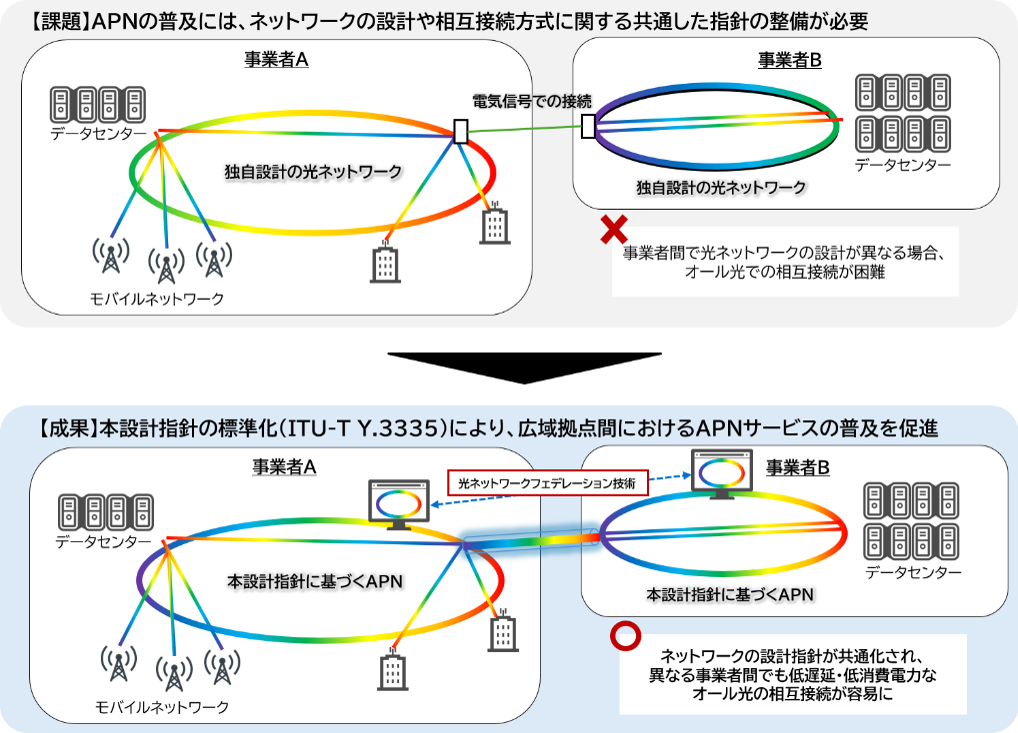
KDDI, NTT, 1FINITY, NEC, Rakuten Mobile, Oki Electric, and Sumitomo Electric led the creation of design guidelines for low-latency, energy-efficient networks supporting all-photonics architecture. The framework was adopted as ITU-T Recommendation Y.3335 on August 13, 2026.
Why it matters
The guidelines enable different carriers to build compatible networks for AI and remote sensor processing without relying on a single vendor or organization. This removes a major barrier to global interoperability—until now, carriers outside existing consortia lacked a shared technical blueprint for all-photonics networks (APN).
What to watch
The seven companies plan to advance a detailed functional architecture recommendation by October 2028 at ITU-T, building on their domestically developed network technology and standardization expertise to drive global APN adoption.
Summaries like this, in your inbox every morning.
The standardization of ITU-T Recommendation Y.3335 represents a shift from proprietary consortia governance to open international standards for next-generation networks. Until now, all-photonics network knowledge had accumulated within specific organizations—notably IOWN Global Forum, which coordinates shared technical documents and optical network federation technology across participating carriers. However, this approach created a participation barrier: carriers and governments outside the consortium lacked a neutral reference design.
The seven Japanese companies—spanning carriers (KDDI, NTT, Rakuten Mobile), equipment makers (NEC, Oki Electric, Sumitomo Electric), and Fujitsu's network unit (1FINITY)—moved to codify their accumulated APN expertise into a framework that belongs to no single entity or implementation method. By embedding this knowledge into an ITU-T recommendation, they have created a public-domain baseline that any carrier or vendor can reference, lowering the cost and complexity of building multi-carrier APN services. The framework is grounded in research conducted under Japan's National Institute of Information and Communications Technology (NICT) Beyond 5G / 6G fund, ensuring it reflects real-world engineering experience rather than theoretical requirements.
Pick your industry and the AI tools you use, and get news related to your work every day.
Free · 30 seconds with Google · unsubscribe anytimeWhat is AIToday? →
Ask AI anything about this article. The AI reads this article, earlier AIToday articles, and Wikipedia, and cites its sources. Q&As are published on this page for other readers too.
Taiwan is considering much stricter export controls on AI chip sales to China, part of a greater alignment wit…

Nichiren announced its generative AI voice usage guideline on October 15, built on three pillars: prior notice…
At the Most Powerful Women Summit, Marissa Mayer said anyone who claims to know how AI will play out is 'eithe…

SHIFT announced it began a project for the Acquisition, Technology & Logistics Agency (防衛装備庁) covering AI-rela…
After its first meeting Thursday, the White House AI task force formally adopted its charter, opening a 120-da…

Anthropic announced a revised Claude usage policy on October 8, 2026 that applies from November 12, 2026, rewr…


