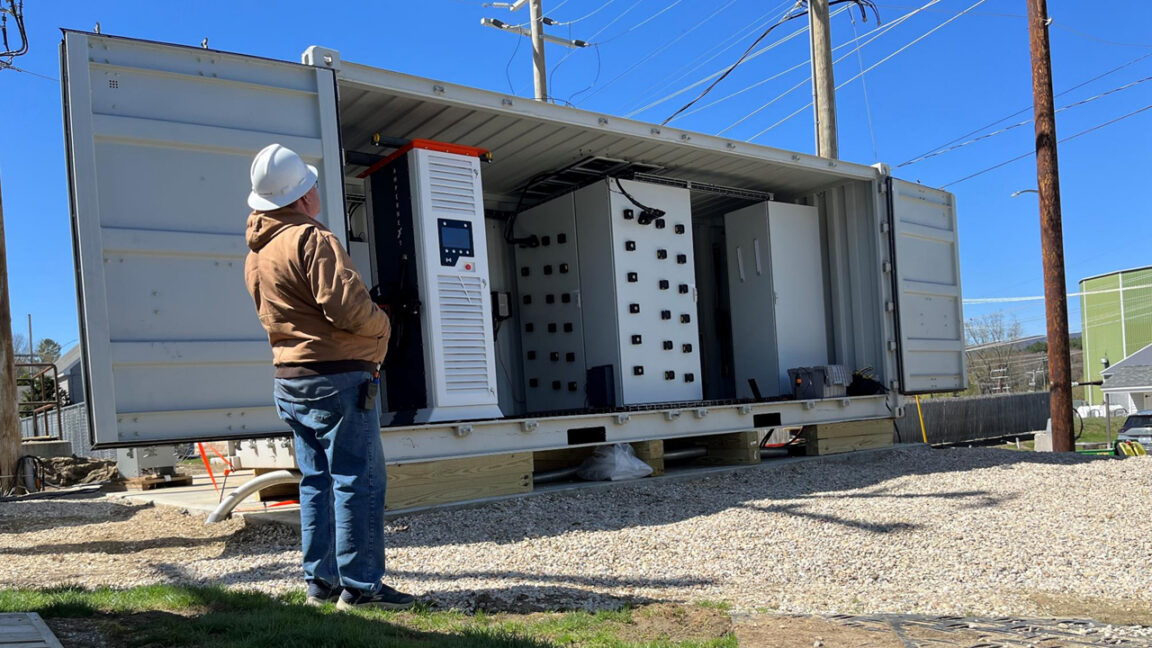
AI data center growth is accelerating investment in solid-state transformers.
These can be mass-manufactured and directly convert AC to DC power.
They could ease transformer shortages and benefit EV charging and homes.
What happened
Data centers have become the "killer application" for solid-state transformers, a technology replacing conventional transformers that date back to the 1880s. Several US companies, including Amperesand, Heron Power and DG Matrix, have collectively raised more than $280 million in funding over the past year to commercialize it.
Why it matters
Conventional power transformers are custom-built by hand, causing delivery waits of up to several years for utility companies. Solid-state transformers can be mass-manufactured using semiconductor materials like silicon carbide, are smaller and lighter, and could ease the broader supply chain shortage affecting power grid upgrades.
What to watch
NC State researchers demonstrated a solid-state transformer handling up to 1 megawatt of power for electric vehicle charging. The device, about 1 meter by 1.5 meters by 2 meters, has been tested at EPRI's Lenox lab since May 2026 and is scheduled to return in September.
Ask the AI about this article →
The conventional power transformers that the US grid relies on are painstakingly assembled by hand, with a design dating back to the 1880s. Because the largest ones are custom-built for each utility substation, customers now face waits of up to several years for delivery, which delays both grid expansion and replacement of aging equipment. Solid-state transformers, by contrast, use high-frequency semiconductor switching and can be mass-produced, offering a potential path around those manufacturing bottlenecks.
Tech companies building large AI data centers are a key early adopter because these facilities are moving to DC power architectures to support energy-hungry AI chips. A solid-state transformer can perform the AC-to-DC conversion in one step, which professor Srdjan Lukic described as a "one magic box" that eliminates infrastructure and interoperability challenges. This adoption is seen as a way to "derisk" the technology for broader use, including EV charging and eventually home DC distribution.
The NC State demonstration at EPRI's lab in Lenox, Massachusetts, is the culmination of a collaboration with the New York Power Authority that began in 2018. The success of this field testing, along with continued commercialization efforts, will likely determine how quickly the technology moves beyond data centers into wider grid applications.
AI-summarized, only the topics you pick — one digest a day via Email, Slack, or Discord.
Free · takes 30 seconds · unsubscribe anytime
Ask AI anything about this article. Q&As are published on this page for other readers too.
Nvidia is reportedly in talks to invest again in AI search startup Perplexity AI at a valuation above $30 bill…

A survey by LIFEFUND shows that 68.5% of construction and housing management companies now use AI in at least…

Tim Bucher, co-founder and CEO of Agtonomy, argues that the next big AI play is embedding physical AI into hea…

IMDEX, an Australian mining technology company, used Cursor to consolidate two flagship geological mapping too…

A Stanford study found that occupations relying on codified knowledge (formal, standardized, documented knowle…

Nucleai announced an ongoing translational research collaboration with Gilead Sciences, using AI-driven tissue…